Metals & Mining Theme, Ferrous, Non-Ferrous
December 02, 2025
COMMODITIES 2026: Turkish deepsea scrap price to remain rangebound amid buyer-seller stalemate
HIGHLIGHTS
Seasonal tightness, bullish freight to support prices
Weak downstream fundamentals to weigh on scrap demand
Competitive local DRI to impact Indian scrap demand
This is part of the COMMODITIES 2026 series, where our reporters bring to you key themes that will drive commodities markets in 2026.
Turkish deepsea imported scrap prices are likely to continue their rangebound movement in 2026, amid differences between buyers' and sellers' price expectations.
"The price [of deepsea ferrous scrap] is surging [at present], but we have to take it with a pinch of salt," a recycler source said. "This momentum will not hold for long."
The year-to-date average of Turkish deepsea imported scrap price stood at $350.06/mt CFR, according to data from Platts, part of S&P Global Energy, on Nov. 28. The price averaged $384.25/mt CFR during the same timeline in 2024.
Mixed outlook
Seasonal supply tightness, bullish ocean freight rates, and a strong euro against the dollar are likely to prompt recyclers in the Eurozone to maintain their dollar-denominated offer levels. The euro was at $1.03 on Jan. 2 and at $1.16 on Nov. 28, according to Platts data.
"We are entering the expensive part of the year for scrap collection from November to February ... availability will become lower," a second recycler source said. "Prices might go higher, but it goes back to the fundamentals."
The scrap collection cost in Europe was heard hovering around Eur255-260/mt delivered to docks on Nov. 27, up from Eur 250-255/mt delivered to docks heard on Oct. 30, according to several EU recycler sources.
US recyclers also cited bullish ocean freight rates alongside a supply crunch to justify aiming for higher prices.
The Platts-assessed Supramax freight rate from Rotterdam to Aliaga was at $24.25/mt on Nov. 28, up from $15.25/mt on Jan. 2. The Supramax freight rate from New Jersey to Aliaga was assessed at $25/mt on Jan. 2 and at $32.50/mt on Nov. 28, according to Platts data.
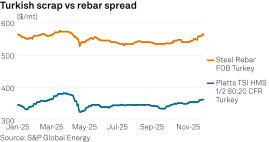
While sellers remained bullish with their price outlook, a narrowing profit margin from rebar sales is likely to make scrap buyers reluctant to pay higher prices.
"Even though sellers want higher prices, I expect mills to slow down purchases and wait due to unknown rebar demand, "a Turkish mill source said. "Prices will probably go sideways for now."
The scrap-rebar margin has narrowed since the middle of 2025, from $214.50/mt on April 25 to $199.50/mt on Nov. 28, according to Platts data.
Availability of competitive billets
Inflows of competitively priced billets from Asia and Russia have dampened demand for deepsea scrap in 2025 and could pose a downside risk to scrap prices in 2026, according to market sources.
Since the beginning of this year, Russia has been the top supplier of billets to Turkey, followed by Malaysia and China.
Imports of semi-finished steel from Russia, under the HS code 7207, stood at 2.23 million mt in January-September, according to S&P Global Commodities at Sea data. Imports from Malaysia stood at 1.48 million mt, and China stood at 733,931 mt during the same period, CAS data showed.
Market participants have also expressed concerns about the impact of the upcoming Carbon Border Adjustment Mechanism on finished steel exports, where additional costs for material imported into Europe will be accrued, with payment due in Feb. 2027.
"There are a lot of uncertainties in the market about the carbon tax and safeguard measures," a trader source said.
Besides CBAM, EU's safeguard restrictions are also keeping several Turkish mill sources concerned.
The European Commission announced earlier on Oct. 7 that it plans to reduce tariff-free steel imports by 47% from 2024 quota levels, and the Turkish Steel Exporters' Union expects this to directly affect Turkey's steel exports to the region, Platts reported earlier. The EC also aims to limit tariff-free import volumes to 18.3 million mt/year and double the level of tariffs on volumes that exceed the quota limit to 50%.
Indian scrap prices to remain under pressure
Ferrous scrap prices in the Indian market are likely to remain under pressure amid weak downstream fundamentals.
"I don't think the situation will tremendously change in the first half of 2026, and there isn't a lot of scope for an upside, maybe 10%," an Indian buyer source said.
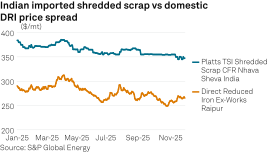
The availability of competitively priced direct-reduced iron in the domestic market is also likely to continue weighing upon imported containerized shredded scrap sentiments in India in 2026.
The price of imported containerized shredded scrap averaged $364.12/mt CFR Nhava Sheva from January to November, according to Platts data. The price averaged $398.21/mt CFR Nhava Sheva in 2024.
The year-to-date average of domestic direct-reduced-iron price stood at $277.74/mt ex-works Raipur on Nov. 28, Platts data showed.

Editor: