Metals & Mining Theme, Ferrous
October 23, 2025
TRADE REVIEW: Iron ore shifts to 61% Fe pricing basis as first trades emerge in Q4
By Rabia Arif, Yuchen Huo, and Keith Tan
HIGHLIGHTS
Deals emerge on 61% Fe basis for Jan 2026 quotation periods
Degraded PBF trades at a premium over 62% Fe IODEX
Ongoing contractual talks cast uncertainty over BHP products
This report is part of S&P Global Energy Metals Trade Review series, where we dig through datasets and digest some of the key trends in iron ore, metallurgical coal,copper,alumina,cobalt,lithium,nickel and steel and scrap. We also explore what the next few months could bring, from supply and demand shifts to new arbitrages and quality spread fluctuations.
The seaborne iron ore market is experiencing a significant pricing shift in Q4 as the Western Australian fines with lower quality have been traded among producers, traders, and steelmakers for over two months, enabling a reassessment of optimal blending and pricing strategies for various fines products.
As the market starts to trade and price cargoes for January 2026 shipment – especially from Brazil, which has earlier lead times for sales due to voyage timings of 45 days to northern China – the first tenders and spot deals have emerged on a 61% Fe basis, against Platts IODEX specifications that will be effective Jan. 2.
With iron ore derivatives for contracts from January 2026 onwards having switched to reflect a 61% Fe basis since Sept. 1, a vertically integrated Brazilian steelmaker has recently concluded spot deals to sell its 62% Fe sinter feed bound for China with a January quotation period based on the updated IODEX specifications with an undisclosed differential to account for quality differences, company sources said.
Australian miner Rio Tinto has also concluded a tender for a 6-month strip of Pilbara Blend Fines on the basis of the updated IODEX + $1.11/dmt for November to April loading. The cargoes priced against the November and December IODEX will be converted to a 61% basis using the 62/61% Fe IODEX Basis Spread.
As term contractual negotiations remained ongoing between China Minerals Resources Group, the state-owned central buyer of the steelmaking ingredient, and global iron ore producers, prices in the interim have been determined by monthly negotiated differentials to the 62% Fe index, with the differentials closely mirroring the performance of each brand against the 62% Fe index in the spot market, market participants said.
Doubling of spot Pilbara Blend Fines sales
Rio Tinto's spot sales volume of Pilbara Blend Fines more than doubled in Q3 compared to the previous quarter, according to data compiled by Platts, driven by new lower quality loading specifications implemented in July, enabling increased flagship product volumes.
The increase in spot sales in Q3 took place as the miner reported an increase of 6% in total iron ore shipments from the previous quarter.
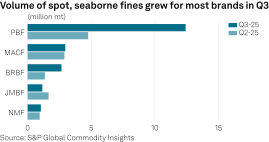
During the quarter, over 90% of Rio Tinto's PBF seaborne spot sales were concluded on a fixed price basis, according to Platts data. Market participants said to have been monitoring these prices and converting them to a floating price basis against the front-month IODEX derivative as an indication for where monthly term contract differentials would be concluded.
"The term-contract differentials for PBF and [Pilbara Blend Lump] in Q4 are still going to be decided on a monthly basis with references to the spot traded levels for the same delivery month," a trader in southern China said. "Seaborne, spot liquidity will likely remain high."
Delivered specifications of PBF more consistent
The chemical specifications of PBF delivered into China have gradually become more consistent, with port stocks of the brand at Chinese ports having traded more closely around the producer's guidance of 60.8% Fe since September, Platts data showed and market participants said.
This has led to greater acceptance of the product among Chinese buyers, who earlier said that fluctuations in its iron content were not conducive to steelmakers when planning sinter blends. Earlier feedback had also pointed to dollar-denominated adjustments for differences in iron content to the product's 61% Fe pricing basis being insufficient to account for discounts on a yuan basis when traded as port stocks.
In the Chinese port stock market, spot liquidity has shifted from PBF with old specifications to PBF with revised specifications throughout the quarter, reflecting improved acceptance among Chinese mills for the new PBF.
Platts has started to reflect updated quality specifications for PBF, PBL, Newman High Grade Fines and Newman Blend Lump in its daily China iron ore port stock brand assessments over Sept. 4-29, with the update applied to each brand and region from when the bulk of spot activity was observed to be mainly for material with new specifications.
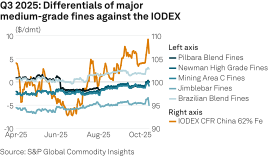
The consistency of quality in the updated PBF has resulted in it trading on the seaborne market at a premium to the 62% Fe IODEX for the first time after the Chinese National Day holidays, at 5 cents/dmt on Oct. 9, while the discount was already seen narrowing over Q3 from around $1.65/dmt over August IODEX on July 1 to flat over November IODEX on Sept. 30, Platts data showed.
BHP fines trade at wider discounts as term talks proceed
While spot transactions for BHP's fines products in August and September saw them trading at lower discounts on a floating price basis, news of a bumpy ride in term contractual negotiations with China Mineral Resources Group, the state-owned central buyer, have led to concerns over the ease at which the products may be accepted by Chinese steelmakers, resulting in the miner's products trading at larger discounts.
Jimblebar Fines, the medium-grade fines with the highest alumina and phosphorus contents, was the sole mainstream brand that saw a decline in seaborne, spot volumes traded in Q3.
Discounts for JMBF shrank drastically from $6/dmt in early July to $2.70/dmt in mid-September against the 62% Fe index, as a rise in the phosphorus content in PBF to 0.11% from 0.098% and in other brands, saw Chinese steelmakers have little short-term alternatives but to bear with higher phosphorus content.
After China returned from National Day holidays, JMBF traded at discounts as high as $6.50/dmt to the 62% Fe index, and market participants expected caution over taking positions in the brand and other BHP fines until they were assured of progress in term contract talks with China.
"Sellers holding BHP brands are also not actively offering at this point, there is quite a bit of apprehension and uncertainty for the value of these cargoes," a Northern Chinese trader source said.
Steel margin decline could buoy demand for lower grades
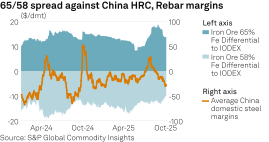
After a quick recovery in July, rising raw material costs have decreased Chinese steel margins in the subsequent two months, boosting demand for lower-grade iron ore. Despite rising domestic coking coal prices since July, Chinese fuel costs remain highly competitive against steelmakers globally.
Stronger buying interest in low-grade fines was evident from the narrowing discounts observed in Fortescue's term contract levels in Q3.
For Super Special Fines, Fortescue narrowed its discount to 10% to the September IODEX from 11.75% in June, Platts data showed, while that for its Fortescue Blend Fines (FBF) was reported to have narrowed to 6% in September from June's 9.25%.
In the medium-grade segment, market sources noted a rise in spot liquidity for Brazilian products such as CSN's IOC6 and Vale's non-mainstream, medium-grade Carajas cargoes.
Brazilian fines tend to have a higher silica content, which costs more in terms of a higher coke rate needed to decompose increased flux requirements. Some market sources have attributed the increased demand for Brazilian fines to declining coking coal prices in China over the past year, though this may change in Q4 if prices rise further.
Analysts at S&P Global Energy forecast the IODEX at $102.05/dmt for the fourth quarter.
"We think iron ore prices will remain rangebound over the rest of this year," Paul Bartholomew, senior analyst for metals and mining at Energy, said, adding, "China typically cuts steel production in the final quarter and unless there are positive policy signs from the upcoming Plenary meeting, the high iron ore port inventories and sluggish steel demand are likely to cap any major price upside."

Editor: