Metals & Mining Theme, Ferrous, Non-Ferrous
October 21, 2025
TRADE REVIEW: Asian steel market seen under pressure in Q4 amid weak demand, trade barriers
HIGHLIGHTS
Asian steel demand weakens, exports to soften
Billet exports surge, prices to face pressure
Ferrous scrap demand stays weak across Asia
This report is part of the S&P Global Energy Metals Trade Review series, where we dig through datasets and digest some of the key trends in iron ore, metallurgical coal, copper, alumina, cobalt, lithium, nickel and steel and scrap. We also explore what the next few months could bring, from supply and demand shifts to new arbitrages and quality spread fluctuations.
The Asian flat and long steel markets are expected to see sluggish demand in the fourth quarter, with export volumes likely to soften after strong early-year shipments, while domestic scrap grows more attractive to Taiwanese steelmakers following a wider billet-scrap price spread in Q3.
With China's domestic demand expected to weaken over the winter amid seasonal construction slowdowns and cold-weather disruptions, exports are likely to remain a key outlet to ease inventory pressures, according to China-based sources.
China's anti-involution measures -- aimed at reshaping the steel industry through consolidation and curbing excessive competition -- have had limited impact, market sources in China said, adding that rising trade barriers are further constraining steel exports.
Many market participants expect that high steel output in China -- with mills ramping up production in recent months amid decent margins -- coupled with persistently tepid demand from geopolitical tensions and an economic slowdown, will limit further supply growth.
Chinese steel exports are expected to ease in September and October, but full-year volumes are likely to remain largely unchanged year over year at about 110 million metric tons, said Paul Bartholomew, principal analyst for metals and mining at S&P Global Energy.
"China's government plans to clamp down on exports that evade tax from October, which may have brought forward some demand," he said. "But ultimately, China's steel prices will remain competitive in export markets and keep shipments at high levels."
Stronger trade measures pressure HRC prices
The Asian hot-rolled coil market is expected to face continued headwinds in Q4, with the current wave of protectionist measures -- particularly in Southeast Asia -- broader and more forceful than in 2015, when Chinese exports last met significant global resistance, an East China-based trader said.
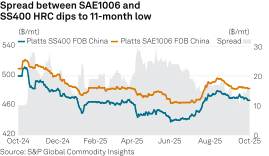
This pressure prompted mainstream mills to cut offers, according to China-based market participants. Platts, part of Energy, assessed the spread between SAE1006 and SS400 HRC on an FOB China basis at an 11-month low of $10/mt on Sept. 16.
In September, Vietnam launched an investigation into wider-width Chinese HRC for potential dumping, just two months after imposing antidumping duties of 23.01%-27.83% on Chinese coils narrower than 1,880 mm.
A Vietnam-based importer said the move aims to "close any loopholes" for Chinese HRC imports, signaling tighter enforcement that could curb shipments and bolster local steel producers.
Following these measures, alternative suppliers like Malaysia and Indonesia have stepped in to fill part of the gap, offering competitive prices for rerolling grades, data compiled by Platts showed.
Indian mills also reentered the Vietnamese market, offering 3 mm-thick coils at as low as $507/mt CFR Vietnam in the week of Sept. 29, amid weak domestic demand.
In Q3, seaborne spot transactions for non-Chinese origin HRC on a CFR Vietnam basis nearly doubled to 25 from 13 in Q2, data compiled by Platts showed.
A Vietnam-based trader said buyers are likely to continue sourcing competitively priced, duty-free alternatives, diversifying their procurement across different origins as Chinese offers lose appeal.
Meanwhile, India imposed a 12% safeguard duty on flat steel imports in April and proposed antidumping measures on Vietnamese HRC, resulting in a 29.4% year-over-year decline in the country's finished steel imports over April-September, Ministry of Steel data showed.
"The safeguard duty has helped, but weak demand and ample supply continue to weigh on the market," a Mumbai-based trader said.
Platts assessed the spot price of IS2062, 2.5-10 mm thick HRC, excluding 18% GST, at Rupees 48,000/mt ($546/mt) ex-works Mumbai on Oct. 17, down Rupees 4,750/mt from the 2025 peak in early May.
China's billet exports rise despite restriction calls
As China relies on exports to manage its supply surplus, continued weakness in the export market could put downward pressure on prices in Q4, according to Asia-based market participants.
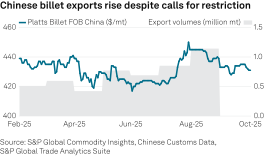
Despite the China Iron and Steel Association's late-June proposal to restrict billet exports in response to substantial Chinese export volumes earlier in 2025, exports surged in July and August.
China's semi-finished steel exports rose from an average of 628,406 mt in Q2 to 852,419 mt in July and 1.14 million mt in August, customs data showed. Most of the outflows are believed to be square billet, China-based trade sources said.
Billet prices rose in early Q3, driven by bullish sentiment from anti-involution policies and a sharp mid-July jump in coking coal prices, according to market sources in China.
However, China-based traders said overseas demand failed to keep pace with these price increases, leaving the export market subdued. The Platts-assessed billet FOB China fell 4.2% from a high of $450/mt on July 30 to $431/mt on Sept. 30.
Traders in China also said mills faced little pressure to sell, supported by pre-National Day restocking and a large backlog of orders for August and September delivery -- most of which were placed in June and July.
However, a Singapore-based trader said that while Chinese domestic buyers were willing to pay higher prices, their purchase volumes remained limited, adding that a drop in exports could boost domestic supply and likely pressure prices downward.
Weak downstream demand pressures ferrous scrap
Asian ferrous scrap prices are likely to remain under pressure in Q4 amid weak downstream demand, following continued declines in Q3 after a brief recovery over July-August, market participants in the region said.
Policy developments in China pushed Asian billet prices higher in Q3, Platts data showed, while the end of Taiwan's high summer electricity rates eroded billet's previous cost advantage over imported scrap.

The Platts-assessed billet-scrap price spread rose to its highest level in Q3, reaching $185/mt on July 25 -- up 39% from the Q2 low of $133/mt on April 4.
With billet prices climbing sharply while scrap prices remained relatively stable, imported scrap became increasingly attractive from September for producers seeking wider profit margins, according to Asia-based market participants.
Despite this, some market participants in Taiwan said demand for imported scrap could remain weak, citing mills' preference for domestic scrap, sluggish downstream rebar sales and adverse weather limiting construction activity.

Editor: