Metals & Mining Theme, Non-Ferrous
October 13, 2025
TRADE REVIEW: Copper concentrate TC/RCs to be pressured in Q4 by restocking demand from smelters

By Lu Han
HIGHLIGHTS
Increased Indonesian conc supply in Q3 supports TC/RCs
Spot liquidity thins as traders turn to term deals
Tightening cathode supply supports spot premiums
This report is part of the S&P Global Energy Metals Trade Review series, where we dig through datasets and digest some of the key trends in iron ore, metallurgical coal, copper, alumina, cobalt, lithium, nickel and steel and scrap. We also explore what the next few months could bring, from supply and demand shifts to new arbitrages, and to quality spread fluctuations.
Asian copper concentrate treatment and refining charges are likely to be pressured in Q4 by restocking demand from smelters for 2026 production, after the previous quarter saw TC/RCs being supported by increased supply of copper concentrates from Indonesia and several smelter maintenance, market participants told Platts, part of S&P Global Energy.
A surge in short-term copper conc supply from Grasberg mine in Indonesia was seen in Q3, as the startup of PT Smelting's Gresik smelter was delayed due to oxygen plant repair works after a maintenance shutdown, resulting in an excess of 100,000 mt of unprocessed copper conc, Platts reported earlier.
Several other smelters in China have also scheduled maintenance from September to November, which reduced demand for copper conc cargoes loaded from July to October, market sources said. Japan's Mitsubishi Material also reduced its copper conc demand due to low TC/RCs, Platts reported earlier.
Platts assessed the CIF China clean copper concentrate treatment charge and refining charge at minus $41.30/mt and minus 4.13 cents/lb, respectively, on Oct. 10, up from the lowest levels of the year at minus $50.50/mt and minus 5.05 cents/lb, respectively, on June 6.
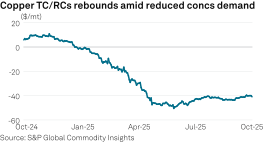
However, supply pressure remains for Q4 after Freeport-McMoRan halted operations at Indonesia's Grasberg mine on Sept. 8 following a flooding incident. Market participants also said they currently see a low likelihood of the Indonesian government permitting PT Amman's Batu Hijau copper mine to export in Q4, as it would have to cover the copper concentrate shortage that resulted from Grasberg. PT Amman did not respond to a request for comment.
Canada's Hudbay Minerals had also announced the temporary shutdown of its Constancia mill operations in Peru amid widespread protests on Sept. 23.
Market participants said they are also increasingly concerned about declining sulfuric acid prices, which have been key in supporting smelters' cash flow this year. Platts assessed FOB China sulfuric acid at $67.50/mt Sept. 24, down 27.4% from its peak on Aug. 27.
These developments have also impacted recent tenders for 2026-loading shipments, which were concluded at minus $100s/mt, widening the gap between traders' purchases in 2026 and smelters' spot purchases to $60-$70/mt TC.
Spot volume plunges in Q3
Chinese smelters' spot purchases of copper concs fell 34% quarter over quarter to 1.46 million mt in Q3, according to data from a Platts survey. This decline was mainly due to traders allocating more supply through term contracts, alongside a rebound in TC/RCs, market sources said.
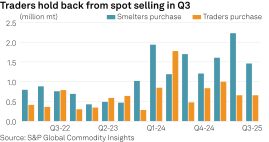
Copper conc spot demand was also dampened by smelters restocking Q4-loading shipments in advance, and scheduled plant turnarounds.
Traders said they expect to receive at least minus $40/mt from smelters for Q4-loading clean copper concentrates, while most smelters were eyeing minus $30s/mt for spot purchases. Traders added that they preferred to deliver via long-term contracts based on index pricing or to allocate through previously agreed-upon optionality with smelters.
Smelters' strong preference for high-quality clean copper concentrates has impacted spot demand for high-impurity copper concentrates. To boost general market liquidity for copper concentrates, traders were also seen selling various grades and qualities as a combined package to smelters.
In Q3, wider spreads were also observed between high-gold-content copper concentrates and standard clean concentrates, as smelters faced higher financing costs when purchasing high-gold concentrates amid soaring gold prices.
Import premiums rise on tighter supply
China's copper cathode import premiums rose in Q3 as supply tightened, although higher copper prices tempered demand in September.
Supply had tightened as a result of the maintenance of Chinese smelters from September to November, production issues of Indonesian smelters, lower availability from Africa due to a power shortage, and a slowdown in domestic transportation. The removal of the copper scrap production tax refund in Jiangxi province of China was also a factor.
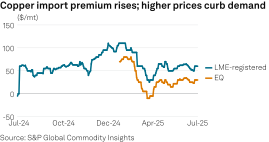
Spot cathode premiums in Southeast Asia rose to over $120/mt on a CIF basis in early October, compared with the term contract premiums in the $80s/mt, due to the impact of the Grasberg mine outage.
The rise came as Chile's total shipments of copper fell 9.9% to 1.459 million mt over January-September, reflecting smelter closures and declining electrowon production. Shipments to China fell 31.6% to 343,419 mt over the same period.
An arbitrage opportunity between prices on the CME and LME exchanges also supported spot premiums. Traders were keen to buy CME-registered copper for delivery to the US.
S&P Global Energy analyst Wang Ruilin said that Chinese copper demand could get an extra boost moving forward if the State Grid Corp. of China ramps up orders by late October, especially since its cumulative investment was below 50% of the annual plan in the first half of 2025.
End-users' restocking of cathodes slowed after copper prices traded well above $10,000/mt at the end of September, and import premiums softened on a negative import arbitrage window.
Platts assessed the CIF China copper import premium at $55/mt Oct. 10, down from the peak of $110/mt May 15.

Editor: