Metals & Mining, Non-Ferrous
October 13, 2026
Japanese Q4 aluminum premium falls 35% to $255/mt CIF Japan

By Louissa Liau
Editor:
HIGHLIGHTS
Q4 MJP premiums fall 35.44% from Q3 settlement of $395/mt
10 trades concluded during negotiations
Improving supply outlook, weak spot market pressure quarterly benchmark
Platts, part of S&P Global Energy, assessed the 2026 fourth-quarter premium for imported primary aluminum to Japan at $255/metric ton plus London Metal Exchange cash, CIF main Japanese ports, on Oct. 13, down 35.44% from $395/mt in the third quarter.
The Q4 premium assessment was based on 10 trades concluded during the negotiations from Oct. 7 to Oct. 13. All deals were concluded at $255/mt with a total minimum volume of 19,500 mt/month, plus LME cash CIF Japan, for seaborne P1020/P1020A ingot for loading over October-December.
Offers throughout the negotiations were in the range of $265-$325/mt CIF Japan. Initial Q4 MJP offers were heard at $310/mt CIF Japan on Aug. 28 and $325/mt on Sept. 2, respectively. The latest offer was at $265/mt CIF Japan, which was made on Oct. 2 and later expired on Oct. 5.
The settlement marks a sharp reversal from Q3, when concerns over disruptions to Middle Eastern production and tightening availability of Good Western-origin metal drove Japanese quarterly premiums to their highest level in more than a decade. By contrast, Q4 negotiations were dominated by weakening spot market fundamentals and a growing expectation that regional supply availability would improve over the coming quarters.
Spot market weakness weighs on premiums
The negotiations took place against a backdrop of declining spot aluminum premiums across both Japan and the wider Asian market.
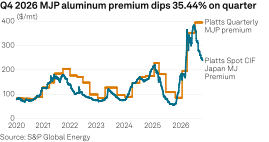
Platts assessed the CIF Japan spot premium at $237/mt plus LME cash on Oct. 13, down 25.94% from $320/mt July 1.
Over the same period, the Platts CIF Main Asian Ports premium fell 39% to $195/mt plus LME cash.
Market participants said limited buying interest reflected more than just weak end-user demand. Many Japanese consumers were reported to be adequately covered under existing supply arrangements and therefore had little urgency to secure additional spot metal before Q4 MJP negotiations concluded.
The prolonged negotiations also encouraged a wait-and-see approach elsewhere in Asia, keeping spot liquidity thin.
Some buyers in the wider Asian market remained convinced that premiums would continue to soften, further reducing incentives to make spot purchases. In addition, the prevailing backwardated London Metal Exchange Aluminum structure discouraged inventory carrying and stockbuilding, with purchases largely restricted to immediate consumption requirements.
Supply-side concerns that dominated sentiment earlier in the year amid the ongoing tensions in the Middle East have also eased. Alternative Middle Eastern shipping routes, partial restoration of disrupted production and expectations of increasing regional supply have reduced the urgency to secure units.
Emirates Global Aluminium (EGA) said the restart of its war-damaged Al Taweelah smelter was running ahead of schedule in August, at about 25% of its nameplate annual capacity of 1.6 million mt/year.
Premiums diverge across Asia
Despite the decline in Japanese spot aluminum premiums, market participants noted that the Japanese market continues to outperform the broader Asian market.
The Platts CIF Japan premium was at a $42/mt premium to the MAP assessment on Oct. 13, reflecting Japanese consumers' continued preference for Good Western-origin material.
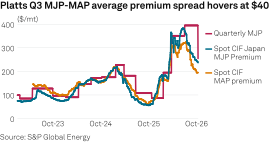
The traditional convergence between Japanese quarterly settlements and wider Asian spot premiums appeared less likely this year, as ex-Japan market fundamentals remain significantly weaker amid ample supply in the ex-Japanese Asian market due to wider brand acceptance.
However, some market participants said that Good Western-origin units could flow to Europe if premiums there were more attractive in addition to a tighter Good Western-origin ingot supply within the Japanese market, which could help support Japanese premiums despite subdued downstream consumption.
In Rotterdam, premiums remained firm as the P1020 aluminum market remained tight, with sellers holding back Canadian-origin metal in anticipation of a potential US-Canada trade agreement. However, the arrival of Indonesian-origin units could potentially create an oversupply.
Platts assessed the daily aluminum duty-unpaid IW Rotterdam premium at $425-$490/mt Oct. 12, with a midpoint of $457.50/mt, stable day over day.
Q1 2027 expectations soften
Looking ahead, market participants generally expect premiums to remain under pressure into the first quarter of 2027.
Some market participants indicated expectations for Q1 MJP negotiations in the range of $190-$200/mt CIF Japan, citing weak spot market fundamentals, subdued demand growth amid the end of the Japanese financial year and expectations for rising regional supply availability.
Market participants remained focused on Indonesia, where expanding aluminum production capacity is expected to increase supply into Asian markets in 2027. S&P Global Energy CERA analysts forecast a 104% year-over-year increase in Indonesia's potential primary-aluminum smelter nameplate capacity by 2027, reaching 4.61 million mt/y.
While market participants cautioned that project ramp-up schedules remain uncertain, many viewed Indonesian production growth as a key factor likely to cap premium upside across the region.
Rather than concerns over supply disruptions, the market's focus has shifted markedly since Q3. Participants are increasingly assessing how quickly additional regional supply might emerge and whether demand would be sufficient to absorb it.
