Refined Products, Metals & Mining, Crude Oil, Diesel-Gasoil, Non-Ferrous, Ferrous, Gasoline, Fuel Oil
September 24, 2026
US diesel export ban could severely impact Latin American metal producers

By Kip Keen
Editor:
HIGHLIGHTS
Latin America faces acute diesel supply risks
Chile imports 88% of diesel from America
Mining costs rise as fuel prices surge
A US ban on diesel could wreak havoc on global mining operations and especially those in Latin America, experts told Platts.
The US, the largest global diesel exporter, is mulling export curbs to tamp down domestic diesel prices, which have skyrocketed amid the ongoing US conflict with Iran and after Ukrainian damage to diesel-producing facilities in Russia.
Overall, Latin America relies on US imports to cover about one-third of diesel demand, S&P Global Energy Horizons analysts said in a Sept. 22 report. Chile, Peru, Mexico and Brazil -- key metal producers of copper, silver, lithium and iron ore -- are among countries that deeply depend on the US for the fuel, according to S&P Global Market Intelligence data.
Mining exposure to diesel, a major cost driver, is especially acute in Latin America, a copper-producing powerhouse, analysts said. Chile and Peru combined accounted for 34.7% of global mined copper in 2025, according to S&P Global Market Intelligence data. Prices for the metal soared this year and reached new records in recent weeks amid bullishness over demand exceeding supplies in the longer term.
The front-month NYMEX October ultra-low sulfur diesel contract settled at $4.7764/gal Sept. 23, a 125.2% increase from the start of the year, and down only slightly from all-time records over $5/gal earlier in September. The Platts assessed US Gulf Coast Export ULSD price hit an all-time high of $4.7833/gal on Sept. 16.
Affected Latin American "countries would have to compete simultaneously for limited alternative cargoes from India, the Middle East, Europe and elsewhere, where available," Andrés González, lead mining industry analyst at consultancy Plusmining, told Platts. "Replacing US deliveries would also take longer and cost more, increasing the risk of local shortages if the ban persisted."
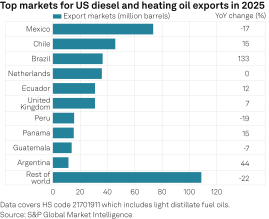
The top five export markets for US diesel and related fuels were Mexico, Chile, Brazil, the Netherlands and Ecuador -- combined accounting for 53.2% of 2025 US exports, according to Market Intelligence's Global Trade Analytics suite data covering HS code 21701911. Total 2025 US exports in the category, which includes light distillate fuel oils, were 418.1 million barrels.
"The truth is the entire [Latin American] region will be affected and will have to consider emergency measures to deal with limited supply," Felipe Perez, S&P Global Energy Horizons head of Latin America fuels and refining research and strategy, told Platts. "The only exception is Colombia, which is not dependent on diesel imports."
Sensitivity to a ban is high in Mexico, where diesel inventories fell under six days of supply in April 2026, González said. Meanwhile, Chile depends on the US for 88% of its diesel imports, according to the analyst.
"With imports meeting roughly two-thirds of domestic consumption, its exposure to a potential US ban is substantial," González said of Chile, while also flagging concerns for Peru and Brazil.
Mexican President Claudia Sheinbaum said Sept. 21 that her administration could maintain support measures through year-end to preserve the government's diesel price cap of Peso 27/liter ($1.56/liter), which the government imposed early in the year.
A full ban would raise metal prices, along with costs for miners, S&P Global Energy Horizons analysts said in a Sept. 23 report.
"We think there would be a massive impact on miners, with an immediate impact on prices and, if this drags on, on operations as well," Patricia Barreto, S&P Global Energy Horizons associate director of short-term analytics for critical minerals, told Platts.
Miners, while benefitting from high prices for many metals like copper and gold, would take a hit.
"For Chile's large-scale copper mines, diesel accounted for approximately 6.5% of exploitation costs excluding depreciation and amortization in 2025," González said. "Furthermore, Chile's diesel import-parity prices have averaged 41% higher so far in 2026 compared to 2025, making fuel costs a growing concern for the sector."
Beyond Latin America
Beyond Latin America, analysts also underscored impacts on other regions. A refinery in Eastern Canada is now under maintenance, adding pressure to Canadian diesel supplies. Meanwhile, the EU is also increasingly reliant on US diesel imports amid disruptions stemming from conflict in the Middle East and Ukraine, which has attacked oil facilities in Russia.
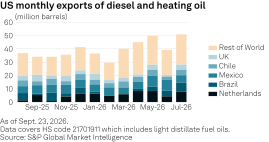
In July, the Netherlands was the top market for US exports of diesel and heating fuel under HS code 21701911, ahead of Brazil and Mexico amid rising EU imports, according to Market Intelligence data.
"We would suggest that talk of such a ban should be stopped as soon as possible, given the huge adverse impact it is already having on prices," James Watson, director general of trade group European Metals, said in an emailed statement to Platts.
Watson warned of steeper costs for European metal producers should global diesel flows further shrink.
US export controls would no doubt push diesel prices higher, analysts said, as buyers adjusted to lower global supplies.
"The lack of available refining capacity elsewhere in the world would likely force global diesel prices to rise precipitously to reduce demand," S&P Global Energy Horizons analysts said Sept. 22.
To ban or not
The Trump administration is divided on whether to ban diesel exports, with Trump seemingly leaning in favor.
A decision would be made "fast, one way or the other," Trump told reporters Sept. 23. "I've said, let's not send out the diesel."
Other officials in the administration have said the US is not looking at an outright export ban, and the White House pushed back against reports saying it planned to impose one.
"This is not true," the White House press office said in response to a Platts question about reports of a coming ban.
The White House pointed to comments by Chris Wright, Secretary of Energy, in the Wall Street Journal where he is quoted as saying the administration is looking to avoid "a blunt hammer of a government policy, understanding the complexity of refining."
A more limited policy could mute the impact on import-dependent countries, analysts said.
"I personally think the narrative is misplaced," Tom Kloza, chief energy advisor at Gulf Oil, a fuel retailer, told Platts. "An outright diesel ban is probably a non-starter, but some sort of speed bumps for moving barrels from the Gulf or West Coast offshore may be a more likely outcome."
The US energy sector has called on the White House not to pursue a ban, saying it could have unintended consequences like higher prices for gasoline. A ban would force US refiners to grapple with a potential glut of diesel, lowering output of fuels at their refining operations.
"There can be collateral damage when you do something like this, and it may not have the intended consequence of even reducing prices in a materially important way," Patrick De Haan, GasBuddy head of petroleum analysis, said in an interview. "I would hope that, that information is getting into the White House."
