Metals & Mining, Non-Ferrous
September 08, 2026 · Updated September 15, 2026
Malaysia, Vietnam emerge as rare earths alternatives, but China still looms

Editor:
HIGHLIGHTS
Malaysia, Vietnam seek diversified rare earths industries
China controls 94% of magnet production
Malaysia and Vietnam are unlikely to pivot away from China on rare earths, even as the two nations emerge as potential alternatives to Chinese-dominated supply chains for the critical minerals, industry experts told Platts, part of S&P Global Energy.
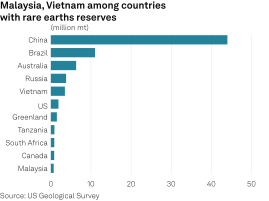
Over the past year, Malaysia and Vietnam have signed critical minerals partnerships with several countries aiming to reduce reliance on rare earths supply chains controlled by China. The two Southeast Asian nations host a combined 5.6% of globally known rare earths reserves, but they account for a small fraction of global production of the metals used in clean energy and defense systems. Vietnam has the world's fifth-largest rare earths reserves at 3.5 million metric tons, while Malaysia has 710,000 mt, according to US Geological Survey (USGS) data.
However, Malaysia and Vietnam maintain deep ties with China, which has a long-established footprint in the region. Malaysia and Vietnam are expected to leverage their relationship with China and increasing rare earths interest from other nations to maximize gains in the global rare earths race, experts said.
"Neither government needs to pick a side, and neither will," Volodymyr Berezhniy, founder and CEO of K66, a US company coordinating allied rare earth magnet supply chains, told Platts. "Buyers do not need Kuala Lumpur or Hanoi to be anti-China. They need specific facilities that can pass an audit."
Chinese influence
As China implements restrictions on rare earths exports, several countries have approached Malaysia and Vietnam to source the critical minerals that are essential in permanent magnets used in fighter jets, wind turbines, and other high-tech applications.
In October 2025, the US signed an agreement to bolster cooperation with Malaysia to advance resilient critical minerals supply chains. In June, Malaysia also agreed to strengthen rare earths cooperation with Japan and work with Australia, France and other like-minded partners.
Similar developments are also happening in Vietnam. In 2026, the country agreed to strengthen critical minerals cooperation with Australia, India, Japan and the EU. Vietnam has also sought to ease permitting for South Korean businesses eyeing rare-earth investments in Vietnam.
Despite the agreements, Malaysia and Vietnam are unlikely to turn their back on China, experts said. Southeast Asian nations consider China a major trading partner, and Chinese influence in the region is expected to remain strong amid a global effort to bolster non-Chinese supply chains. In March 2026, the Association of Southeast Asian Nations reiterated its shared commitment with China to advance their cooperation under a comprehensive strategic partnership.
On a bilateral level, Malaysia and Vietnam have remained open to Chinese rare earths investments. Vietnamese President To Lam and Chinese President Xi Jinping committed to exploring cooperation in critical minerals, according to an April 17 joint statement released during To Lam's visit to China.
Malaysia and China also discussed a refinery project in October 2025, according to reports.
Heavyweight producer
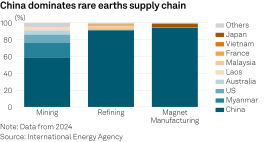
China's tight grip of the rare earths supply chain could keep Malaysia and Vietnam reliant on Chinese technology to develop their rare earths reserves, experts said. China controlled 60% of global mined rare earths production, 91% of global refined output and 94% of permanent magnet production in 2024, according to data from the International Energy Agency.
"The challenge will be that the majority of the technology and expertise continues to lie within China," Tricia Yeoh, director of the Asian Institute for Policy and Engagement at the University of Nottingham Malaysia, told Platts.
But Malaysia and Vietnam are also avoiding heavy dependence on China, experts said. Malaysia's neutral geopolitical stance could favor the country as it seeks to attract other rare earths players, said Amalina Anuar, senior director of Malaysia-based publication FMT Business and a visiting fellow at the ISEAS – Yusof Ishak Institute think tank.
"Malaysia has consistently maintained a neutral stance, open to all investors regardless of origin," Amalina told Platts.
Vietnam is also adopting the same strategy, said Tran Thi Mong Tuyen, a Vietnam-focused fellow at the Hawaii-based Pacific Forum think tank.
"Working with different countries allows Vietnam to access technology, investment and expertise without relying too heavily on any one partner," Tuyen told Platts.
By demonstrating neutrality, Malaysia and Vietnam could host both Chinese and non-Chinese operations and achieve a diversified investment landscape for their respective rare earths industries, experts said.
Surging foreign investments
The rare earths industries of Malaysia and Vietnam are currently in different stages of development. Malaysia's rare earths industry is more advanced, ranking second in rare earths refining in 2024 with a 4.5% market share, according to IEA data. Australia-listed Lynas Rare Earths Ltd. operates the Gebeng rare earths processing plant in Malaysia, which is considered the largest commercial rare earth separation facility outside China, according to experts.
"Lynas is often pointed to as one of the success stories of global diversification of rare earth elements beyond China, and Malaysia's role and place in this is highly important and gives it significant geoeconomic leverage," said Chris Vandome, who leads the Critical Minerals Initiative at the London-based Chatham House think tank.
However, the Gebeng plant uses feedstock from Lynas' Mt Weld mine in Western Australia. Malaysia only produced 110 mt of rare earths in 2025, based on USGS data. Lynas is ramping up its presence in Malaysia, announcing a deal in July with South Korea-based JS Link Inc. to build a permanent magnet plant in the city of Kuantan.
Other companies are emerging in Malaysia. In July, France-based Carester and Malaysian miner Malaco outlined a plan to develop a rare earth separation facility in Perak state. Amid the intensifying rare earths race, Malaysia is considering lifting some export restrictions on unprocessed rare earths to meet increasing demand, according to reports.
Budding industry
Meanwhile, Vietnam's rare earths sector is still nascent. Japan's Shin-Etsu Chemical Co. Ltd. is the only company with a significant commercial footprint in Vietnam, according to Mun Leong, associate director for critical minerals markets at S&P Global Horizons. The country recorded rare earths production of 150 mt in 2025, far below its reserves, USGS data showed.
But that could change soon, as Vietnam is also drawing more foreign investments. In March, Lynas and South Korea-based LS Eco Energy Ltd. signed a framework agreement to develop a rare earth facility in Vietnam.
As interest in Vietnamese rare earths surges, the Vietnamese government has implemented several measures to prop up its rare earths industry. In December 2025, the parliament passed a law to reaffirm an export ban on unprocessed rare earths while restricting exports of refined rare earths. Vietnam also outlined its plan to prioritize the development of its rare earths industry, according to reports.
While Chinese rare earths expertise and the country's competitive advantage remain unmatched, the global push to develop new supply chains now goes beyond mere economics, as national security concerns fuel some countries to play catch-up, experts said.
"Buyers and governments are seeking alternative sources to reduce exposure to Chinese export controls and geopolitical supply risks," Leong told Platts. "In this context, diversification, supply security and strategic autonomy are likely to outweigh purely cost considerations."
Platts assessed neodymium-praseodymium oxide (NdPr) — a rare earths compound — at $110/kilogram CIF North America Aug. 31, down $5/kg from July 31. NdPr oxide FOB China was assessed at $112/kg on Aug. 31, unchanged from the previous month.
