Metals & Mining Theme, Non-Ferrous
December 18, 2025
COMMODITIES 2026: Southeast Asia navigates power rivalry for critical minerals

HIGHLIGHTS
US, EU seek closer ASEAN ties to ease China dependence
ASEAN a major source of nickel, rare earths, other critical minerals
Experts advise balanced approach in maintaining relations
This is part of the COMMODITIES 2026 series, where our reporters bring you key themes that will drive commodities markets in 2026.
Southeast Asian nations should prioritize protecting their strategic interests as the US and the EU seek deeper engagement with the region to reduce reliance on China for critical metals, according to industry experts.
The Association of Southeast Asian Nations, comprising 11 countries in Southeast Asia, possesses substantial reserves of nickel, copper, rare earth elements and other critical minerals essential for electric vehicles, renewable energy infrastructure and defense applications.
China has long dominated the processing of these metals, prompting the US and the EU to increasingly view ASEAN's resource endowment as a potential alternative source of raw materials.
Industry experts say governments in Southeast Asia face the challenge of negotiating carefully to maximize the value of their resources while avoiding entanglement in trade disputes between global powers, all while seeking to maintain balanced relations with China.
"The fact that the US and the EU go to ASEAN for these deals means they have leverage," Zsuzsa Anna Ferenczy, a visiting fellow on EU-Southeast Asia relations at the Martens Centre in Belgium, told Platts, part of S&P Global Energy. "The question is, how do you negotiate those deals that best serve [ASEAN's] interests?"
Trade agreements
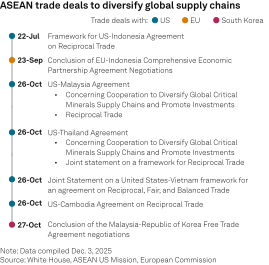
In 2025, the US and the EU intensified engagement with ASEAN member states, securing trade agreements that include commitments to develop resilient mineral supply chains.
In October, Malaysia and the US signed a deal to strengthen cooperation on critical minerals. During the same month, the US signed deals that could accelerate critical minerals development in Thailand, Vietnam and Cambodia.
Indonesia finalized free trade negotiations with the EU in September and reached a trade deal with the US in July. The Philippines has held extensive trade talks with the US and the EU, according to media reports.
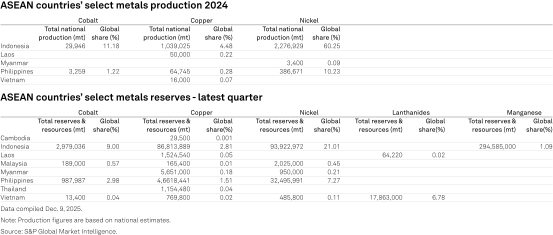
The agreements affirm ASEAN's status as a significant source of critical minerals beyond China.
Indonesia was the world's largest nickel producer in 2024, with 60.3% of global output, according to S&P Global Market Intelligence data. Indonesia also accounted for 11.2% of the world's cobalt production. Meanwhile, the Philippines produced 10.2% of the world's nickel in 2024, the data showed.
"ASEAN member states are seen in general by the global business community as a key growth area [in critical minerals] and one that is attractive for supply chain diversification, as well as an area to develop new markets," Chris Humphrey, executive director of the EU-ASEAN Business Council, said.
Southeast Asian nations also produce rare earth elements, a group of minerals used in magnets for EVs, wind turbines and advanced weapon systems.
The combined rare earth mine production of Malaysia, Myanmar, Thailand and Vietnam represented 11.4% of global output in 2024, according to US Geological Survey data. China, which produced 69.2% of the world's rare earths in 2024, also sources rare earth materials from Malaysia and Myanmar, the data showed.
Meanwhile, other ASEAN nations without known mine production are seeking to tap into their mineral potential. Brunei has recognized the importance of critical minerals in its efforts to diversify the economy away from oil, according to media reports. Timor-Leste, which joined ASEAN in October, is promoting mineral exploration within the country.
"It has just become a tug of war between China and the US, whereas for us in the region, it is about economic development," Mirza Sadaqat Huda, a Singapore-based senior research fellow at the ODI Global think tank, said.
Chinese clout
While the US and the EU continue efforts to establish their own supply chains, industry experts said they must also navigate China's significant influence in Southeast Asia.
Chinese investments represented 69.9% of Indonesia's nickel refining capacity in 2024, according to Market Intelligence data.
In 2024, Indonesia was the largest recipient of Chinese investments under the Belt and Road Initiative at $9.3 billion, according to a report by the Green Finance & Development Center at Fudan University, China.
China has also established a significant presence in Malaysia's rare earth industry. In 2022, MCRE Resources Sdn Bhd partnered with Chinese firms to use technology to extract rare earths in Malaysia's Perak state, according to MCRE's website. Even before it signed a critical minerals deal with the US, Malaysia had welcomed cooperation with China on rare earth processing.
Myanmar is also a major supplier of rare earths to China, accounting for an annual average of 60%-87% of Chinese rare earth imports from 2017 to 2024, according to a report by the Institute for Strategy and Policy-Myanmar, a think tank.
Maintaining balance
For the US and the EU to become successful in Southeast Asia, they must recognize ASEAN's geopolitical importance and not engage with it solely for its mineral resources, according to Ferenczy.
"ASEAN is seen as a region that has remained stable and can provide that stability that is required to counter growing tensions," Ferenczy said. "These countries want to be seen on their merits."
In the global race for critical minerals among powerful nations, Huda said ASEAN nations do not have to choose sides.
"Southeast Asia really needs to find a way to attract investment without upsetting any of the major powers," Huda said. "What we are trying to do is develop our critical minerals, and we need to collaborate with all major partners."
Platts assessed Indonesian nickel pig iron with 10% content at $111/metric ton unit FOB Indonesia on Dec. 18, unchanged from the previous day and up $3/mtu from Dec. 1.
Platts assessed the CIF China clean copper concentrate treatment charge at minus $49.60/mt and the refining charge at minus 4.96 cents/lb on Dec. 18, down 80 cents/mt and 0.08 cent/lb, respectively, from Dec. 17.
Platts assessed cobalt hydroxide prices at $24.85/lb CIF China on Dec. 18, inching up 5 cents/lb day over day and rising more than threefold since the start of 2025.

Editor: