Metals & Mining, Energy Transition, Non-Ferrous, Renewables
September 02, 2026
INTERVIEW: India's ex-China rare-earth magnet capacity could emerge by 2029-31: CMAI's Kanuganti

Editor:
HIGHLIGHTS
Copper faces largest supply-demand gap through 2030
Strategic reserve program allocates $52.7M funding
India is moving to secure critical mineral supplies essential for its energy transition and industrial growth, though establishing a fully integrated domestic supply chain remains a long-term hurdle. Despite expanded policy support for mining, processing, and manufacturing, India's critical minerals value chain remains reliant on imported materials and overseas refining capacity.
Platts, part of S&P Global Energy, spoke with Rahul Kanuganti, vice chairman, Critical Minerals Association of India, about the development of India's critical minerals ecosystem, prospects for domestic rare-earth magnet production, copper supply challenges, strategic stockpiling efforts and the role of partnerships in achieving greater supply security. This interview has been edited for clarity.
Platts: What is India's realistic timeline for building a domestic rare-earth processing and magnet-manufacturing ecosystem independent of Chinese refining?
Rahul Kanuganti: India can establish meaningful ex-China rare-earth magnet capacity by around 2029–31, but a mature, integrated ecosystem is more realistically a 2032–35 objective.
India already has some mining, separation and oxide-refining capability through IREL. The bigger gaps are converting oxides into metals, metals into alloys, and alloys into high-performance sintered magnets at an industrial scale. India's Rare Earth Permanent Magnets Scheme is designed to address precisely these stages and targets 6,000 metric tons of annual integrated magnet capacity.
If implementation proceeds broadly on schedule, the first large facilities could begin production around 2028–29, followed by commercial scaling over the next two or three years. India has also commissioned a 500-mt samarium-cobalt magnet facility and launched a pilot program for neodymium-iron-boron magnets.
The critical qualification is that manufacturing magnets in India does not automatically mean independence from Chinese refining. Indian plants will initially need reliable supplies of separated neodymium-praseodymium oxide and, for high-temperature magnets, dysprosium and terbium. Australia is the most credible non-Chinese source for these materials.
India's projected magnet demand is about 8,220 mt in 2030, while the government scheme targets 6,000 mt of capacity. Therefore, even full implementation would not eliminate imports. A reasonable expectation is initial industrial production by 2028–29, significant scale by 2030–32, and a broadly resilient ecosystem by 2032–35.
Platts: What is India's current stockpile policy for critical minerals and is it moving toward a strategic reserve?
Rahul Kanuganti: India has moved beyond simply considering a strategic reserve. The National Critical Mineral Mission includes a formal Critical Mineral Stockpile Program, with 5 billion Indian rupees ($52.7 million) allocated through 2030–31.
However, it is still an early-stage program rather than a fully operational reserve. The government has not publicly disclosed which minerals will be stockpiled first, the quantities involved, storage arrangements, or release mechanisms.
It is also possible that defense, atomic-energy and public-sector organizations hold inventories that are not publicly disclosed. Nevertheless, there is no evidence yet of a large, centrally managed reserve capable of insulating Indian industry from a prolonged Chinese supply disruption.
A risk-based approach is preferable. Gallium, germanium, heavy rare-earth oxides and specialized graphite products deserve priority because supply is highly concentrated and relatively small volumes support strategically important industries. The reserve should also combine government-owned stocks with inventories held by major industrial users.
Platts: Should India initially build processing plants around imported feedstocks and which sources offer the best near-term opportunities?
Rahul Kanuganti: Yes. Building processing plants around imported feedstock is the most practical near-term approach. Waiting for Indian mines to reach commercial production could leave the country without meaningful midstream capacity for much of this decade.
For rare-earth magnets, separated neodymium-praseodymium oxide is the most suitable initial feedstock. It would allow Indian companies to concentrate on the missing oxide-to-metal, alloy-making, powder-production, sintering and magnet-finishing stages without immediately taking on the technically difficult and environmentally sensitive treatment of radioactive monazite concentrates.
Australia is the strongest near-term partner. Several Australian projects are approaching production of separated rare-earth oxides, and an emerging Indian magnet producer has already reached an arrangement for up to 500 mt/year of NdPr oxide from Australia's Nolans project.
Platts: Which critical minerals face the largest supply-demand gaps in India through 2030 and which sectors will drive demand?
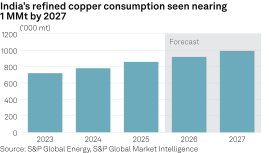
Rahul Kanuganti: In absolute volume terms, copper is expected to face the largest gap, followed by graphite. Nickel, lithium and phosphate materials form the next tier, while rare earths and cobalt remain strategically important despite smaller physical volumes.
Copper demand will be driven by transmission and distribution networks, renewable-energy infrastructure, railways, urban development, industrial equipment, electric vehicles, charging infrastructure and data centers. NITI Aayog estimates that energy-transition technologies alone could require about 1.88 million mt of copper between 2025 and 2030 under a net-zero pathway.
Graphite is likely to be India's largest battery-material challenge by volume, driven by demand for lithium-ion battery anodes. The challenge is battery-grade spherical purified graphite, an area still dominated by China.
Lithium and nickel demand will also grow rapidly alongside electric vehicles and battery storage. Nickel demand will depend partly on battery chemistry choices.
Overall, copper and graphite present the largest volume challenges, while rare earths, lithium and cobalt carry the greatest strategic risk.
Platts: Is there a realistic path to reducing India's copper concentrate import dependence below 80% by 2035?
Rahul Kanuganti: India's strategy has four elements: expand domestic mines, increase smelting and refining capacity, recover more copper through recycling, and secure foreign concentrate through long-term contracts and overseas investments.
Hindustan Copper plans to increase ore-mining capacity from around 4 million mt annually to 12.2 million mt by 2030 through mine expansions, reopening viable operations and improving beneficiation.
Meanwhile, new refining projects are adding processing capacity, with the Copper Vision Document envisioning up to 5 million mt of refining capacity by 2030.
The challenge is that new smelters do not reduce dependence on imported concentrate unless domestic mine output grows at a comparable pace. Government projections still indicate roughly 95% import dependence by 2030.
India is therefore pursuing long-term supply agreements, overseas mine investments and trade arrangements with countries such as Chile and Peru, while also engaging with Australia and African copper producers.
Reducing concentrate import dependence to below 80% by 2035 does not appear realistic, given the currently identified domestic projects. A more achievable goal is to reduce dependence on the spot market by diversifying and securing overseas supply.
