Metals & Mining, Non-Ferrous
August 13, 2026
India's refined copper imports set to shrink, concentrate needs persist: industry panel

Editor:
HIGHLIGHTS
Copper concentrate imports remain at 85% of total
Demand expected to reach 3.3 million mt by 2030
India's copper industry is moving closer to refined copper self-sufficiency as producers expand smelting capacity, although the country is expected to remain dependent on imported concentrate for the foreseeable future, industry executives said at the Global Commodity Conclave in Mumbai Aug. 13.
The comments come as copper demand in India continues to outpace economic growth and producers position themselves to meet rising requirements from industrial and other sectors.
India's copper demand is expected to reach 3.3 million metric tons in 2030, according to India's Ministry of Mines.
Copper demand is expected to grow by about 10% annually from the projected 2 million mt in 2026, Mayur Karmarkar, managing director of the International Copper Association India, said at the event.
India's refined copper imports, estimated at 300,000-500,000 mt/year over the past eight to 10 years, should decline as new capacity ramps up, according to Krishnan AV, head of sourcing and marketing at Adani's Kutch Copper Ltd.
"We are poised to bring that required change into the Indian copper industry," he said, citing the company's new smelting capacity of around 500,000 mt/year that started processing in June 2025.
Vijay Kamle, national sales head at India's leading copper producer Hindalco, said the company was also preparing for continued demand growth and plans to add nearly 300,000 mt of smelting capacity over the next two to three years. "We are already gearing up" to meet future demand, he added.
From the consumer side, Sandeep Bhargava, chief procurement officer at Havells India, said the availability of copper cathodes in India has really improved and predicted the country could become self-sufficient within 24 to 30 months.
"The availability is there," he said, noting that ongoing expansion projects should further strengthen domestic supply.
Concentrate challenge
However, panelists repeatedly highlighted India's access to copper concentrates as a challenge.
India's imports of copper concentrates accounted for around 85% of overall copper imports in 2025, according to S&P Global Market Intelligence's Global Trade Analytics Suite.
Kamle said India lacks sufficient domestic copper concentrate resources and remains import dependent, while noting Hindalco was not currently facing raw-material supply issues because of long-standing supplier relationships.
Bhargava said India was unlikely to achieve self-sufficiency in concentrate because it lacks domestic concentrate resources, adding that the country would continue to need to secure concentrate supplies.
The issue is becoming more important as India's share of global copper demand grows.
Anil Tembe, chief operating officer at Vedanta's Sterlite copper unit, said India currently accounts for about 4%-5% of global refined copper production and consumption, but this could rise to 8%-9% within a decade.
Roughly 30% of future growth in global refined copper consumption and 40% of future refined copper capacity additions could originate from India, Tembe added.
Addressing concentrate security, Hemankur Upadhyay, director at Lloyd Metals and Energy, said India would need greater upstream investment in overseas copper resources, including mine investments, minority stakes, and long-term offtake agreements.
He pointed to opportunities in established copper-producing nations such as the Democratic Republic of Congo, Chile, and Peru, as well as emerging sources like Papua New Guinea, which offer potential for concentrate supply.
Upadhyay also called for state-backed risk insurance, country-level supply-chain agreements, and long-term financing support for mining projects.
Despite optimism over capacity additions and demand growth, executives acknowledged challenging economics for smelters.
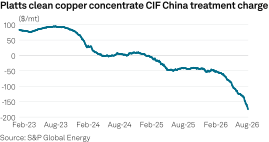
Krishnan said treatment and refining charge conditions have become difficult globally, increasing the need for efficient operations, robust supply chains, and greater recycling integration.
Treatment and refining charges (TC/RCs), a key benchmark negotiated between copper miners and Chinese smelters, fell to negative $178/mt Aug. 13, according to data from Platts, part of S&P Global Energy.
Those processing charges have been negative since 2024, as several factors, including mine disruptions and weather-related issues, continue to affect concentrate supply.