Metals & Mining, Coal, Agriculture, Ferrous, Non-Ferrous, Vegetable Oils
August 26, 2026
Indonesia's planned mineral exchange may improve nickel price transparency: experts

Editor:
HIGHLIGHTS
Supports development of Indonesian reference price
New platform to target Class II nickel trade
State seeking more control over commodity pricing
Indonesia's plan to launch a mineral exchange in 2027 could serve as an additional platform for nickel price discovery and complement the London Metal Exchange industry benchmark price, which does not directly incorporate most Indonesian production, market experts told Platts, part of S&P Global Energy.
Indonesia's President Prabowo Subianto announced Aug. 14 that the nation will establish its own mineral and strategic commodities exchange by Jan. 1, 2027. The proposed exchange would allow Indonesia to become a "price setter" and prevent other countries from determining prices and profits that the country generates from its own resources, Prabowo said in a speech ahead of the country's Aug. 17 Independence Day. The exchange could also include coal and palm oil, according to media reports citing presidential spokesperson Prasetyo Hadi.
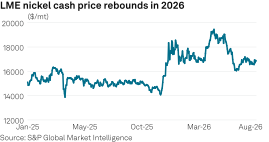
As the world's largest nickel producer, Indonesia has demonstrated its immense sway in the nickel market, with its production cuts in 2026 primarily driving a rebound in LME nickel prices. The planned mineral exchange could bolster the nation's market influence, as it would promote transparency in the opaque segments of Indonesia's nickel industry that are not yet reflected on the LME, experts said.
"Once Indonesia's mineral exchange goes live, it could provide an alternative pricing mechanism for domestic nickel transactions and allow greater government oversight of price regulation within the industry," S&P Global Energy CERA analyst Joenelle Donato told Platts, which is also part of S&P Global Energy.
"The exchange is expected to support the development of an Indonesian reference price, which could improve pricing transparency and increase the country's influence over physical nickel transactions," Donato added.
Opaque pricing
Prabowo said the proposed minerals exchange will create an Indonesian reference price for the country's main commodities, providing clearer transaction data while curbing price manipulation.
The exchange could improve pricing for most of the nation's nickel products, which are currently traded in opaque transactions within Chinese-linked groups, according to Ahmad Zuhdi Dwi Kusuma, principal at the Energy Shift Institute think tank. China dominates ownership of Indonesian nickel facilities after an Indonesian ban on nickel ore exports in 2020 prompted Chinese companies to invest in Indonesia's downstream industry.
"A large share of output moves inside vertically integrated, mostly Chinese-affiliated industrial groups under intra-group contracts, which means much of the trade is not normal," Zuhdi told Platts.
Most of Indonesia's nickel production such as nickel pig iron and ferronickel — which are mostly used for stainless steel production — is classified as lower-purity Class II nickel. LME warehouses only accept Class I nickel, which has over 99% nickel content, Donato noted.
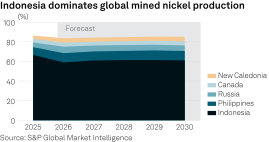
Despite this, Indonesia is capable of influencing LME nickel prices due to the nation's control of global mine supply, according to Donato. Indonesia produced 66.6% of global mined nickel supply in 2025, according to S&P Global Market Intelligence data. Indonesian production can also impact Class I supply, as some plants can convert nickel pig iron into nickel matte, which is exported to China and processed into Class I refined nickel and battery-grade nickel sulfate, CERA analyst Jason Sappor said.
With an Indonesian mineral exchange, trading of Indonesia's Class II nickel products will no longer be limited to non-transparent transactions, according to Zuhdi.
"A credible index for those products is achievable and would be beneficial for Indonesia," Zuhdi said. "Visible transaction prices for [nickel] intermediates would improve royalty and reference-price assessment and narrow the space for transfer pricing inside integrated groups."
The proposed exchange could further boost Indonesia's leverage in nickel markets, as international traders may eventually incorporate Indonesia's domestic reference prices into their price formation once the exchange improves its liquidity, according to Salvatore Pinizzotto, co-founder and managing director of Xida Communications, an Italy-based critical raw materials advisory firm.
"An Indonesian exchange could become particularly relevant to physical price formation in parts of the nickel value chain where Indonesia is dominant, while the LME retains an important role as an international financial and hedging benchmark," Pinizzotto told Platts.
While Prabowo touted the exchange as a way for Indonesia to set prices, Pinizzotto does not expect it to replace the LME as the industry benchmark due to the LME's long-established position in the market.
"An exchange does not become an international benchmark simply because it is located in the world's largest producing country," said Pinizzotto, who also served as director of market research and statistics at the International Nickel Study Group. "Indonesia has the scale to become increasingly influential in price formation, but benchmark credibility ultimately has to be earned by the market."
The LME declined to comment.
Industry impact
The Indonesian Nickel Miners Association (APNI) expressed support for the proposed exchange, saying it would provide a more stable pricing mechanism for Indonesian nickel products compared to the LME, which "often experiences extreme volatility and manual intervention."
"Over the past three years, APNI has consistently promoted the idea of an Indonesia Metal Exchange to the government and relevant authorities," Nanan Soekarna, APNI's chairman, said in a statement. "[The president's announcement] is the state's recognition of the urgency we have conveyed since 2023: Indonesia must not continue to be a price taker for commodities that we ourselves produce in the largest quantities in the world."
However, not all industry participants are expected to welcome the Indonesian exchange with open arms. Zuhdi expects some market players that benefit from opaque bilateral discounts to resist transparent pricing that the exchange offers.
The exchange could also cause transaction bottlenecks if it becomes mandatory. Buyers could also remove Indonesian material or restructure contracts if the government uses the exchange to implement an unreasonable price floor, Zuhdi added.
Prabowo outlined Indonesia's plan to launch an exchange amid the government's broader efforts to tighten control of its commodities sector and increase state revenue. After years of depressed nickel prices, Indonesia reduced its nickel ore production quota in 2026 to address oversupply.
Following the move, the LME nickel cash price hit $16,855.28/metric ton on Aug. 24, up 11.1% from the 2025 average of $15,171.13/mt, after trading at between $16,500 and $19,000/mt earlier in 2026, Market Intelligence data showed.
In June, Indonesia created PT Danantara Sumberdaya Indonesia, a state-owned body tasked with monitoring the nation's commodity exports and combating under-invoicing. Danantara Sumberdaya has identified $5 billion in potential additional state income just from differences and adjustments in prices, Prabowo said.
Over the past year, Indonesia has also increased domestic benchmark prices for nickel ore, restricted approvals of new smelters, and introduced permitting reforms for the mining industry.
