Metals & Mining, Fertilizers, Chemicals, Non-Ferrous
April 30, 2026
Nickel batteries could further lose spark as Indonesian production costs surge
Editor:
HIGHLIGHTS
Production costs surge on sulfur shortage, higher ore prices
MHP prices rise, threatening nickel battery viability
Nickel-based batteries could lose further market share amid rising production costs for a key battery input predominantly sourced from Indonesia, according to industry participants and experts.
Higher input costs have raised prices for mixed hydroxide precipitate, an intermediate nickel product used in electric vehicle batteries. Indonesia, the world's largest nickel producer, is home to several plants that use high-pressure acid leaching technology to produce MHP.
HPAL plants rely on sulfur from the Middle East to extract nickel from ore, but the war in the region has tightened sulfur supplies. HPAL facilities are also facing increased cost pressure due to an anticipated rise in nickel ore prices after Indonesia introduced a new nickel ore benchmark price formula April 15.
The rise in MHP prices may keep Indonesian HPAL operations viable, but the cost increase could push more EV manufacturers to choose battery chemistries with less nickel.
"Such a squeeze would likely accelerate the global shift toward alternative battery chemistries," Joenelle Donato, an analyst at S&P Global Energy CERA, said.
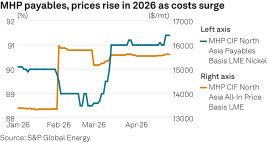
Platts, part of S&P Global Energy, assessed MHP CIF North Asia -- calculated from an LME nickel basis -- at 92.5% payables April 29, up from 90.1% on Jan. 2 and higher than the average of 79.6% for 2023-2025.
The Platts-assessed MHP CIF North Asia all-in price was $15,806/metric ton on April 29, climbing 17.9% from the start of 2026.
Cost pressure
MHP has emerged as a preferred feedstock in Asia, as it offers a more cost-effective way to produce battery-grade nickel sulfate than refining pure nickel metal, according to the industry group Nickel Institute.
HPAL plants process high volumes of low-grade limonite ore to produce MHP, CERA analysts said in an April 17 report, and the low-cost structure of Indonesia's integrated nickel facilities makes it economical to produce MHP.
This cost advantage will likely diminish as high sulfur and ore costs affect HPAL plant operations, and some may consider cutting output. In addition, new HPAL projects may be delayed due to escalating costs, according to Arief Tiammar, an advisory board member of the Indonesian Metallurgical Professional Association, an industry group also known as Prometindo.
Platts assessed the weekly FOB Middle East solid sulfur contract and spot price at $469/mt April 23, up 71.8% from $273/mt Feb. 8. Meanwhile, Indonesia's new ore pricing framework doubles the current rate for limonite ore, according to CERA's April 17 report. Nickel ore prices were already elevated even before the new formula due to the government's production restrictions.
"Rising prices of sulfuric acid and limonite ore will erode the profits of HPAL plant owners," Prometindo's Tiammar told Platts.
Poor outlook
HPAL operators would remain afloat as long as they maintain solid margins and MHP payables remain high despite higher production costs, according to Michael Insulan, vice president of commercial operations at Toronto-based Electra Battery Materials Corp.
However, this cost increase does not look promising for nickel-based batteries in an increasingly competitive battery market where more affordable lithium-iron-phosphate chemistries have been gaining momentum.
"[Higher feedstock and sulfur costs] increase cost pressure on nickel-bearing lithium-ion batteries and ... make LFP batteries more appealing," Insulan told Platts.
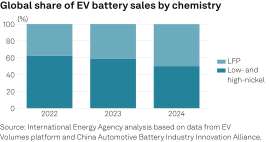
The global market share of low- and high-nickel EV batteries dropped to 50% in 2024, from 59% in 2023 and 63% in 2022, according to the International Energy Agency's Global EV Outlook 2025 report. In contrast, worldwide LFP battery sales rose from 38% in 2022 and 41% in 2023 to 50% in 2024.
LFP batteries are not the only competition for nickel batteries. Sodium-ion batteries have emerged as a new option, due to better performance in cold climates compared to LFP chemistries, according to the IEA.
The bleak demand prospects for nickel batteries make the high-cost environment challenging for HPAL operators. HPAL facilities could mitigate higher costs by prioritizing the processing of limonite ore with low magnesium oxide, which helps reduce sulfuric acid consumption, said Brandon Colwell, CEO of Indonesia-focused Nusa Nickel Corp.
"For HPAL operators, sulfur remains a key point of vulnerability, but the cost burden is not entirely fixed," Colwell told Platts. "Part of the impact can be mitigated through feed optimization."
But with demand for nickel-based batteries declining, controlling costs could only do so much.
"With rising risks of a global economic slowdown linked to the [Middle East war], demand for premium electric vehicle models -- where nickel-intensive batteries are primarily used -- is unlikely to strengthen in the near term," Linghui Ni, an analyst at UK-based minerals consultancy Project Blue, said in a note.
"This will make it increasingly difficult for nickel producers to pass through higher costs," Ni said.
