Electric Power, Metals & Mining, Ferrous
August 21, 2026
Higher costs, contract mix limit Cleveland-Cliffs' gains from US steel tariffs

Editor:
HIGHLIGHTS
Cliffs lags other US steel producers despite 50% tariff boost
Auto dependence, contracts slow price gains
Cleveland-Cliffs trails other US steelmakers, despite a 50% US steel tariff, due to higher production costs, its contract mix and dependence on the automotive industry, analysts told Platts, part of S&P Global Energy.
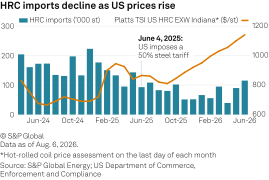
In June 2025, US President Donald Trump imposed a 50% tariff on global steel imports, driving up domestic steel prices and suppressing steel imports. US steelmakers Nucor and Steel Dynamics have posted strong quarterly results and steel shipments since the tariff, but Cliffshas struggled, posting an adjusted EBITDA loss in the fourth quarter of 2025. Cliffs has been hamstrung by its exposure to a soft auto industry and long-term contract structure.
"The ability of US steelmakers to realize price trends diverges significantly based on their contract structures," Ali Oktay, a senior analyst at S&P Global Energy CERA covering ferrous metals, told Platts. "Cleveland-Cliffs' mix has historically been heavily weighted toward fixed-price contracts, driven by its strong exposure to the automotive market. Conversely, [electric arc furnace] producers like Nucor and Steel Dynamics predominantly utilize index-linked contracts, allowing them to capture spot market uptrends with minimal lag."
Cleveland-Cliffs declined to comment for this story.
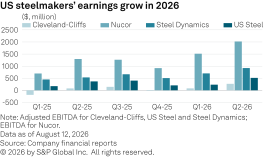
Shipment levels for Cliffs over the past few quarters have hovered around 4 million net tons. Net tons are equivalent to short tons. Cliffs reported an adjusted EBITDA of $286 million in the second quarter, more than triple the $94 million reported in the year-ago quarter, but lower than that of its US peers.
Nucor reported a record 7.1 million nt steel mill shipments with an EBITDA of $2.02 billion, while Steel Dynamics shipped a quarterly record of 3.7 million nt and posted an adjusted EBITDA of $920.5 million.
US Steel, which was purchased by Japan's Nippon Steel in 2025, shipped 2.1 million nt and 1.2 million nt of steel from its flat-rolled and mini-mill operations, respectively. US Steel reported an adjusted EBITDA of $514 million in the second quarter.
Down to costs
As an integrated steel producer, Cliffs pays more to produce steel than electric arc furnace (EAF) producers like Nucor and Steel Dynamics.
"If we're talking about just Cliffs' earnings and their cash flow, it has taken longer because of the volatility in their cost structure relative to mini-mills," Nick Giles, senior equity research analyst with B. Riley Securities, Inc., told Platts.
Cliffs primarily uses blast furnaces and has a much older asset base than other US steelmakers. The US fleet of blast furnaces has an average operating age of 74 years, according to nonprofit Global Energy Monitor.
Over 70% of US steel production, including Nucor and Steel Dynamics, uses EAFs, which rely on electricity, according to the American Iron and Steel Institute. EAFs are more energy-efficient and less capital-intensive than traditional blast furnaces, and they have lower carbon emissions.
"Electric arc furnace steelmaking is much more leveraged to the cost of raw materials versus the heavier fixed cost load of a basic oxygen furnace," Samuel McKinney, equity research analyst at KeyBanc Capital Markets, told Platts. "Steel pricing increase has dramatically outpaced the raw material cost increase, which has led to more operating leverage for the EAF producers."
Raw materials account for about 75% of EAF's production costs, compared to roughly 50% of the cost to produce steel through the basic oxygen furnace production method, McKinney said.
Platts assessed the TSI US HRC EXW Indiana at $1,205/short ton Aug. 20, up 47% year over year.
Meanwhile, raw material prices have risen more slowly than steel, boosting Cliffs' competitors. Platts assessed the TSI Shredded Scrap Delivered US Midwest at $415/long ton on Aug. 20, up 9.2% from a year ago. The weekly US pig iron import price was assessed at $505/metric ton CIF New Orleans on Aug. 14, up 16.1% from $435/mt assessed on Aug. 15, 2025.
Contract mix
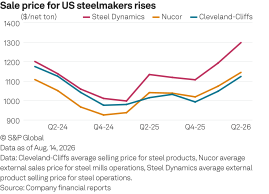
Nucor and Steel Dynamics rely more heavily on index-linked and shorter-duration contracts, which reset more often and allow the companies to capitalize on the US steel prices uptrend. But Cliffs relies on long-term off-take contracts, with several negotiated before the tariff, limiting the company's ability to capture the rise in steel prices.
Cliffs will have the opportunity to reset a substantial number of its fixed-price contracts in coming months,President and CFO Celso Goncalves said on the company's second quarter earnings call on July 23.
Cliffs has said a slab contract with ArcelorMittal, which finished as 2025 ended, dragged on the company. Cliffs' steel product revenue grew by $200 million in the second quarter of 2026 after shifting toward higher margin hot-rolled products.
Cliffs said the slab contract contributed to the company's 2025 performance, noting that it became "value-destructive" in its final year. Cliffs estimated that replacing slabs with higher margin products would improve its annual EBITDA by about $500 million.
Automotive industry
Nucor and Steel Dynamics maintain a more diversified customer base and have worked to expand their product offerings, including steel grating and lower-carbon products.
Direct automotive sales account for nearly 30% of Cliffs' production. US light-vehicle sales collapsed to 14.5 million in 2021 due to the COVID-19 pandemic, just a year after the company increased its exposure to the industry with the purchase of AK Steel Holding Corp. and ArcelorMittal's USA assets.
Sales haven't recovered to their 2016 record of 17.6 million units and are forecast to fall between 15.8 million and 16 million units in 2026, according to financial firm Morningstar.
The company deepened its exposure to autos in 2024 when it spent $2.5 billion to acquire Canada's Stelco Holdings Inc., which supplies steel to the automotive, construction and energy sectors.
Trump imposed a 25% tariff on auto imports, aimed at boosting carmakers, which could benefit Cliffs. But those tariffs have yet to be fruitful. However, the steel tariffs have helped Cliffs.
"It's definitely allowed them to meet that 4-million-ton level, but 4 million tons is still shy of where they would like to be," Giles said.
