Metals & Mining, Ferrous
August 05, 2026
China rebar sinks to near 10-year low amid weak demand, elevated inventories

Editor:
HIGHLIGHTS
Inventories rise amid weak construction
Mills maintain output despite soft demand
Chinese domestic rebar prices fell below 3,000 yuan/metric ton ($444/mt) in early August for the first time in nearly 10 years, pressured by persistently weak construction steel demand, insufficient production cuts and pessimistic market sentiment.
Several China-based mill and trading sources expected that elevated rebar inventories could cap any seasonal recovery in late August and September.
Platts, part of S&P Global Energy, assessed China's domestic rebar at 2,990 yuan/mt on Aug. 3 and Aug. 4, marking the first breach of the 3,000 yuan/mt threshold since January 2017, the year when the steel market was grappling with severe oversupply.
The rebar market recovered later in 2017 after China eliminated about 140 million mt/year of illegal induction-furnace steelmaking capacity, removing a major source of excess supply.
However, several mill sources said the current industry landscape differs significantly from that period.
Following years of large-scale pig iron and steel-making capacity replacement projects, China has largely eliminated outdated and illegal steelmaking capacity, leaving little room for similar supply-side reforms.
As a result, meaningful capacity reductions remain difficult to achieve in the near term, the mill sources said.
While some mill sources and traders expect a sharp collapse in rebar prices to be unlikely this time, they warned that insufficient production cuts in August could keep rebar inventories elevated and restrain price gains even during the traditional construction steel peak season in late August and September.
Output cuts remain insufficient
Several mill and trading sources said during Aug. 3-5 that steelmakers in China are in a much healthier financial position than they were in 2016-2017, with more diversified product portfolios and stronger cash flows.
Chinese mills are now more willing and also able to reduce rebar production or shift crude steel output toward more profitable products if losses become excessive, unlike during 2016-2017 when heavily indebted mills often maintained output despite substantial losses, the sources said.
Nevertheless, these market sources noted that current losses on rebar sales remain manageable for most producers, limiting the incentive for deeper production cuts.
A second mill source said that the company had already significantly reduced rebar production since 2025 amid persistently weak construction steel demand and redirected more crude steel toward flat steel production.
"Compared with our other steel products, our current rebar production is already very small. Given that rebar sales still generate marginal profit, there is no need for further output cuts," the source said.
Squeezed steel margins amid weak domestic demand since July would lead the company to use lower-grade iron ore in its blast furnaces in August, while maintaining normal pig iron and steelmaking operations, another mill source said.
These mill sources and some traders said they expected only slight declines in rebar, pig iron and crude steel production during August, mainly due to seasonal factors, which would be insufficient to offset falling demand.
A fourth mill source and a steel industry analyst said rebar production has slowed since July and remained below year-ago levels. However, rebar demand has weakened even more quickly, causing inventories to rise steadily since early July and exerting increasing downward pressure on prices.
Rising inventories
The rebar inventories at major spot markets in China, monitored by the China Iron and Steel Association (CISA), stood at 4.21 million mt as of July 31, up 9.1% from the end of June and 35% higher than a year earlier, according to CISA data released Aug. 3.
According to sources, the rebar inventories showed no signs of declining in early August.
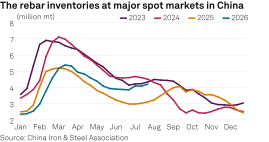
"If production cuts remain inadequate this month, rebar inventories could exceed the levels seen in the past few years," a trader said. "In that case, even when seasonal construction demand improves in late August and September, the high inventory burden would make it difficult for rebar prices to recover meaningfully."
Property downturn
China's domestic rebar demand has remained on a downward trajectory since the property sector entered a prolonged downturn in the second half of 2021.
According to Platts calculations based on official data, domestic rebar demand has fallen further in 2026. In June, rebar demand was 15.05 million mt, down 9.4% year over year and below levels seen in the same period over the past three years. Platts is part of S&P Global Energy.
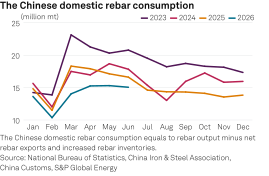
While seasonal factors such as high temperatures and heavy rainfall have weighed on construction activity, the primary drivers of weak construction steel demand remain declining property construction starts and sluggish infrastructure investment, according to market sources Platts spoke to during Aug. 3-5.
The Politburo meeting of China's Communist Party held on July 30 did not announce new stimulus measures targeting the property or infrastructure sectors, further dampening market sentiment.
Without stronger policy support, the property sector still has a long way to go before recovering, and construction steel demand is likely to remain on a downward trend, which will keep pressure on rebar prices in the coming months, according to mill and trading sources and a macroeconomic analyst.
