Metals & Mining, Crude Oil, Natural Gas, Electric Power, Non-Ferrous, Ferrous
August 04, 2026
Secondary aluminum outlook: The implications of proposed EU aluminum scrap export restrictions

By Tom Bennetts
Editor:
HIGHLIGHTS
EU aluminum scrap export decision expected in September
Scrap prices surge 42% from Jan. to June amid supply shocks
Asian demand drains European material supply
Europe's secondary aluminum sector remains deeply split over proposed scrap export restrictions as a September decision by the European Commission (EC) approaches.
While secondary producers argue the measures are essential to secure feedstock, recyclers have long warned the proposal would harm the bloc's competitiveness.
Brussels-based industry association European Aluminium said the EC has delayed proposed targeted restrictions on aluminum scrap exports from an initial end-Q2 2026 timeline to September, extending uncertainty for an industry grappling with high exports and differing views on supply security.
The delay gives more time for the Commission to navigate the contentious debate, but does little to resolve fundamental disagreements about whether Europe faces a genuine scrap shortage.
"While we would have preferred a faster timeline, a short delay does not change the bigger picture: this is a structural issue that Europe needs to solve for the coming years," Kelly Roegies, a spokesperson for the association, told Platts in June.
The policy divide
Secondary aluminum producers and European Aluminium have maintained that export restrictions are necessary to address what they describe as a structural feedstock crisis threatening Europe's secondary aluminum production.
Speaking at the Bureau of International Recycling (BIR) World Recycling Convention in Gothenburg on June 2, Paul Voss, the director general of European Aluminium, said their stance was a "targeted measure" rather than an outright export ban.
"I do think there is a middle way where we can do this in a way that allows our value chain not only to remain intact, but to thrive," Voss said.
The EU's proposed measure has long split the aluminum value chain.
In late May, a consortium of 90 recycling companies and industry associations wrote a letter to European Commissioner Maros Sefcovic and Executive Vice-President Stephane Sejourne.
The signatories said they had "serious concerns" that a policy designed to curb aluminum scrap exports is based on a mistaken assumption of material shortages within the bloc.
At the BIR convention, recycling companies said there was a "mismatch" between EU material needs compared with recycled aluminum scrap volumes.
"Export restrictions on aluminum scrap are the worst option because of a mismatch on what's needed in the EU market and what we recycle," a European recycler said.
Price surges and supply squeezes
The policy debate intensified as European aluminum scrap and alloy prices surged to record levels in the first half of 2026, driven by a confluence of supply shocks and structural market tightness that altered trade flows.
High-grade auto shredded scrap prices, known as Twitch, jumped 42.2% from €1,800/metric ton DDP Germany on January 2 to €2,560/mt on June 11, while 226-grade alloy prices climbed 42.7% from €2,330/mt to a peak of €3,325/mt DDP Germany on June 12.
Both assessments reached their highest levels since Platts launched them in 2024 and 2018, respectively.
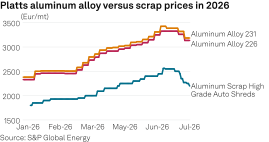
The catalyst came when war erupted in the Middle East in early March, prompting producers Qatalum and Aluminium Bahrain to declare force majeure.
The disruption removed a critical supply artery, as the Middle East accounts for approximately 8% of global aluminum output and 20% of European supply.
Sustained high London Metal Exchange (LME) prices throughout the period sent strong bullish signals to the scrap market, keeping prices firm even when alloy demand was only modestly improving.
The near closure of the Strait of Hormuz suspended much of the oil and gas exports from the Persian Gulf, causing a sharp rise in European energy prices. Some producers reported adding energy surcharges to April and subsequent deals.
Asian competition drains European supply
EU aluminum exports reached approximately 1.27 million metric tons in 2025, Eurostat data showed. For 2026, European Aluminium forecasts volumes will rise another 3% through April, with expected gains of 8% to India, 12% to China, and 15% to Hong Kong.
Asian demand for European aluminum scrap surged through spring 2026 after the Middle East war disrupted Gulf primary supply, forcing buyers to seek substitute feedstock.
According to market participants, scrap sellers prioritized export markets over domestic customers due to higher offers, leaving secondary producers struggling to secure material.
In March 2026 alone, aluminum scrap exports from the EU rose 74.7% year over year, data from S&P Global Market Intelligence's Global Trade Atlas Analytics Suite showed.
Chinese ADC12 prices also surged through the spring, jumping $330/mt in a single week in early March. With buyers forced to seek replacement material due to the impact of the events in the Middle East, prices plateaued through May due to elevated scrap costs.
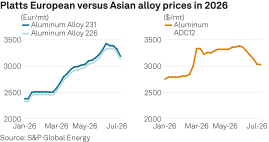
Scrap scarcity in the bloc was amplified by the Middle East war, which simultaneously removed a major source of primary aluminum supply and redirected Asian demand toward European scrap.
Secondary producers in Europe said they were caught between soaring input costs, dwindling raw material availability, and rising energy prices, which pushed both scrap and alloy prices to record levels by June 2026.
Policy chronology
On March 19, 2025, the EC released its Action Plan on Steel and Metals to strengthen the competitiveness of the EU in both sectors.
Alongside reforming steel safeguards, the plan aimed to boost metal circularity within the bloc by setting targets for recycled metal and keeping more material within the continent.
The Commission followed the plan with an announcement on July 23, 2025, that a customs surveillance system had been initiated, designed to record and monitor the movement of ferrous waste and scrap into and out of the bloc.
By November 2025, the EC said it was developing a policy to address scrap outflow with a decision expected by end-Q2 2026, before delaying the measure until September.
Market outlook
After prices peaked in June, both alloy and scrap prices have since fallen gradually, driven by a broader market slowdown ahead of traditional summer shutdowns in Southern Europe, which has reduced overall scrap demand.
"The export market is very weak. Suppliers who are exporting big quantities are now offering us quantities," a scrap buyer said in late July.
Market participants added that die casters are fully booked for both July and August, thus reducing the need for fresh bookings.
As of late July, sources said previous export pressure had dissipated, yet others raised concerns that scrap would remain tight once smelters restart after the August production downturn.
Platts assessed high-grade auto shredded scrap stable at Eur2,200/mt DDP Germany on August 3, while grade-226 alloy prices also held stable in the range Eur2,950-Eur3,020/mt on July 31.
The global supply picture faces additional complications. The United Arab Emirates banned exports of steel, copper, and aluminum scrap on June 10 in a move to secure domestic raw material supplies amid trade disruptions at the Strait of Hormuz, Dubai Customs said June 24.
Following directives from the UAE Ministry of Foreign Trade, the export prohibition will run through October 8.
The ban is expected to hit aluminum scrap markets the hardest, with the UAE's withdrawal from export flows adding pressure to an already strained global supply picture.
Indian buyers, who rely on Gulf Cooperation Council (GCC) nations for approximately 20% of their aluminum scrap intake, are likely to seek alternative sources in Europe and thus intensifying competition for available material in the bloc, René Djibril, director industry and market intelligence at European Aluminium, told Platts in May.
With the EC's measure now expected in September, the outcome will determine whether Europe secures critical feedstock for its secondary production sector or risks undermining its recycling industry amid intensifying global competition for scrap.
