Metals & Mining, Non-Ferrous
June 11, 2026
Aluminum recycling accelerating shift from green initiative to necessity amid tight supply

Editor:
HIGHLIGHTS
Aluminum recycling becoming increasingly important for supply chain security
Scrap aluminum plays key role in alleviating supply tightness amid Middle East war
US, EU trade groups pushing for policies to bolster aluminum recycling sector
Historically tight aluminum supply stemming from disruptions caused by the Middle East war is accelerating demand for recycled aluminum, highlighting its strategic necessity and sustainability benefits.
Supply chain shocks and Iranian strikes at major smelters in the UAE and Bahrainare forecast to reduce 2026 Middle Eastern aluminum production by up to 2 million metric tons, according to S&P Global CERA aluminum analysts. The production loss, along with shipping freezes in the Strait of Hormuz, has forced markets to scramble for alternative supplies. Industry leaders said scrap aluminum is playing a key role as Western nations adapt to looming supply shortages.
"Recycling remains essential from a sustainability perspective — recycled aluminium requires around 95% less energy than primary production and significantly reduces CO2 emissions," a spokesperson for the Brussels-based European Aluminium trade group told Platts, part of S&P Global Energy. "But geopolitical tensions and supply disruptions have highlighted the strategic importance of recycling from an industrial and economic security perspective."
The trade group highlighted rapidly increasing global demand for scrap aluminum amid war-induced supply disruptions in aMay 7 interview with Platts.
"As primary aluminium supply tightens due to disruptions in the Persian Gulf, manufacturers are increasingly turning to scrap and recycled aluminium as alternative inputs," the group said. "This is already increasing global competition for scrap and putting upward pressure on scrap prices and availability."
Recycling for supply resiliency
Experts have compared the trend to similar developments in renewable energy.
"It's early days in this shift," Ross Murdoch, chief sustainability officer at packaging-technology firm Meadow, told Platts in an interview. "It's almost like a delayed version of the reaction to build out renewable energy. There's been a very vocal reaction in the last few months of 'okay, this is why we need renewables, so that we have security of our energy supply,' and we're seeing a similar version happening around material supplies as well."
Murdoch said the significant energy savings in recycling aluminum versus primary aluminum production also reduce a country's exposure to surging energy costs during geopolitical crises.
Emirates Global Aluminium, whose 1.5 million mt/year Al Taweelah smelter in Abu Dhabi was fully shutdown following Iranian strikes in the region, sees recycling as an important part of mitigating impacts from lost supply.
"From EGA's perspective, both in the UAE and North America, recycling is going to strengthen our supply chains, it's going to support our customers through the volatility, it's going to complement our primary production," Jake Skelton, CEO of EGA Americas, told Platts. "That balance is what a resilient aluminum supply chain is going to look like for our customers long term."
US, EU face different recycling challenges
The US aluminum sector has also taken a similar perspective on the importance of scrap aluminum.
"Something the Trump administration is very interested in when we talk about recycling is the supply chain aspects of it," Matt Meenan, vice president of external affairs at the DC-based Aluminum Association trade group, told Platts. "During COVID, there was a realization of 'these supply chains really matter, and we really don't want to be overly reliant on foreign sources for our material.'"
But the US and EU face very different challenges in bolstering domestic recycled aluminum supply chains.
"In Europe, you're looking at a 75% recycling rate for an aluminum can on average," said Murdoch. "Some European countries are up near 99%, and then in the US it's a little below 50%, and that's all consumer behavior."
Despite better consumer recycling rates, European markets are struggling with surging scrap aluminum exports.
The EU's scrap aluminum exports surged 74.7% year over year in March, according to S&P Global Market Intelligence's Global Trade Analytics Suite.
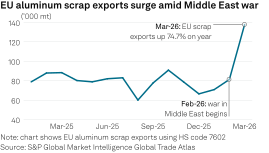
"Europe continues to export large volumes of aluminium scrap, while at the same time, recyclers are facing higher energy costs and growing international competition for feedstock," said European Aluminium.
The US sector is seeing the opposite story and said it is heavily focused on consumer behavior.
"American consumer recycling is broken, and it needs to be fixed," Charles Johnson, president and CEO of the Aluminum Association, told Platts.
Johnson said the trade group has been encouraging the White House and Congress to support policies that bolster consumer metal recycling.
Low recycling rates have been partially offset by a surge in scrap aluminum imports driven by US tariffs that do not apply to scrap.
US scrap aluminum imports rose 24.3% year over year in March, according to GTAS data.
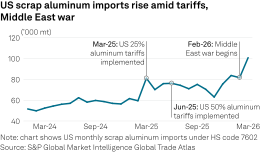
"This is happening because [US] primary aluminum prices are astronomically high right now," Meenan said. "Tariffs are incentivizing the import of scrap to the US."
US primary aluminum prices more than quadrupled in 2025 due to 50% tariffs implemented on primary aluminum imports.
Platts assessed the spot 99.7% P1020 US Aluminum Transaction Premium at 116.90 cents/pound plus LME cash, delivered Midwest, net 30-day payment terms, on June 10.
This assessment, known as the Midwest Premium, has increased nearly fivefold from the start of 2025.
Meenan added that increasing US aluminum can recycling rates is a major challenge and a big focus for the Aluminum Association.
"If I could wave a magic wand tomorrow and get our aluminum recycling right up to 100%, it wouldn't completely fill our metal supply gap, but it would fill a pretty decent chunk of it," said Meenan.
The Aluminum Association in October 2025 called for US export controls on aluminum scrap, especially highlighting the value of retaining used beverage containers.
European Aluminium says it supports targeted scrap export curbs as the EU considers ways to bolster aluminum recycling.
"The wider point is that [export controls] are a signal that policymakers are seeing the importance of keeping material in and keeping it circulating in your own markets," said Murdoch.
Recycling key in aluminum sector's future
Business leaders see recycling as a crucial part of the aluminum industry's future.
"All the major [aluminum producers], minus Rusal, have exposure to recycling," said EGA's Skelton. "Primary [aluminum] is number one for us, but recycling can help us get those additional tons without having to go all the way back to the smelting process."
Skelton added that aluminum end-users are increasingly seeking localized supply chains to reduce exposure to volatile global trade, which may further boost recycling.
"Automotive companies in particular, after this latest disruption, are going to really look toward reshoring their supply," Skelton said. "Now they're going to change their thinking to say, 'well, yes, this is more expensive, but security of supply is more important,' and that's going to be a shift that takes place. It's more economical to invest in more recycling infrastructure. Primary aluminum smelters are massive investments."
