Metals & Mining, Ferrous
July 07, 2026
Malaysia, Japan, Korea steel groups split on EU's new import quotas

Editor:
HIGHLIGHTS
Malaysia group says it's penalized despite moderate exports
Japan's quota cut 50% below recent averages
South Korea gets favorable quota after negotiations
The EU's new steel import quotas drew mixed reactions from steel groups in Malaysia, Japan and South Korea, as industry participants assessed the impact of the new regulation on their access to the European market.
The EU on July 1 set a tariff-free steel import quota of 18.3 million metric tons, aiming to protect the European steel industry from global overcapacity. Half of the quota was allocated to countries with free trade agreements with the EU. The remainder was allocated to all EU trading partners, including the bloc's FTA partners, according to the European Commission.
Any imports outside the quota would face a 50% tariff across all product categories, up from the 25% duty under the previous system, the commission said.
Malaysia's concerns
The Malaysian Iron and Steel Industry Federation, or MISIF, told Platts July 7 that it had "deep concern" over EU's new quotas. MISIF said Malaysian steelmakers are being penalized even though they have not contributed to a surge in imports into the EU.
Despite Malaysia's moderate steel exports to the EU, the country's access to the region will be restricted as it does not have an FTA with the bloc, according to MISIF.
"We have exported responsibly and in moderation, never contributing to the surpluses these measures target," MISIF President Roshan Abdullah said in a statement. "It is therefore of real concern that our producers now find themselves among the most disadvantaged."
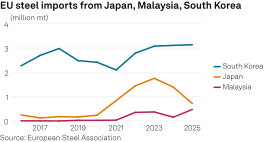
Malaysia exported 474,227 mt of steel products to the EU in 2025, up 205.2% from 155,380 mt in 2024 and 1,280.1% from 34,362 mt in 2021, according to data from the European Steel Association, or Eurofer.
Malaysian steel exports spiked from 2022 to 2024 after several steel producers entered the export market amid market recovery from the coronavirus pandemic. The country's export volumes during those years do not reflect its long-term export potential, according to MISIF.
MISIF called for fair and equitable treatment of Malaysian steel producers amid global measures to curb global steel overcapacity.
Japan threatened by EU quotas
Meanwhile, five steel industry associations in Japan described EU's steel quotas and other safeguard measures as "inappropriate and regrettable," noting that the two parties are FTA partners.
The latest tariff quota for Japan was set at about 800,000 mt, nearly half of EU's yearly average import volumes from Japan of about 1.5 million mt from 2022 to 2024, according to the Japanese steel groups.
"Unfair trade measures taken by the EU have been creating a serious situation that hinders the smooth export of steel products by Japanese companies to the European market and threatening our capacity and contribution to serve customers in the European market," the Japanese steel groups said in a July 1 statement.
The Japan Iron and Steel Federation, Special Steel Association of Japan, Japan Stainless Steel Association, Japan Wire Products Association and Non-Integrated Steel Producers' Association signed the statement, which also urged the Japanese government to continue negotiations with the EU.
Japan shipped 718,619 mt of steel products to the EU in 2025, a 48.4% decline from 1.4 million mt in 2024, according to Eurofer data. Before the drop, Japan's steel imports to the EU surged to an average of 1.5 million mt/year from 2022 to 2024 from 839,067 mt in 2021 and 238,463 mt in 2020, Eurofer data showed.
South Korea welcomes new regime
Meanwhile, the Korea Iron and Steel Association welcomed the favorable quotas that the country secured following successful South Korea-EU negotiations anchored by their FTA.
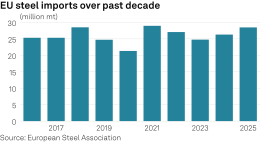
The EU provided South Korea with a dedicated steel quota of 2.073 million mt. While this represented a 19.7% drop from the previous safeguard, it was below the EU-wide drop of about 46% in duty-free imports under the new system, according to a June 30 statement from South Korea's Ministry of Trade, Industry and Energy.
"Our steel industry will be able to maintain existing business relationships in the EU market more stably and secure a predictable export foundation even amid rapidly changing trade conditions," the Korea Iron and Steel Association said in a July 1 statement.
The EU imported 3.1 million mt of steel products from South Korea in 2025, steady year over year but up 49.6% from 2.1 million mt in 2021, according to Eurofer data.
Platts, part of S&P Global Energy, assessed the TSI South European hot-rolled coil, ex-works for southern Europe, at $770.65/mt on July 6, down $1.55/mt from July 3 but up $5.31/mt from June 29.
