Metals & Mining, Non-Ferrous
July 06, 2026
FACTBOX: US expands strategic push into Africa’s critical minerals sector

By Euan Sadden
Editor:
HIGHLIGHTS
Aims to cut reliance on China-dominated supply chains
Approach combines finance, infrastructure, commercial deals
Infrastructure push centers on 1,300-km Lobito corridor
The US has significantly expanded its strategic engagement with Africa's critical minerals industry through a multi-layered approach that combines diplomatic agreements, development finance, infrastructure support and private-sector partnerships. The strategy is aimed at strengthening and diversifying supply chains for minerals essential to batteries, renewable energy technologies and advanced manufacturing, while reducing reliance on supply networks dominated by China.
In Africa, Chinese companies have developed extensive mining and logistics networks across several mineral-rich regions, from Zambia's copper-producing Copperbelt to Zimbabwe's emerging lithium sector. Their model often links geological exploration, mine development, ore extraction, processing capacity, transport infrastructure and export logistics. This has allowed Chinese firms to secure long-term access to mineral supply while offering African governments infrastructure investment, export revenue and industrial development opportunities.
Diplomatic engagement
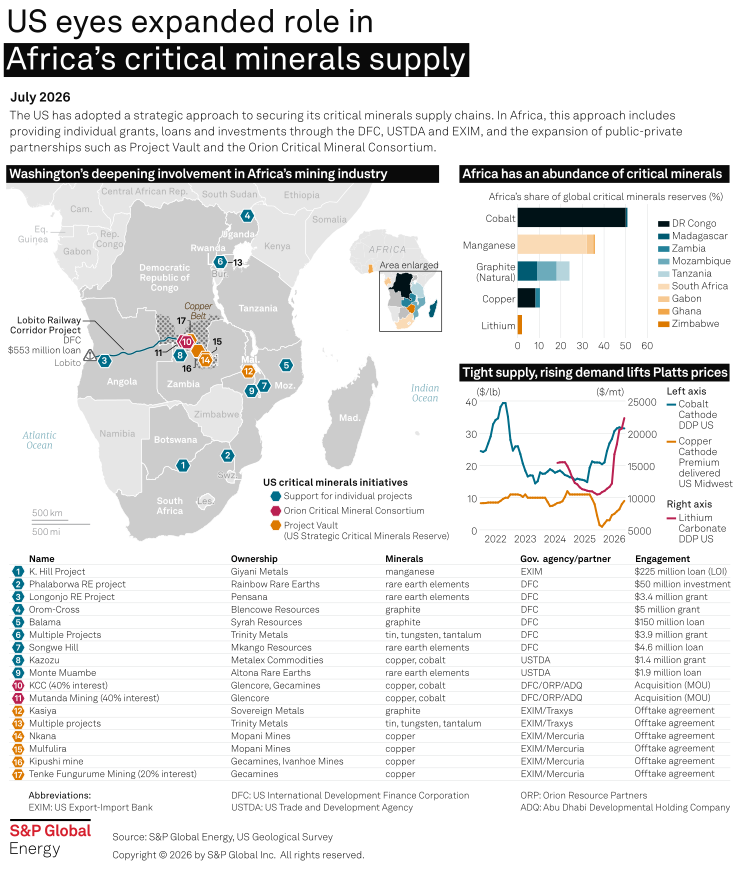
- At the diplomatic level, the US has signed strategic agreements with the Democratic Republic of Congo and Rwanda as part of efforts to integrate African producers more closely into diversified critical minerals supply chains.
- Washington has also established memorandums of understanding with Zambia, Botswana, Mozambique and Angola, focusing on cooperation across mineral production, processing, infrastructure development and trade. These agreements are intended to create a broader framework for investment, technical cooperation and supply-chain coordination.
Project and infrastructure investment
- US development finance institutions are playing a central role in this strategy. The US International Development Finance Corporation and the US Trade and Development Agency are supporting a portfolio of African critical minerals projects intended to expand non-Chinese supply options, encourage private investment and promote greater value addition on the continent.
- Key commitments include a $50 million equity investment in the Phalaborwa rare-earths project in South Africa, a $150 million loan to the Balama graphite project in Mozambique and a $4.6 million loan to the Songwe Hill rare-earths project in Malawi. These investments reflect Washington's effort to support upstream and midstream mineral projects that could feed more diversified supply chains for US and allied markets.
- Infrastructure support is particularly concentrated on the Lobito Corridor, a 1,300-kilometer transport and logistics route designed to connect the Copperbelt region of northern Zambia and southern DR Congo with Angola's Atlantic port of Lobito. Backed by a $553 million DFC loan, the project includes railway rehabilitation, road upgrades and port modernization. For producers of copper, cobalt and other battery metals in Zambia and the DRC, the route could provide an alternative to longer or more congested export corridors, potentially lowering logistics costs and improving supply-chain resilience.
Public-private partnerships
- The US is also leveraging public-private partnerships to secure access to critical minerals and mobilize commercial capital. One major initiative is Project Vault, a $12 billion strategic minerals program supported by the US Export-Import Bank. The program works with global commodities trading firms, including Traxys, Mercuria and Hartree Partners, to help secure critical mineral supplies for US industry. Recent Africa-related developments include Mercuria's $200 million pre-payment agreement for copper from Zambia's Mopani Mines and Traxys' non-binding memorandum to market graphite from Malawi's Kasiya rutile-graphite project.
- Another important initiative is the Orion Critical Mineral Consortium, an investment group led by US investment group Orion Resource Partners in partnership with the DFC and Abu Dhabi-based investment and holding company, ADQ. The consortium aims to develop secure and resilient critical minerals supply chains for the US and allied markets. In February 2025, Orion CMC announced a non-binding memorandum of understanding to acquire a 40% interest in Glencore's DRC mining assets, including Mutanda Mining and Kamoto Copper Company, at a total enterprise value of $9 billion. Glencore currently owns 95% of Mutanda and 75% of Kamoto, with the DRC government and state-owned Gecamines holding the remaining stakes.
- Together, these diplomatic, financial, infrastructure and commercial initiatives reflect a broader US effort to build a stronger foothold in Africa's critical minerals sector. The approach seeks not only to secure access to key minerals, but also to support processing capacity, improve logistics, encourage private investment and create supply chains that are more diversified, resilient and less exposed to geopolitical concentration.
Prices
- The Platts assessment for 99.9% Co alloy-grade cobalt cathode remained at $30-$31/lb delivered, duty-paid US, on July 2, unchanged day over day and week over week.
- The Platts premium for 99.99% copper cathode also remained unchanged for the June 24-30 period at spot COMEX plus 9-10 cents/lb, delivered Midwest.
- Platts assessed the daily CIF US nickel sulfate premium at $2,090/mt on July 2, unchanged day over day and week over week, while the calculated Platts US nickel sulfate price was at $4,049/mt, down $24 day over day.
- Platts assessed daily DDP US battery-grade lithium carbonate at $22,200/mt, July 2, stable on the day and on the week, reflecting standard battery-grade quality, minimum 99.5% Li2CO3, delivered 15-60 days forward.
- Platts assessed daily DDP US battery-grade lithium hydroxide at $21,700/mt, July 2, also unchanged on the day and on the week, reflecting standard battery-grade quality, a minimum of 56.5% LiOH H2O, delivery 15-60 days forward, and a minimum volume of 5 mt.
- On rare earths, the Platts assessment for terbium oxide rose to $4,800/kg CIF North America in June from $4,700/kg in May. The assessments for neodymium-oraseodymium (NdPr) oxide and dysprosium oxide were unchanged at $120/kg and $2,100/kg CIF North America, respectively.