Metals & Mining, Ferrous
June 25, 2026
UK government finalizes country-specific steel safeguard quotas
By Charles Thompson and Riley Waters
Editor:
HIGHLIGHTS
UK cuts steel import quotas by 51% from July
Annual EU HRC quota set at 375,000 mt
The UK's Department for Business and Trade published country-specific steel import safeguard quota levels on June 25.
The measures commencing from July 1, are less restrictive than initially anticipated, marking a 51% overall reduction across all tariff-free steel imports, compared with the previous safeguards. Out of quota material will face a tariff of 50%.
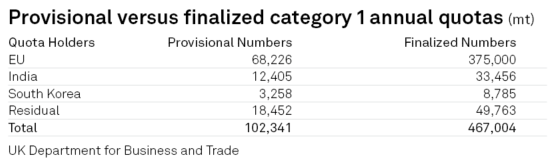
The category 1 hot-rolled coil quotas have been reduced by about 52.9%, with imports from the EU holding an annual quota of 375,000 mt, India a quota of 33,456 mt and South Korea 8,785 mt. Other countries that fall under the Residual moniker hold a total annual quota of 49,763 mt.
For category 1 "authorized use" products, or hot-rolled coils that are further processed upon purchase, there will be a single global quota allocated, with a 40% cap on exports per quarter from any individual country. The total quota differs slightly over the next four quarters, but for July 1 to Sept. 30, it will be set at 595,950mt.
For category 4, metallic-coated sheets, the annual quota levels for the EU have been reduced to 510,273 mt, India to 125,796 mt, and South Korea to 100,753 mt. Vietnam holds a quota of 174,367 mt while the residual category holds a quota of 100,116 mt.
The proposed quota levels were significantly harsher than the new measures, with the EU HRC import quota initially proposed at just 68,226 mt annually.
"We will wait and see now that the quotas are released," one EU-based mill source said, adding, "We expect a flurry of activity as buyers have been holding back from purchasing recently."
The trade measures have been a contentious topic for the steel industry, as industry bodies, including the International Steel Trade Association and members of parliament, have criticized the plans, due to the limited capacity of UK steel makers, and their inability to produce certain grades of steel that face having their quotas slashed.
"I am not too sure how to feel," one trader source said, adding, "It is still not great but there are some considerable changes from the proposal."
During a parliamentary debate on June 17, MP Andrew Griffith, shadow secretary of state for business and trade, called for the measures to be delayed for at least six months, and for certain product categories with defense-related applications to be exempt.
Similarly, market sources cited that it had significantly reduced spot liquidity and buying interest as consumers opted to wait for the measures to be announced or remained hopeful that the quota levels would be changed.
As part of the announcement, the Department for Business and Trade said, "We have allocated country-specific quotas in a way that is designed to make our steel supply chains more secure, including by strengthening UK domestic steel production, while avoiding unnecessary disruption to UK industry and our trading partners."
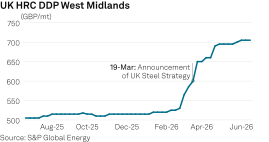
Platts, part of S&P Global Energy, assessed UK HRC at GBP705/mt DDP West Midlands June 18, stable week over week, but up GBP180/mt since the start of the year.
