Coal, Metals & Mining, Metallurgical Coal, Ferrous
June 17, 2026
FERROUS WEEK: China's Mongolian coking coal demand seen higher in 2026 on blending, supply curbs
HIGHLIGHTS
Blending demand drives structural growth
Safety inspections tighten domestic supply
The first part of this Ferrous Series provides an updated visualization of steel decarbonization efforts being undertaken across the Asia-Pacific. The second piece takes a closer look at Japan's green transformation, while the third examines how differing interpretations of carbon accounting have emerged to comply with CBAM. The fourth report looks at Simandou's export ramp-up and its impact on iron ore markets, while the fifth explores how the Mongolia-China coking coal trade has evolved. In the final piece, we interview an executive at coking coal trading company E-Commodities.
China's imports of Mongolian coking coal are set to rise further in 2026, driven by sustained cost advantages, structural blending demand and tightening domestic supply following safety inspections, according to industry analysts.
Mongolian material has emerged as a core component in China's coking coal mix, particularly for inland steel hubs, with volumes to rise from already elevated levels seen in 2025, JinSong Tang, head of coking coal at JSL Global Commodities, said in an interview.
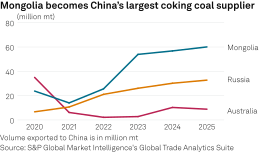
China imported 60.07 million metric tons of Mongolian coking coal in 2025, accounting for China's 51% of annual met coal imports, according to the China Iron & Steel Association.
Import volumes potentially could reach 80 million mt or more in 2026, driven by favorable pricing and compatibility with domestic blending requirements, JinSong said.
Blending demand supports structural growth
Demand for Mongolian coal remains closely tied to its role as a cost-efficient blending component rather than a direct substitute for domestic or seaborne material.
Typically, low in ash and sulfur, Mongolian coking coal is widely blended with higher-sulfur domestic coal, particularly in Shanxi and Hebei, helping coke producers reduce costs while maintaining quality.
Mongolian coal does not directly compete with domestic supply but complements it as a blending component, JinSong said, describing it as a Tier-2 hard coking coal that fits well into Chinese blending strategies.
At the same time, China's second-largest coking coal exporter, Russia, has continued to face many challenges, including a 3% import tariff imposed on Russian coal in 2024.
China and Russia are currently talking about canceling the tax, analysts at the industry body China Coal Transportation & Distribution Association (CCTD) said.
But the Russian coal sector has been facing issues like rising costs, mining bankruptcies, and overseas sanctions, the analysts said.
As a result, Russian coal's price advantage is eroding due to rising costs and logistical issues that arise during winter, pushing Chinese buyers to import Mongolian coal instead, analysts at CCTD said.
A cross-border railway linking Mongolia to China's Ganqimaodu land port by 2027 is expected to reduce shipment times, supporting future Mongolian exports to China, analysts at consultancy Galaxy Futures said.
Once completed, delivery times from Mongolian mines to Chinese mills could fall to about 20 hours from three days, potentially lifting exports to 100 million mt by 2027, they said.
Imports seen surging
China's imports of Mongolian coal have already shown strong growth in 2026.
Over January–April, China imported 26.42 million mt of Mongolian coal, up 68% year over year, with both March and April exceeding 7 million mt, according to customs data.
Chinese mills' daily met coal consumption averaged around 1.56 million mt in the week to May 23, remaining close to the supply of about 1.64 million mt, keeping inventories under pressure, according to analysts.
Market participants said domestic output meets only around 75% of demand, reinforcing reliance on imports.
Mongolian coal mining costs are about Yuan 50-150/mt lower than Shanxi's main coking coal average costs and about Yuan 150-200/mt lower than China's main met coal average costs, according to China-based consultancy GF Futures.
Competitive prices and improved logistics are helping push more Mongolian coal into China.
The daily average of Mongolian coal hauled by trucks to China via the Ganqimaodu land port is expected to exceed 1,400 trucks, analysts at China-based consultancy Tongguan Jinyuan said.
Limited overlap with seaborne supply
Mongolian coal largely serves northern inland markets, while seaborne cargoes, particularly Australian premium hard coking coal, are more widely used by southern coastal mills, limiting direct competition.
Australian supply continues to anchor high-quality blends where coke strength is critical, though higher prices limit usage to performance-driven demand.
As a result, Chinese buyers are expected to maintain a dual sourcing strategy, balancing inland Mongolian supply with seaborne imports based on price spreads, logistics and quality, according to analysts.
Safety inspections tighten domestic supply, lift prices
Domestic supply disruptions following mining accidents have supported near-term prices, prompting stricter safety inspections across key producing regions in China.
A fatal gas explosion at the Liushenyu mine in Changzhi, Shanxi, on May 22 halted operations at the site, which has an annual capacity of 1.2 million mt.
"While the mine's capacity is limited, we expect the incident to trigger stricter inspections, potentially tightening supply in the short term, and supporting CFR prices," analysts at S&P Global Energy CERA said in their latest outlook report.
Following the accident, China's domestic met coal stocks have tightened, analysts at Tongguan Jinyuan said.
Upstream producers are drawing down inventories, while midstream and downstream operators have begun stockpiling, according to the analysts.
Production controls are expected to remain in place for at least two to three months, curbing domestic output and tightening availability, according to JinSong. This has supported both domestic and imported coal prices, with Mongolian cargoes seeing increased demand at the border, he said.
Steel margins, raw material economics
This dynamic has also supported steady import growth even as Chinese mills navigate weak steel margins and shifting demand fundamentals.
Chinese steel mill margins remain mixed heading into the second half of 2026.
Hot-rolled coil margins are relatively stable at around Yuan 150–200/mt, supported by export demand, while rebar margins remain weaker at around Yuan 50/mt amid continued construction sector weakness, JinSong said.
Lower iron ore prices have eased cost pressure, allowing mills to absorb higher coking coal and coke prices, he added.
This is expected to support coking coal demand even as seasonal consumption softens, according to analysts.
