Metals & Mining, Non-Ferrous
June 16, 2026
Aluminum price falls on US-Iran deal but supply normalization to take time: analysts
Editor:
HIGHLIGHTS
Aluminum price drops 11% from 2026 peak
Supply restoration expected to take months
GCC output remains at 62% of prewar levels
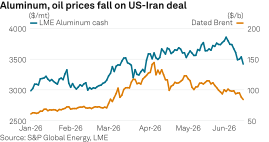
Global aluminum prices fell 11% from their 2026 peak in response to the tentative US-Iran peace deal, but analysts expect supply restoration to take significant time.
The London Metal Exchange spot aluminum price fell to $3,418/mt June 15, the lowest since mid-March, and down from the year-to-date peak of $3,854/mt reached June 2. The LME three-month aluminum contract price fell 4.4% day over day to $3,380/mt June 15 on the deal's potential for normalizing shipments through the Strait of Hormuz, ING said June 16.
"The drop reflects a rapid unwind of the geopolitical risk premium as markets price in the reopening of the Strait of Hormuz and a gradual return of Gulf exports," Ewa Manthey, commodity strategist at ING, told Platts.
Still, analysts said it was too early to provide firm timelines for the Gulf Cooperation Council's aluminum production and shipment normalization.
"Final deal closure, verification, and operational restarts will all introduce significant execution risks," said Fadwa Aouini, metals and mining analyst at Middle East North Africa-focused equity research company AlphaMena.
'Not instantaneous'
Anoop M. Fernandes, SICO Bank vice president for research, said the number of stranded ships, stranded consignments, port congestion, buyer responses and other factors complicate the task of estimating when prewar conditions will return.
However, when commenting on prices, the analysts concur that the immediate opening of Hormuz will likely trigger further downward pressure on the aluminum price.
Fernandes said most commodity prices linked to the GCC region have come off over the past few weeks.
"I'm not sure if the reason is a demand one -- essentially buyers deferring purchases because they were expecting Hormuz issues to be resolved -- or because supply from the region itself had improved on the back of logistical workarounds, or a combination of the two. If it is the former, then Hormuz opening could drive a wave of fresh buying because inventories may have depleted significantly," Fernandes told Platts.
He added that some buyers may want to defer purchases if they believe a deluge of supply could deflate prices.
"We would expect a 5%-10% correction in the first two to four weeks post-deal, with LME aluminum potentially trading toward $2,850-$2,950/mt before stabilizing. This assumes Hormuz opens and shipping resumes within two to three weeks of final deal closure," Aouini said.
AlphaMena projects LME price stabilization at $2,900-$3,050/mt by July-September, reflecting Saudi producer Maaden's increased supply offsetting other producers' outages.
A Maaden spokesperson declined to comment.
AlphaMena said that if Hormuz opens this week and restoration begins immediately, Maaden's shipments could reach prewar pace within four to six weeks, and its export and import logistics to fully normalize within eight weeks.
"Maaden suffered no direct physical damage [from the conflict] and has maintained near-stable [aluminum] production totaling 248,000 mt in Q1 2026, slightly down quarter over quarter but operationally intact," Aouini said, adding that other GCC aluminum producers EGA, Alba, and Qatalum, however, will face a phased recovery, including winding down of their excess inventories built during curtailment.
"Some producers have indicated aggressive production restoration schedules to minimize recovery time, but equipment damage and supply chain constraints mean that normalization will not be instantaneous," he said.
Given that restoration of damaged facilities typically requires three to six months under optimistic conditions, and some historical precedents suggest six to 12 months for full capacity return post-conflict, AlphaMena sees full recovery of Alba, EGA and Qatalum, currently operating at 30%–60% of their capacities, as unlikely before Q4 2026 at earliest.
"If damaged capacity remains offline longer than expected, the aluminum market will likely tighten again in H2 2026, supporting prices in the $3,000–3,200/mt range through year-end," said Aouini.
ING also predicted the physical recovery could lag expectations.
"Restarting aluminium capacity is a slow process, with smelters requiring months rather than weeks to return to normal operating rates. So while the agreement reduces near-term upside risks, it does not eliminate underlying tightness. The market is still expected to remain in deficit this year," Manthey said.
In April, GCC's primary aluminum production fell to 62% of its prewar daily rate. The region accounts for 6%-8% of global primary aluminum output, but supplies 19% of EU primary aluminum imports, 20%-21% of US imports, and 28% of Japan imports.
Asked how even a limited upside in GCC aluminum exports could rebalance the market, analysts also pointed at difficulties with understanding demand.
"Real demand may be forecastable based on GDP, but estimating apparent demand, which is real demand plus change in inventory, and what analyst supply-demand models are based on, becomes really complicated in this environment," said SICO Bank's Fernandes.
"We have no idea of the level of inventory depletion across the manufacturing system and what impact it will have on buyer response once the strait reopens. GDP linked models may find it difficult to capture that, because for the past three months the world has deviated materially from business as usual conditions," he added.
