Metals & Mining, Non-Ferrous
June 12, 2026
INTERVIEW: EQ Resources expanding in Spain, Australia amid tungsten supply crunch

Editor:
HIGHLIGHTS
EQ Resources doubles crushing capacity to 2 mil mt
Tungsten market faces 30,000 mt supply deficit
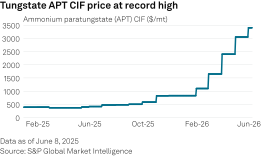
Prices hold at $2,800-$3,180/mtu globally
EQ Resources Ltd. acquired six exploration permits on June 9, next to its Mount Carbine project in Queensland, Australia.
The company approved an A$39 million (US$27.6 million) investment June 3 to double Mount Carbine's crushing capacity from 1 million metric tons/year to 2 million mt/y.
The metal is increasingly in demand following Chinese export restrictions, which have resulted in Western supply chains scrambling for mined material for defense applications, among other uses. Platts, part of S&P Global Energy, spoke to Craig Bradshaw, EQ's managing director, about its position in the tight tungsten market.
Platts: How does your growth trajectory sit within the current macro scene for tungsten?
Craig Bradshaw: We are doubling the crushing capacity of our processing plant for [Mount Carbine], and given we have already got most of the equipment, we expect to have it operational by the end of the third quarter of the financial year 2027. Tungsten is emerging as a strategically important commodity,and there are a number of different projects that people have got that are five to seven years away from production. So, given how tight the market is, I think there is an opportunity for consolidation. It is a matter of what that is going to look like. No one has come and spoken to us directly about anything, but who knows what the future holds?
At this point, we are focusing on our assets and getting them up the curve. We had a market cap of A$80 million in September 2025. So we have come a long way very quickly, but we remain focused on getting our assets up the curve and hitting our aspirational targets of 1,600 mt/y from Spain and 1,750 mt/y from Australia. On the back of current prices, that will generate significant free cash flow. While mergers and acquisitions are interesting, they are secondary to ensuring that our core assets perform at the level they should.
Platts: What is happening in the market to trigger record prices and corporate activity?
Craig Bradshaw: The market deficit, because of the absence of Chinese supplies to the rest of the world, is 30,000 mt. Some projects may take three years if they undergo expedited processes. At the moment, you are still not seeing governments expediting projects or processes and cutting red tape. So in a normal market, you are looking at five to seven years before additional mines come online. So the challenge in the short term is that people are going to look at existing assets with the view that if you are in production and underappreciated by the market, there is potentially an opportunity.
Total global demand is 150,000 mt of WO3 [tungsten trioxide]. Half of that is consumed in China, the other half in the rest of the world. That means demand in the rest of the world is 75,000 mt. Of that, 40% comes from recycled material. That takes 35,000 mt out. Thus, the gap of 40,000 mt is currently required by the rest of the world, and it has to come from primary mine supply, and at the moment, that is sitting around 10,000 mt to 14,000 mt. Therefore, 26,000 mt to 30,000 mt is currently not being fulfilled.
Platts: Do you see prices continuing on their record run?
Craig Bradshaw: Yes. The reason the Chinese domestic price declined was that Chinese companies delivered 2025 production into the 2026 quota. Last year, the government gave them the first quota, but they did not give them the second quota. As a result, they could not continue to sell. So what a lot of the Chinese companies did was continue to produce in 2025. They then closed down for the Lunar New Year. They then sold their 2025 production into the 2026 quota. Some of them have now shut down again because they have fully used their 2026 quota. The price went down to $1,090/mt, then clicked back up to $1,250/mt, and then $1,260/mt. So it has actually turned and started to increase. You are also finding that the Chinese are actively buying US scrap.
Domestic issues, not international ones, drove down the Chinese price. The price in the rest of the world remains around $2,800-$3,180/metric ton unit. The price in the rest of the world is solid. I have got more requests for material than we have got production, and it is going to take us all of the rest of 2026 to get through our backlog of deliveries.