Metals & Mining, Ferrous
June 12, 2026
Canada, Mexico push for steel tariff relief amid USMCA negotiations

Editor:
HIGHLIGHTS
Canada, Mexico look to bolster domestic steel industries
US steel imports drop 34.8% in first quarter of 2026
Trump administration resists tariff removal push
Canada and Mexico, two key US trading partners, are pushing the US to drop its steel tariff by bolstering their domestic industries amid US-Mexico-Canada Agreement negotiations, with leaders from both countries hoping to persuade the US that a free trade zone benefits each country. However, the Trump administration has given Canada and Mexico little reason to believe either will accomplish their goal.
Mexico and Canada have been economically wounded by a 50% US tariff on steel imports, referred to as "Section 232" tariffs for the legislation that authorized them, so both countries have made removing both the steel and aluminum tariffs a top priority in the required 2026 review of the USMCA.
The US is pushing for major changes and threatening to withdraw, while Canada and Mexico are largely pleased with the agreement as is, Patrick Childress, an international trade attorney with Holland & Knight, told Platts, part of S&P Global Energy.
"Given that it's the US government making these demands in the context of the USMCA negotiations, I think it's going to be hard for Mexico and Canada to forcefully introduce demands related to Section 232 as a condition related to the USMCA review," said Childress, a former assistant general counsel at the Office of the US Trade Representative.
Canada defiant
Canada has taken a more pugnacious stance toward the US than Mexico. It supplied 22.7% of US steel imports in 2024, making it the largest foreign steel supplier, according to the US International Trade Administration.
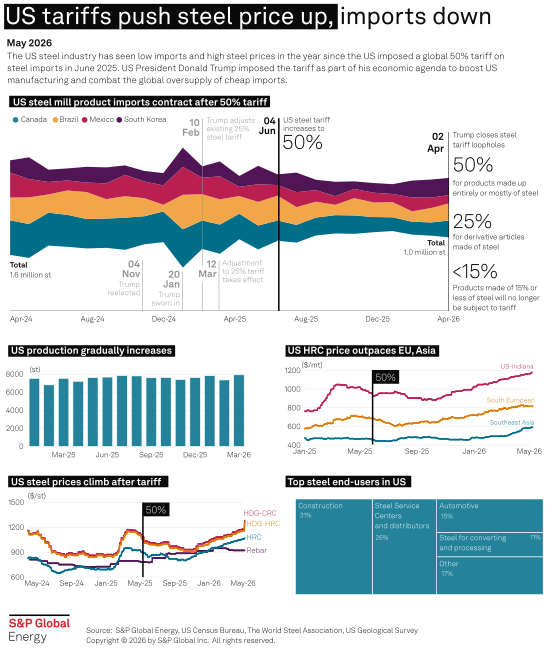
US steel imports have declined overall, with 5.1 million short tons imported in the first quarter of 2026, down 34.8% from 7.8 million st a year earlier, according to US Census data.
Canada initially imposed reciprocal tariffs on the US, but later lifted most measures except for those on steel, aluminum and automotive sectors.
The tariffs have served as a wake-up call on the Canadian economy's dependence on the US, Jessica Horwitz, an international trade attorney at Bennett Jones LLP, told Platts.
"I do think that there is a recognition now that that is a point of vulnerability," Horwitz said.
Since then, leaders have taken steps to support Canadian industries hurt by US tariffs, including a billion-dollar program to strengthen the country's economic resilience.
"Many of our former strengths, based on our close ties to America, have become our weaknesses. Weaknesses that we must correct," Canada's Prime Minister Mark Carney said in an April video address. "Workers in our industries most affected by US tariffs, in autos and steel and lumber, are under threat."
Canada has moved to counter global overcapacity, imposing a 25% surtax on steel imports containing steel melted and poured in China. It also tightened quotas for steel products from non-free trade partners and added 50% tariffs above quota limits. Ottawa extended this policy for another year, as well as tariff relief for eligible US steel products.
Canada has also focused on fortifying trade enforcement mechanisms. Both Canada and Mexico increased the number of antidumping and countervailing investigations in 2026 compared with prior years, according to international trade attorneys.
Mexico, in talks
Mexico has taken a more diplomatic approach, holding multiple talks with the US in which the steel tariff has been a recurring topic.
Before the steel tariff, Mexico was the third-largest steel exporter to the US, shipping 3.5 million st in 2024, or 12.2% of US steel imports, according to the US ITA. Exports have since crashed, dropping 51.7% to 551, 361 st in the first quarter of 2026 compared with the year prior.
Mexican President Claudia Sheinbaum has responded with new "Made-in-Mexico" policies to try to offset lost US demand, which includes the government's partnership with Mexican steelmakers to buy 200,000 metric tons of domestic steel for infrastructure projects.
"It is a historic formal agreement to promote the national steel industry," Sheinbaum said on the day of the agreement.
Mexican lawmakers have imposed new restrictions on imports, including expanding tariffs across 17 sectors on goods from countries that have no free trade agreement with Mexico. The tariffs now range from 10% to 35% on more than 200 steel products.
Mexico has also stepped up enforcement, suspending 750 steel importers in March over alleged irregularities tied to origin rules and trade compliance.
"They have to focus on the Mexican market," said Emilio Arteaga, an international trade attorney in Mexico City. "They can't export to the US, so now they're trying to focus on selling domestically."
US not listening
USMCA priorities for the US include curbing transshipment through Mexico and Canada and increasing the use of North American products.
Deputy US Trade Representative Jeffrey Goettman said on May 12 that the US is seeing steel derivative imports made with cheaper inputs enter the country via its two neighbors—a concern the US hopes to address in USMCA negotiations.
Goettman also said that while the US has opportunities to strengthen the original USMCA agreement, the decision on whether to renew the agreement is up to US President Donald Trump. On June 10, Trump said at a White House event that he "is not looking to renew" the USMCA and that "the US does not need anything that Canada has and anything that Mexico has, but they need everything that we have."
So far, the Trump administration has shown little willingness to ease the steel tariff. US Trade Representative Jamieson Greer reportedly told Mexican industry groups not to expect relief from the USMCA negotiations. The administration was also reportedly seeking concessions from Canada before engaging in formal talks.
"The president, his trade policy has not changed. He's not going to go back to the old situation where we had no tariffs, and we just let foreign goods made by foreign workers come in without any fee, to the detriment of domestic workers," Greer said during testimony to the US House Ways and Means Committee on April 22.
US crude steel production levels over the first three months of 2026 increased by only 5.7% compared with the same period in 2025, according to data from the World Steel Association, an international trade group.
Trump's 50% tariff on steel imports, part of his administration's effort to boost domestic manufacturing, has helped raise US steel prices. Platts assessed the TSI US HRC EXW Indiana at $1,110/short ton on June 8, up 30.6% from $850/st on June 9, 2025.
"Canada and Mexico do not have a lot of negotiating leverage to make these big demands on Section 232 steel and aluminum tariffs," Childress added.
