Metals & Mining, Non-Ferrous
May 19, 2026
Miners flag antimony challenge as Australia explores virtual, physical stockpile

Editor:
HIGHLIGHTS
Miners say storing antimony concentrate proves impractical
China controls majority of antimony smelting capacity
Australia's government is open to its A$1.2 billion critical minerals strategic reserve stockpiling materials virtually or physically, but miners say physically stockpiling the priority commodity antimony could be problematic.
Antimony will be prioritized in the reserve along with rare earths and gallium, all of which have seen export controls from China over the past two years.
France's government is monitoring the reserve, with an eye to potentially creating its own as a "financial mechanism" to incentivize domestic production. However, Australian executives have told Platts, part of S&P Global Energy, that they are unsure whether their government's stockpile will be a physical one.
King's office has now provided some clarity.
"The reserve gives the government a flexible suite of new financial tools to bring new critical minerals projects to market, including offtake arrangements, price support, guarantees, and the ability to stockpile material virtually or physically," a spokesperson for the King told Platts.
The reserve will draw on A$1 billion from the previously expanded A$5 billion Critical Minerals Facility for transactions, according to the Federal Budget. The government is also providing A$150 million for "selective stockpiling of minerals," A$20.4 million to "support the operation of the reserve," and A$2.9 million to "support delivery of Australia's international critical minerals commitments."
Impractical storage
Ron Heeks, managing director of Larvotto Resources Ltd., was unsure whether the reserve would be physical or virtual, but believes a smelter would better suit the needs of Australia's western allies within any stockpile due to the difficulty in storing antimony concentrate.
"You don't want to stockpile concentrate [as] it's going to bleed acid, because it's sulfide concentrate and it's going to turn into a concrete" after a period of time, Heeks told Platts.
Similarly, Nic Earner, managing director and CEO of Alkane Resources Ltd., Australia's only current antimony concentrate producer at Costerfield in Victoria, said: "You wouldn't store a concentrate as it would start to oxidize."
"Were any government wishing to build a stockpile of our style of concentrate, they could. They just have to approach us and place orders. That's no big deal, but concentrate in any form of any metal is not particularly useful without smelting," Earner said.
"In the case of antimony, it's not particularly useful without the downstream technologies and functions in order to turn them into future products."
However, "part of the federal [government's] response has been really trying to understand what the US response is going to be, and then trying to work out whether there's value capture that can occur within Australia," Earner said.
China has the "vast majority" of the world's antimony smelting capacity, Earner said. Therefore, if Australia wants to stockpile antimony concentrate, "it's actually stockpiling something that is unusable by everybody who wants it. They want metal," Heeks said.
The US military wants high-purity trioxide produced from the metal for ammunition primers and night-vision goggles, Heeks said.
"Every high-quality lens in the world has antimony, which is why it goes into solar panels as it clarifies glass and takes out a lot of the microbubbles. So the panel becomes more efficient," Heeks said.
The South Australian and federal governments helped accelerate Nyrstar NV's demonstration plant in Port Pirie, from where the first Australian‑produced commercial-grade antimony metal was shipped in February. While that first shipment will be used by an Australian domestic manufacturer on Australia's east coast, future shipments are destined for export to customers in Europe, Asia or the US, according to Nyrstar.
Nyrstar's Port Pirie multi-metals facility will have the potential capacity to produce up to 5,000 metric tons/year of antimony metal, representing about 15% of the global market and the equivalent of nearly all of US imports in 2023, according to the Belgium-headquartered company.
Smelting challenges
Heeks had previously discussed a smelter with King and told Platts he would "build it tomorrow" if he received confidence in timely federal environmental approvals.
Larvotto's Hillgrove gold-antimony project in New South Wales will start up "about 2.5 months from now," Heeks told a May 13 investor briefing in Perth, Australia. Hillgrove will produce 4,878 mt annually of antimony concentrate over an eight-year mine life, according to its May 2025 definitive feasibility study.
United States Antimony Corp. triedunsuccessfully to acquire Larvotto in October 2025, after securing a US$245 million Pentagon contract in September.
Both Heeks and Earner believe building an antimony smelter would be relatively cheap at sub-A$200 million, though the Alkane executive warned that operating it could be economically prohibitive.
"Labor and power in a smelting facility are two of the largest cost components. So, unless something has either a lot of automation or a lot of scale attached to it, it's difficult to be cost-competitive with Australia," Earner said.
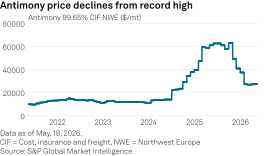
The antimony 99.65% CIF NWE price was US$27,750/mt on May 15, down 56% from its October 2025 record high, according to S&P Global Market Intelligence data.