Metals & Mining, Ferrous
May 11, 2026
India dominates global steel capacity pipeline; coal reliance threatens net-zero target

Editor:
HIGHLIGHTS
India drives 42% of global steel expansion: Global Energy Monitor
Coal-based production threatens net-zero goals
EAFs reach 34% of operating steel fleet
India is leading global growth in steelmaking capacity, accounting for 42% of all planned projects worldwide; however, the country's reliance on coal-based steel production poses a major challenge to achieving industrywide decarbonization targets, according to a Global Energy Monitor report May 11.
India is developing 357 million metric tons/year of new steel capacity, triple that of China's new capacity expansion, the report said.
The South Asian nation now represents 62%, or 212.4 million mt/y, of all basic oxygen furnace capacity under development globally -- a significant increase from a 6% share five years ago, according to the report.
Furthermore, India is responsible for 60% of the global blast furnace capacity in the development pipeline, with 93% of its upcoming ironmaking capacity expected to rely on coal-based technology, the report said.
In 2025, India added 50 million mt/y of new blast furnace capacity without retiring any existing assets, according to the report.
China capacity levels off
China's capacity additions through carbon-intensive means have slowed.
The country accounts for 20%, or 67.6 million mt/y, of developing basic oxygen furnace capacity -- a 4% decrease year over year, the report said.
Over the past year, China's developing blast furnace capacity declined 23 million mt/y, with the country retiring 40 million mt/y of older capacity, according to the report.
EAF momentum, DRI bottlenecks
Globally, the transition toward lower-emission steelmaking is showing incremental progress, with electric arc furnace technology now representing 34%, or 727 million mt/y, of the operating fleet, up from 31% in 2022, the report said.
Electric arc furnaces comprise 50% of all developing steel capacity worldwide and 71% of projects that have broken ground, according to the report.
Direct reduced iron capacity is also set for rapid global expansion, with the potential to increase by 141% if all planned developments move forward, the report said.
However, the shift to direct-reduced iron is hindered by significant supply-side constraints. Direct-reduced iron production depends on high-grade iron ore with an iron content exceeding 67%, which currently represents only about 4% of the global iron ore supply, according to the report.
Additionally, although green hydrogen-based direct-reduced iron is regarded as the most viable pathway to achieving net-zero primary steel production, only about 2%, or 4 million mt/y, of operating DRI capacity currently utilizes green hydrogen as a primary reductant, the report said.
The iron and steel industry accounts for roughly 11% of global CO2 emissions.
Coal-based blast-furnace-basic-oxygen-furnace routes generate about 2.2 mt of CO2/metric ton of steel produced, according to the report.
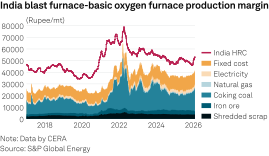
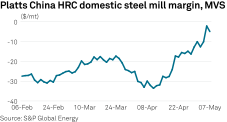
Platts, part of S&P Global Energy, assessed HRC India domestic ex-works Mumbai at $608.56/mt on May 8, down $2.33/mt day over day.