Metals & Mining Theme, Ferrous, Non-Ferrous
January 19, 2026
TRADE REVIEW: Policy uncertainty, global overcapacity to weigh on Asian steel markets in Q1
HIGHLIGHTS
Cautious EU buying sees exports redirected to SE Asia
Indian mills look to shift volumes overseas to manage surplus
Taiwanese mills favor domestic scrap procurement over imports
This report is part of the S&P Global Energy Metals Trade Review series, where we dig through datasets and digest some of the key trends in iron ore, metallurgical coal, copper, alumina, cobalt, lithium, nickel and steel and scrap. We also explore what the next few months could bring, from supply and demand shifts to new arbitrages and quality spread fluctuations.
Asian steel markets are expected to see stiffer export competition pressuring prices as market participants contend with policy uncertainties in the first quarter of 2026, while Taiwanese mills might maintain their preference for domestic scrap due to subdued long steel prices.
Market participants are navigating the implementation of several new policies in Q1, including the enforcement of the EU's Carbon Border Adjustment Mechanism and China's inclusion of steel products in its export licensing management scheme. These have led to a cautious approach among participants in the Asian market, contributing to decreased trading activity amid year-end slowdowns, market sources told Platts, part of S&P Global Energy.
Additionally, the market witnessed further trade protection measures to support domestic industries amid global steel overcapacity, including India's finalization of safeguard duties on non-alloy and alloy steel flat products, and the European Commission's proposal to reduce tariff-free import quotas and increase out-of-quota tariffs.
The proposed safeguard replacements by the EC, paired with additional CBAM-related costs, made importers and buyers hesitant to commit to purchasing externally from the EU, said Paul Bartholomew, associate director of metals and mining analytics at S&P Global Energy CERA.
Market sources said that cargoes originally destined for the EU were redirected to alternative markets such as Southeast Asia and the Middle East.
Additionally, market participants were closely monitoring the impact of China's export licensing requirement on export volumes in Q1. Non-VAT offers have almost disappeared in the export market in Q4 2025 due to uncertainties and risks with the export licensing scheme, according to traders. Whether those offers would make a return in Q1 will largely impact Chinese export prices, said at least five traders.
India targets SE Asia for HRC exports
The Asian hot-rolled coil market is expected to face downward pressure in Q1, as intensifying export competition and tepid demand are likely to continue as headwinds.
Despite sluggish domestic demand in China pressuring steel prices in Q4, import prices in Southeast Asia had fallen faster, partly due to active offerings from mills in India and South Korea, themselves responding to subdued domestic demand.
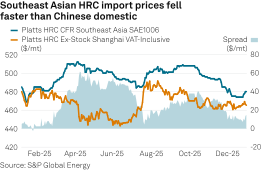
Notably, Indian mills had turned attention to the Southeast Asian market amid intense competition in the Middle East and cautious buying by the EU, according to sources.
The number of heards for deals, offers, bids and indications of Indian HRC reported on a CFR Vietnam basis rose to 143 in Q4, from 20 in Q3, according to spot market data compiled by Platts.
While domestic demand failed to show significant improvement, India's implementation of a safeguard duty on flat products bolstered domestic prices. Platts assessed the spot price of HRC on an ex-works Mumbai basis at Rupees 52,000/mt ($573/mt) on Jan. 16, up 13% from Dec. 1.
Looking ahead, trader sources expect the sustainability of the rally to hinge on the pickup of domestic demand, while mills are expected to step up export activity to manage surplus volumes, keeping Indian export offers active in the Asian market in the near term.
Increased Chinese export volumes pressure rebar prices
Similarly, the rebar market in Singapore is expected to face price pressures in Q1 due to heightened competition from increased Chinese exports aimed at addressing domestic overcapacity.
"The peak of demand in several domestic Chinese sectors, including shipbuilding, construction machinery, high-speed rail, and high-speed trains, has passed. As reliance on exports to alleviate overcapacity continues, it is highly likely that export prices will decline further in the coming year," a Zhejiang-based mill source said.
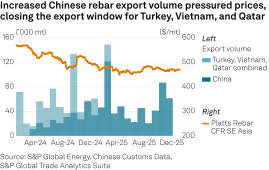
Chinese rebar export volumes to Singapore increased from 266,089 mt in 2024 to a cumulative total of 544,898 mt from January to November 2025, representing a 105% increase, according to Chinese Customs data.
Conversely, Turkey, Vietnam, and Qatar, which accounted for 18.6% of rebar exports to Singapore in 2024, experienced a substantial decline in their export volumes in 2025, now representing only 1.3%, according to S&P Global Market Intelligence's Global Trade Analytics Suite. Market sources in Asia said the decline in rebar prices in Singapore has resulted in the closure of their export opportunities.
Platts assessed the CFR price for 16-32 mm BS4449-grade 500 rebar in Southeast Asia for Q4 2025 at $469/mt, down 7.3% from $506/mt in Q4 2024.
Local traders said that Singapore's limited geographical size could restrict any potential increase in demand. The influx of low-priced products from Chinese steel mills, aiming to capture more market share, is likely to intensify competition, they added.
Taiwanese mills cautious on scrap imports moving into Q1
Likewise, Taiwanese imported ferrous scrap prices are expected to face headwinds in Q1, as market participants remain cautious amid policy uncertainties and subdued demand.
Platts data showed Taiwan's containerized import scrap prices rose slightly to $299/mt CFR Taiwan on Dec. 31 from $297/mt on Oct. 1, driven by seasonal supply tightness and rising Turkish scrap prices.
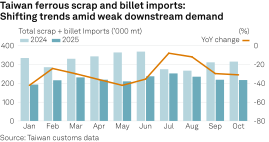
Amid weak downstream demand, Taiwanese buyers favored domestic scrap procurement over imported scrap and billet as a more economical alternative in Q4, and this trend is expected to persist into Q1 this year, weighing on imported scrap demand and prices.
Total scrap and billet imports in October 2025 decreased by 31% year over year, Taiwan customs data showed.
In Bangladesh, scrap market activity remained subdued in early January on limited offers and a wide bid-offer gap, with participants closely watching the upcoming February 2026 elections for greater clarity on the new government's policies and potential impact on the scrap market.

Editor: