Metals & Mining Theme, Non-Ferrous
January 09, 2026
TRADE REVIEW: Asian lithium expected to soften in Q1 amid fading seasonal support

By Louissa Liau
HIGHLIGHTS
Chinese domestic prices rise on GFEX-led momentum, supply-side risk
Seaborne market observes thin liquidity amid slow demand
Spodumene prices firm on tight offers and cautious selling
This report is part of the S&P Global Energy' Metals Trade Review series, where we dig through datasets and digest some of the key trends in iron ore, metallurgical coal, copper, alumina, cobalt, lithium, nickel and steel and scrap. We also explore what the next few months could bring, from supply and demand shifts to new arbitrages, and to quality spread fluctuations.
The Asian lithium market is expected to ease in the first quarter of 2026, as it exits the Q4 seasonal demand peak and sentiment-driven gains unwind.
While prices strengthened in Q4 due to restocking, higher cathode output, and futures-led momentum in China, Q1 lithium prices are expected to depend on the post-Lunar New Year demand in China.
"Lithium-ion battery (LIB) production could quickly slow in January 2026 as orders and production normalize from the peak season and China starts to levy higher PEV purchase taxes," according to an S&P Global Energy report. Despite diverging views on demand for energy storage systems (ESS) into 2026, "the exuberance is excessive", S&P Global Sustainable1 said, expecting much slower growth in LIB ESS installations in 2026, hindered by weaker project economics in China due to the policy overhaul.
Cathode production is expected to decrease by 7%-8% in January 2026 compared to December 2025, according to market sources, as leading LFP cathode producers – including Hunan Yuneng, Wanrun New Energy, Defang Nano, and Anda Technology – announced monthlong maintenance shutdowns starting in late December or early January.
Q4 Chinese lithium prices top Yuan 100,000/mt level
The Chinese lithium market saw a strong rebound in Q4, driven by volatility on the Guangzhou Futures Exchange (GFEX) and supply headlines, rather than physical market fundamentals.
The quarter started slowly due to the Golden Week lull in China in early October, with buying interest remaining muted while converters managed production schedules, focusing on lithium carbonate, which experienced stronger demand amid the increasing market share of lithium-iron-phosphate (LFP).
As downstream restocking resumed amid improved cathode operating rates starting mid-October, lithium carbonate prices began to rise. However, support for the uptrend remained headline-sensitive, with periodic pullbacks on talk of potential supply resumption -- most notably CATL's suspended Jianxiawo lepidolite mine -- followed by rebounds when restarts appeared to be delayed.
The rally grew stronger in December as the market absorbed signals that Jianxiawo's restart would likely take longer than expected, with many expecting it closer to the Lunar New Year. Sentiment was further boosted after news of proposed mining license cancellations in Jiangxi on Dec. 17, which market participants described as sentiment-positive despite limited immediate physical impact on supply.
Platts, part of S&P Global Energy, assessed battery-grade lithium carbonate DDP China hit above the Yuan 100,000 per metric ton mark on Dec. 17, before rising further to its highest in 2025 at Yuan 125,000/mt Dec. 26, up 111.86% from its lowest recorded price of Yuan 59,000/mt June 20, 2018.
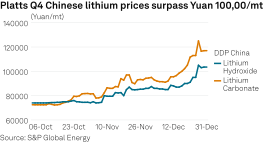
The uptrend ultimately peaked into a year-end correction as the market experienced heavy profit-taking and rapid position closing on the GFEX in the final week. This pulled prices lower, exposing downstream resistance to elevated prices.
Platts assessed battery-grade lithium carbonate at Yuan 139,000/mt DDP China on Jan. 8, down Yuan 1,000/mt day over day but up Yuan 22,000/mt week over week.
Meanwhile, battery-grade lithium hydroxide prices rose along with carbonate prices later in the quarter but remained structurally weaker, due to softer demand from NMC-related sources as most NMC cathode producers' raw material needs were already covered by long-term contracts.
Platts assessed battery-grade lithium hydroxide at Yuan 138,700/mt DDP China on Jan. 8, with market talk indicating muted spot activity and cautious procurement activity.
Seaborne prices track domestic Chinese market
Seaborne CIF North Asia prices broadly tracked China's domestic lithium price trends in Q4. Similarly, in the North Asian market, trading activity was restrained at the beginning of Q4 due to holidays, as well as some South Korean NMC battery factories operating at around 50% capacity amid slow demand.
Further into the quarter, seaborne prices increased, tracking gains in China's domestic market prices. However, North Asian end-user spot activity remained limited, with traders adopting a wait-and-see stance amid overall slow demand for lithium and sensitivity to the GFEX.
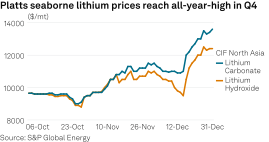
Platts assessed battery-grade lithium carbonate CIF North Asia at $13,600/mt on Dec. 31, the highest in 2025, up 70% from its lowest in 2025 at $8,000/mt on June 25.
CIF North Asia lithium prices softened briefly in December alongside domestic prices before surging into year-end, reaching an all-year high. Platts assessed battery-grade lithium carbonate CIF North Asia at $13,600/mt Dec. 31, the highest in 2025, up 70% from its lowest in 2025 at $8,000/mt June 25.
Spodumene sees support from cautious selling
Spodumene—the primary feedstock for both lithium carbonate and hydroxide—prices remained resilient, tracking the prices of lithium carbonate. Additionally, prices were further supported by cautious selling and tight prompt availability, as sellers held off on offers amid sharp, future-driven swings in lithium carbonate prices.
Platts SpodIX assessment reached $1,705/mt CIF China on Dec. 26, its peak since the assessment was launched on Sept. 1, up 101.8% from $845/mt CIF China on Oct. 1.
With the turn of the year, based on theoretical calculations, and spodumene prices anchored at elevated levels—above $1,500/mt CIF China—lithium converters are likely to face negative margins.
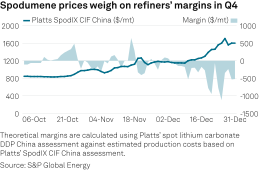
Spodumene concentrate priced at $1,600/mt CIF China Dec. 31 was equivalent to a theoretical production cost of Yuan 120,665/mt for lithium carbonate, according to Platts data. This includes a refining cost of Yuan 19,000/mt, 13% value-added tax and the dollar-yuan exchange rate. On the same day, lithium carbonate on a DDP China basis, was assessed at Yuan 103,500/mt, reflecting a negative Yuan 17,165/mt margin for lithium converters using spodumene purchased in the spot market.
Platts assessed SpodIX at $1,950/mt CIF China on Jan. 8, up $20/mt day over day and $350/mt week over week.
Platts assessed spodumene concentrate with 5.5% lithium oxide content at $1,769/mt CIF China Jan. 8, up $18/mt day over day and $321/mt week over week.
Spodumene concentrate with 6% lithium oxide content was assessed at $1,925/mt FOB Australia Jan. 8, up in tandem with SpodIX.
The 0.1% spodumene concentrate differential, reflecting the value of each 0.1% of lithium oxide for spodumene grades within a range of 5.5%-6%, was assessed at $32.08/mt FOB Australia Jan. 8.

Editor: