Metals & Mining Theme, Non-Ferrous
January 12, 2026
TRADE REVIEW: Tight copper concs supply to keep smelter margins under pressure in Q1

By Lu Han
HIGHLIGHTS
Traders see downward pressure for TC/RCs in Q1 2026 on anticipated demand
Smelters pivot to scrap, blister amid concentrate deficit
Cathode term premiums hit record highs on prevailing copper shortage
This report is part of S&P Global Energy's Metals Trade Review series, where we dig through datasets and digest some of the key trends in iron ore, metallurgical coal, copper, alumina, cobalt, lithium, nickel, steel, and scrap. We also explore what the next few months could bring, from supply and demand shifts to new arbitrages and quality spread fluctuations.
Copper concentrate treatment and refining charges are expected to face continued downward pressure in the first quarter of 2026, as market participants anticipate a pickup in spot activity when major smelters resume restocking for the new year, traders said.
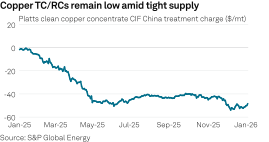
This follows a fourth quarter in 2025 where TC/RCs traded within a narrow range of minus $40/metric ton to minus $45/mt between traders and smelters amid thin spot liquidity during annual contract negotiations.
On the supply side, the Indonesian government's approval for copper exports from the Batu Hijau mine for six months helped partially offset the loss of exports from the Grasberg mine. Increased flows of Chilean-origin copper concentrates into China were also observed in 2025, likely due to reduced imports by Japanese smelters and softer domestic demand in Chile.
Small and mid-sized Chinese smelters were buying more actively in the spot market to secure material for first-quarter production needs, while larger smelters remained on the sidelines due to scheduled maintenance, sufficient feed for December loadings, or a wait-and-see approach during contract talks. In late December 2025, Chilean copper miner Antofagasta and a leading Chinese smelter agreed to zero processing fees for 2026 term copper concentrate contracts.
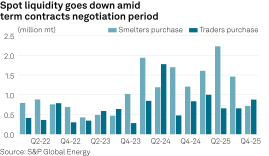
Demand for complex copper concentrates with high arsenic content fell in Q4 2025, as blenders faced a shortage of clean copper concentrates for blending. The December copper concentrate output from Chile's major Collahuasi mine was heard to have an arsenic content above 0.5%, preventing its direct allocation to smelters and temporarily worsening the tight supply of clean copper concentrates.
Platts, part of S&P Global Energy, assessed the CIF China clean copper concentrate treatment charge and refining charge at minus $47.40/mt and minus 4.74 cents/lb, respectively, on Jan. 8.
Looking ahead, an increasing supply of copper concentrates is also expected from road-transported deliveries, including from Rio Tinto's Oyu Tolgoi copper mine and from Russia-origin material, as more output is expected. This added quantity would help offset reduced supply from the Kamoa-Kakula copper mine, where output will be prioritized for Ivanhoe's new copper smelter that started operations on Nov. 21.
On the demand side, new smelter projects commissioned in recent years, including China's Tongjin Jinxin and India's Adani, will continue to add pressure to the spot copper concentrate market. However, if realized, planned production cuts of at least 10% in 2026 by China's top five smelters would reduce copper concentrate consumption.
Long-term contract negotiations for 2026 have been slow as smelters remain undecided about their target production plans for the new year, and gaps between bids and offers remain wide.
Smelters seek alternatives to copper conc
Amid concerns over production losses from extended negative TC/RCs and a likely supply deficit in 2026, smelters have become more open to purchasing gold concentrates and pyrites, while actively sourcing secondary materials to boost output.
Japan's Mitsubishi Materials announced a plan to cut its reliance on copper concentrates by using more scrap, driven by low TC/RCs.
China's CNMC International Trading and Jiangxi Copper reached an agreement on the CIF import blister copper refining charge benchmark at $85/mt for 2026 term contracts, down from $95/mt in 2025.
More transactions for pyrites and gold concentrates, including term contracts for 2026 loading, were also observed in the Chinese market as smelters looked to use more substitutes due to the copper concentrate shortage. Sulfuric acid prices hit a record high in 2025, reaching $121/mt on Dec. 24, up 142% year over year, supported by strong demand, unexpected production disruptions from smelters, and tight copper concentrates, according to Pan Yuya, a sulfur analyst at S&P Global Energy.
Pyrites is typically priced based on gold payables only, and the payable can vary due to impurity content, according to buyers and sellers.
Copper cathode term premiums peak
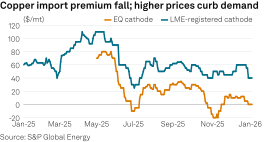
Import premiums for copper cathodes delivered to China remained sluggish in Q4 2025, as high copper prices led to subdued demand despite term contract offers hitting a record high. Surging term contract offers were driven by an arbitrage opportunity to the US, an expected supply shortage in Asia, and concerns over production cuts due to the copper concentrate shortage.
Codelco offered $350/mt to Chinese buyers for 2026 term contracts on a CIF basis.
Freeport-McMoRan plans to restore large-scale production at its Grasberg copper and gold mine in Indonesia by the second quarter of 2026, following a flooding incident on Sept. 8, which could help to increase regional cathode supply from Q2 2026.
However, spot demand might be hindered by elevated copper prices, sluggish end-user demand, and limited import interest from traders, according to market sources.
Platts assessed copper cathode import premium at $45/mt CIF Shanghai on Jan. 8.
In 2026, Chinese smelters are eyeing an increase in copper cathode exports to offset import losses, attracted by higher export premiums compared to the domestic market. Term contracts were offered at $280/mt from Chinese smelters to Southeast Asian buyers on a CIF basis, while domestic premiums were offered above the Yuan 200/mt level.

Editor: