Metals & Mining Theme, Non-Ferrous
January 13, 2026
TRADE REVIEW: Asian cobalt market to stay supported in Q1 on DRC Congo shipment delays
By Leah Chen and Marco Loke
HIGHLIGHTS
Export hurdles tighten supply, pushing cobalt prices up
First DRC shipment arrival unlikely before mid-March: source
Refiners turn to cobalt metal as alternative feedstock for cobalt salt
This report is part of the S&P Global Energy's Metals Trade Review series, where we dig through datasets and digest some of the key trends in iron ore, metallurgical coal, copper, alumina, cobalt, lithium, nickel and steel and scrap. We also explore what the next few months could bring, from supply and demand shifts to new arbitrages and quality spread fluctuations.
The Asian cobalt market is expected to remain supported in the first quarter of 2026, with prices continuing to rise amid persistent supply bottlenecks caused by export delays in the Democratic Republic of Congo -- the world's largest cobalt producer -- following the lifting of the export ban on Oct. 16, according to several China-based producers, traders and end-users.
The market is expected to shift to an 11,000-metric-ton cobalt deficit in 2026, from a projected surplus of 21,000 mt for 2025, according to analysts at S&P Global Energy CERA.
DRC cobalt export delays tighten supply
Shipment delays stemming from administrative hurdles related to the DRC's implementation of new export procedures, as well as processing backlogs, have resulted in cobalt export volumes originally allocated for shipment through Dec. 31, 2025 being carried over into 2026, several China-based market sources said.
Despite this, export volumes for 2026 and 2027 are expected to be 48% below 2024 levels, according to analysts at S&P Global Energy CERA.
The DRC's Authority for the Regulation and Control of Strategic Mineral Substances Markets replaced the export ban with a quota system on Sept. 21, 2025, allowing miners to ship 18,125 mt of cobalt metal for the remainder of 2025 and up to 96,600 mt/year in 2026 and 2027.
However, the US-brokered peace deal between the DRC and Rwanda to secure mineral supplies, including cobalt, may complicate export quota enforcement and divert cobalt feedstocks away from China, potentially widening price gaps between Chinese and non-Chinese markets, said Alice Yu, principal analyst at S&P Global Energy CERA.
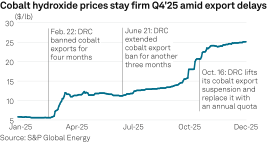
Platts, part of S&P Global Energy, assessed 30% Co cobalt hydroxide CIF China at $25.60/lb on Jan. 12, up about 357% from $5.60/lb on Feb. 21, before the DRC imposed the export ban to curb oversupply and support historically low cobalt hydroxide prices.
"Even if the materials are shipped out, the earliest they can reach China is mid-March 2026," a Chinese cobalt trader said, adding that they remain bullish on the near-term price outlook and expect cobalt hydroxide prices to stay supported even after the first shipment leaves the DRC due to the lengthy transit time.
Another Chinese cobalt trader estimated that if global demand remains stable at about 58,300 mt over the next three and a half months, inventory outside the DRC will not be sufficient to meet demand.
Weak battery demand caps cobalt sulfate prices
Cobalt sulfate prices are expected to remain supported in Q1 amid continued tightness in cobalt hydroxide supply, a third Chinese cobalt trader said. However, upside potential may be limited by persistent weakness in demand for nickel-manganese-cobalt batteries.
Tight supply of cobalt hydroxide -- a key feedstock for cobalt sulfate production -- put upward pressure on cobalt sulfate prices throughout Q4. Platts assessed cobalt sulfate at Yuan 94,300/mt DDP China ($12,500/mt) on Jan. 12, up 40.75% since the start of Q4.
Still, sluggish demand from the NMC battery sector capped cobalt sulfate price growth. While China's electric vehicle sales continued to rise in November -- after surpassing 50% of total vehicle sales for the first time in October -- the market is expected to shift away from cobalt-bearing NMC batteries in 2025 due to technological improvements in lithium-iron phosphate batteries.
China's NMC battery production totaled 36.4 GWh in November, accounting for just 21% of the battery market, down 11% year over year, data from the China Automotive Battery Innovation Alliance showed. Cobalt-free LFP batteries dominated the market with a 79% share in China, limiting incremental demand for cobalt sulfate -- a key feedstock for NMC battery production -- despite strong overall EV sales.
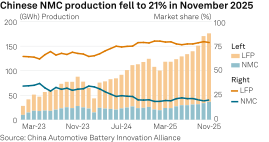
Additionally, the recent surge in demand for battery packs in energy storage systems -- including solar farms and behind-the-meter installations -- has largely focused on LFP chemistry, thanks to its lower cost and longer lifespan, a Japanese cobalt trader said.
"There are still deals for cobalt sulfate, but buyers are using it for cobalt tetroxide production rather than for NMC battery applications," a Chinese cathode producer said.
Cobalt metal as alternative feedstock for cobalt salt
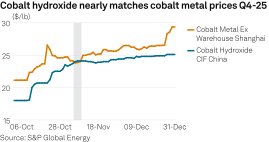
To buffer the cobalt hydroxide supply shortage, a Meishan-based cobaltrefiner said some producers are turning to alternative feedstocks such as cobalt metal -- priced nearly at parity with cobalt hydroxide in Q4 -- to produce downstream cobalt salts like cobalt sulfate and cobalt tetroxide.
Platts assessed cobalt hydroxide at $24/lb on Nov. 5, surpassing the 99.95% Co cobalt metal assessment of Yuan 372,000/mt ex-works Shanghai, equivalent to $23.80/lb, for the first time.
Although cobalt metal resumed trading at a premium over cobalt hydroxide thereafter, the price gap between the two remained narrow at $1-$2/lb throughout Q4, widening to $3.90/lb on Jan. 12, Platts data showed.
"We usually procure cobalt sulfate on a spot basis, but [2026's] quota is less than half of [2025's] production volume, so we have to secure feedstocks through other means," the cathode producer said. "We are requesting offers through various channels and making multiple purchases."
"There isn't much cobalt sulfate available in the spot market. Most transactions involve cobalt metal," the second Chinese trader said, adding that the metal is converted to cobalt sulfate by adding sulfuric acid. The cathode producer agreed that cobalt sulfate produced from melting cobalt metal is of high quality due to its low impurity levels.
Strong demand for cobalt metal has tightened supply, with a major producer sold out through Q1 and able to offer new deliveries only from Q2 onward, a North Asia-based cobalt salt producer said. Meanwhile, output of cobalt salts made from cobalt metal has reached 2,000 mt/month, the first Chinese trader said, reflecting robust demand.

Editor: