Natural Gas, LNG
June 15, 2026
European gas market sees welcome but limited relief amid looming US-Iran deal

By Matt Hoisch
Editor:
HIGHLIGHTS
US, Iran set to ink agreement June 19
EU gas storage fill remains key concern
‘We are not out of the woods yet’: analyst
The announcement of a deal between the US and Iran to halt hostilities and reopen traffic through the Strait of Hormuz offers welcome but limited immediate relief to European natural gas and LNG markets amid logistical hurdles and persistent geopolitical uncertainty, market watchers said June 15.
Iran and the US have agreed to sign a preliminary deal in Switzerland on June 19 that could suspend attacks around the strait, according to statements from both Iranian and US officials. However, a formal text has yet to be released, leaving many analysts circumspect.
"There is a lot to achieve before we are in a stable situation," said Anne-Sophie Corbeau, a research scholar with Columbia University's Center on Global Energy Policy.
While a deal could alleviate the virtual halt to maritime traffic through the strait that has strangled global trade since the start of the war in late February, there are also other shorter and longer-term challenges.
Qatari LNG capacity is expected to take two to three months to ramp up after Hormuz flows resume, analysts with JP Morgan said in a note on June 11, before the US-Iran deal was announced.
Some supply impacts will persist longer. In particular, Qatar lost some 17% of its LNG export capacity in Iranian attacks in March. QatarEnergy expects it will take three to five years to repair the damage.
"Generally, if there's an agreement, it means that we're going to have more supply and prices are going to go down," Cypriot energy minister Michael Damianos told Platts in an interview on June 15. Cyprus holds the rotating EU Council Presidency until the end of June.
"It's going to put down prices [but] it's not going to go down to the level that it was before the war."
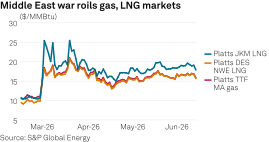
The July 2026 Dutch TTF gas price was trading at Eur42.525/megawatt-hour as of 1513 GMT on June 15, down some 9.1% from June 12, according to data from the Intercontinental Exchange.
The easing still leaves the index higher than the recent lows reached in mid-April, when Platts assessed the month-ahead TTF benchmark at Eur38.735/MWh amid earlier promising signs of US-Iran discussions.
Gas storage
Even if Hormuz flows resume, gas stocking remains a key concern for Europe, which has struggled to fill storage sites in recent months amid unfavorable summer-winter spreads that have sapped the economic incentive for market players to build stores ahead of the heating season.
Aldo Spanjer, head of commodity strategy at BNP Paribas, attributed the relatively tempered intraday TTF drop on June 15 to an understanding among market participants that storage is "the real problem" as long as the spread dynamics stymie stocking.
"I still don't have a summer-winter spread," he said. "Without the summer-winter spread, you just don't build, and then you stay strong. So I think it's a relatively correct reaction."
An analyst with a major LNG buyer also stressed that storage remains a central concern for the continent.
"Europe storage is still low, so it all depends upon how quickly Middle Eastern supply can ramp up, and that depends on logistics and how many vessels can go through [Hormuz and] by when," the analyst said.
EU gas storage was filled to 44.3% as of June 13, according to the latest data from Gas Infrastructure Europe. At the same points in 2025 and 2024, stocks were filled to 53.0% and 72.7%, respectively.
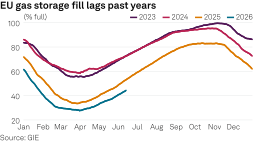
S&P Global Energy CERA analysts project European gas storage will reach 78% full by the end of October if voyages through Hormuz steadily resume from early August. This is slightly short of a revised target of 80% advocated by EU Energy Commissioner Dan Jorgensen amid the recent trade disruptions, but above a theoretical minimum of 75% allowed under the EU's latest gas storage regulation.
"Europe will need to price above Asian markets through Q3 2026 to attract sufficient marginal cargoes, particularly from the US and West Africa," said Dominic Simmons, senior principal gas analyst for CERA. "Any return of Qatari and UAE LNG volumes ahead of our August restart case would free up more Atlantic basin cargoes than we expected in our forecast, allowing greater than expected storage fill in Europe."
The analyst with a major LNG buyer projects EU gas storage will reach 76% full by Nov. 1 if Hormuz traffic ramps up "very soon."
BNP Paribas's Spanjer projects an 80% fill by November but added it would make a difference if stocking is spurred by market drivers or government requirements.
Government-mandated filling "will happen later, it will be quite expensive, but it will get you the molecules," he said.
Europe can 'still manage'
The US-Iran deal, if successful, would come just in time for Europe to "still manage" this winter, Spanjer said. With EU storage 80% full, he projects European gas prices peak around Eur40-45/MWh in Q1 2027.
"I don't like my winter prices, but it's not excessively high," he said. "Eur40/MWh is not great; it's also not a disaster."
One India-bound LNG tanker crossed the strait out of the Persian Gulf early June 15 in the hours after the US-Iran deal was announced. But headwinds to more robust trade persist, with an executive at one major shipowners' organization warning June 15 that transits through the strait remain "very risky."
While the announcement of a US-Iran deal is widely seen as a step in the right direction, market watchers remain vigilant for further details and assurances that the pending agreement can in fact cement a lasting end to the conflict beyond the expected June 19 signing.
"I don't think we are out of the woods yet," Columbia's Corbeau said.
