Natural Gas, LNG
June 11, 2026
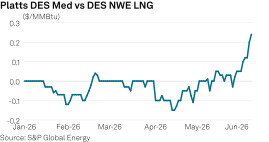
LNG NWE at the widest discount to Med in seven years
Editor:
HIGHLIGHTS
Strength of regional gas hubs contributing to discount
Higher shipping costs drive Med premium
Med LNG May monthly imports fall 25% on year
The discount between Northwest Europe LNG prices and the Mediterranean marker reached the widest level on June 10 seen since July 2019, underpinned by higher shipping costs and firmer Southern European hub premiums, which continued to support Med pricing.
Platts, part of S&P Global Energy, assessed the DES NW Europe marker for July at $16.91/million British thermal unit June 10, at a discount of 4 cents/MMBtu to the July TTF hub futures price.
On the same day, Platts assessed the Mediterranean marker at $17.150/MMBtu, leaving NWE at a 24-cent discount to Med, the widest seen since a 25-cent discount on July 11, 2019.
The Platts Mediterranean marker reflects pricing across Southern Spain, Portugal, Southern France, and Western Italy.
Buoyant shipping costs
An Atlantic-based trader said that the Mediterranean premium "makes sense due to extra shipping [costs]" required to reach the region.
Platts assessed the LNG Atlantic carrier day rate for two-stroke ships at $105,000/day June 10.
Shipping rates in the Atlantic Basin have remained relatively elevated compared to levels before the Middle East war. However, the same market participant said increased demand was not contributing to the premium versus NWE in the region.
Strong gas hub vs TTF spreads
Another factor behind the rise in Mediterranean prices has been the strength of regional gas hubs, which signaled a firmer Southern European market structure.
Platts assessed the Spanish PVB July contract at Eur49.850/megawatt-hour June 10, a 54.50-euro cent premium to the French PEG July contract.
At the same time, Platts assessed the Italian PSV July contract at Eur52.195/MWh, a Eur2.145/MWh premium to the Dutch TTF July contract. That PSV-TTF spread has averaged Eur2.278/MWh since the start of the month.
Some traders believe the resilience in Southern European hubs has stood in contrast to Spain's relatively comfortable supply picture.
"It's interesting because there is quite a lot of buying interest for prompt and Q3, and tanks are far from being empty," a TVB trader said. "I feel like the LNG market is holding and stressing these high prices in Spain because there is no demand [there]."
Enagas data showed LNG inventory tanks in Spain at 81% capacity June 10, with stocks in Bilbao registering the fullest at 94%, closely followed by Cartagena at 90%. In comparison, Spanish LNG tank levels stood at 75% on the same day in 2025.
Broader gas storage indicators painted a similar picture. Spanish gas stocks stood at 26.10 terawatt-hours, equivalent to 72.85%, June 9, according to the latest Aggregated Gas Storage. This registered just a 0.33 percentage point deficit year over year, versus a much wider EU shortfall of 8.6 percentage points.
Med LNG imports down
Lower LNG imports to the Mediterranean region have reflected softer demand requirements. Average LNG deliveries to Spain were at 382.9 million cubic meters/day June 1-9, down 15% year over year, S&P Global Energy CERA data showed.
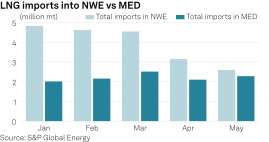
In May 2026, the Mediterranean imported 2.28 million mt of LNG into the region, according to CERA data, down about 25% year over year.
Imports into Southern Spain and Southern France were particularly lower year over year, CERA data showed. Imports into Southern Spain fell to 79,000 mt in May from 1 million mt a year ago, while imports into Southern France declined to 50,000 mt from 86,000 mt in May 2025.
By comparison, Platts data showed NWE imports were up year over year to 2.59 million mt in May 2026 from 2.48 million mt in the same month in 2025.
LNG traders estimated that competition between Asia and the Atlantic Basin has not yet peaked.
An Atlantic-based trader suggested that August could be a pressure point. With demand in the Mediterranean remaining relatively stable, Med prices may remain elevated to attract cargoes into the region.
Mediterranean gas storage remained steady, with Portugal 86.9% full and Spain at 72.9%, according to Aggregated Gas Storage Inventory data June 9.
However, the region's LNG demand could change quickly, due to the small storage capacity of countries such as Spain.
Spain's technical underground gas storage capacity stood at 35.83 TWh, far below that of larger markets such as Germany with 247.75 TWh and Italy with 203.42 TWh. Total EU storage capacity amounts to 1,131.46 TWh.
"Expectations are Q3 will be tight in the Med, you can see it from TVB levels currently," an LNG trader said.
"The Med buyers are sitting on the sidelines but it's getting tighter day by day."
