Natural Gas, LNG
June 04, 2026
Open arbitrage economics, narrow LNG-gas spreads sap NW Europe liquidity

Editor:
HIGHLIGHTS
Narrow LNG-TTF spreads cut liquidity
Europe LNG imports fall 8% year over year
Traders divert cargoes to premium markets
Liquidity across the Northwest European LNG markets has taken a hit due to narrow LNG-gas economics and stronger global competition for cargoes, traders said.
Since the onset of the war in the Middle East, about 20% of global LNG flows from the Middle East have been cut. As a result of the supply loss, pockets of demand destruction have emerged across the global LNG and natural gas markets as countries seek cheaper alternatives to meet domestic demand.
Despite Europe entering its injection season, the pace of gas injections into underground storage has been sluggish, as a flat-to-backwardated forward curve and narrow LNG-TTF spreads have provided little incentive for buying in Europe.
While Europe typically imports LNG and pipeline gas to fill its underground storage stocks over the summer ahead of the winter heating season, the curtailment of global LNG supply has led to shifts in trading activity in Northwest Europe.
With arbitrage to Asia and other premium-demand epicenters open, LNG-TTF spreads in Europe have strengthened, making cargoes attractive.
Platts assessed the DES Northwest Europe marker for July at $16.643/million British thermal unit June 3, up 46.4 cents/MMBtu day over day and at a 4-cent discount to the July TTF hub futures price. The LNG-TTF spread of minus 4 cents was the strongest differential seen since the plus 50 cents/MMBtu seen March 2, the day after the Middle East war started.
The current LNG-TTF spreads are making it uneconomical to import LNG into Northwest Europe. Typically, LNG prices are at a discount to domestic gas prices, as buyers must cover additional logistics costs, such as regasification, storage, unloading, and grid injection.
In Northwest Europe, the breakeven for terminals is about 20-30 cents when only variable costs are considered, traders said. This means that the LNG-TTF spreads have to be at least minus 20 to 30 cents to incentivize buying activity in Northwest Europe, traders said.
As a result, bids and offers in Northwest Europe, as well as trades and tradable values, have seen varying spreads as traders shift strategies and manage their portfolios.
On one side of the market, traders with shipping and portfolio flexibility have been diverting cargoes to Asia or other premium destination markets, such as Turkey, Greece, and Egypt.
In May and so far in June, data from S&P Global Energy CERA shows several Atlantic diversions to premium destination hubs, with traders diverting their Atlantic volumes to those hubs.
| Diversion date | Vessel | Pre-diversion port, country | Post-diversion market | Final import market |
| 05/08/2026 | Umm Al Hanaya | Brunsbüttel, Germany | China | Tongyeong, South Korea |
| 04/15/2026 | BW Pavillion Aranda | Gate, the Netherlands | Turkey | Turkey |
| 04/04/2026 | LNG Finima II | Dunkirk, France | India | Dahej, India |
| 04/15/2026 | Wilpride | Ravenna, Italy | Egypt | Damietta, Egypt |
| 04/07/2026 | MOL Azure | Brazil | Bangladesh | Moheskhali, Bangladesh |
These traders have been paying a premium relative to other European regas capacity holders, as they can cancel or offload their slots and divert their cargoes to reap the rewards of premium markets.
While some offers in the market are at a premium to TTF for July, other sellers are still offering TTF minus 10 cents for DES NW Europe, traders said. Additionally, there are bids at flat to TTF to minus 10, while there are also bids about minus 30 to minus 40 cents, traders added.
"Some are still bidding bigger discounts to make importing viable, but with an open arbitrage and where JKM is versus Europe, most sellers will not sell at a discount to TTF right now," an LNG trader said. "Some are trying to cover their own costs while others are bidding higher to fill a short, so the wide gap in sentiment and tight spreads is taking away liquidity."
On the other side of the market, downstream companies in Europe have kept their bids relatively wide as they look to cover their regas economics. These players have still seen their bids at relatively decent discounts to gas hub prices, enabling them to manage their downstream portfolio.
"Liquidity has taken a hit... If you can't cover your costs at the terminal, then you will cancel your slot and divert the cargo elsewhere," a second trader said. "Unless you are trading DES-DES or have a short, then you won't pay up these premiums we hear; you'd need to cover those variable costs at the terminals in Europe."
As a result of the varying sentiment across Northwest Europe, liquidity has slowed, as trading houses and portfolio players manage their supply positions through diversions or downstream companies in Europe look to backfill their positions with pipeline gas.
LNG imports into Europe totaled 9.48 million metric tons in May, down about 8% year over year. Additionally, month-over-month European imports fell about 4.6% from the 9.94 million mt imported in April, according to CERA data.
In May, European LNG utilization was 44%, down 2% month over month and 4% year over year. Utilization peaked in February at 64%, but regasification utilization fell by 18% from February to April, CERA data showed.
Summer liquidity picks up
Traders expect European liquidity to improve as the need for storage injections incentivizes LNG purchases.
"I think at one point Europe will realize how much LNG it needs and how short we really are. Whatever the spreads and contango or backwardation may be, we will need to buy to fill storage," a third trader said. "Either a contango has to form, TTF has to spike, or DES NWE has to rally to stay attractive for cargoes over that peak-period."
Europe is competing with Asia for West African and US flexible cargoes as global importers seek to replace lost volumes amid the ongoing war.
Platts, part of S&P Global Energy, assessed the July JKM at $19.011/million British thermal unit June 3, placing the spread between JKM and Northwest Europe at a 2.368/MMBtu premium.
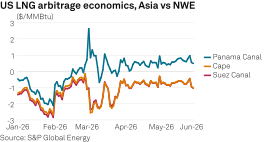
Platts assessed the US LNG arbitrage from North Asia through the Panama Canal at 48.5 cents/MMBtu, which was the lowest since May 12, when Platts assessed the arbitrage at 41.2 cents/MMBtu.
CERA forecasts that Europe, including the UK and Turkey, will import 57.16 million mt over the typical April-September summer-injection cycle, up from 55.69 million mt in the same period a year ago.
Notably, CERA forecasts Europe to import 40.47 million mt in the fourth quarter, which would be the highest quarterly imports on record to date and exceed the 35.45 million mt imported in Q4 2025.
