Natural Gas, LNG
June 04, 2026
Investment funds' net-long position in TTF gas futures softens in May: ICE
By Geraint Moody and Phoebe Davies
Editor:
HIGHLIGHTS
Falling net long positions reveals more optimistic geopolitical picture
Investment fund risk appetite weaker amid heavier paper losses
LNG demand to rise in summer as cross-basin competition intensifies
Overall net positions for investment funds slid notably at the end of May, as players in both the European natural gas and LNG markets continue to digest the uncertainty around a peace deal between the US and Iran.
Combined long and short positions held for Dutch TTF gas futures among investment funds have dropped 11% over the last three weeks of May, as market players trimmed down long positions and boosted short ones, according to the latest Commitment of Trader report from the Intercontinental Exchange.
Investment funds' total net position for the Dutch TTF gas futures for the week ended May 29 totaled 262 million lots, or 262 terawatt-hours (TWh), having fallen from a recent high of 295 million lots in the week ending May 15.
Long positions for investment funds in the span of those three weeks fell nearly 6% from 427 TWh to 402 TWh. On the other side, short positions increased nearly 7% from 131 TWh to 140 TWh.
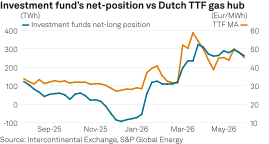
Price levels have since rebounded, with Platts assessing the front-month contract at Eur49.04/MWh on June 3.
The fairly consistent decline in net long positions suggests market players are increasingly focused on peace negotiations between the US and Iran, with recent agreed ceasefires providing some optimism about the possibility of reopening the Strait of Hormuz.
"Positioning data for TTF continues to show that investment funds have been somewhat unfazed by ongoing LNG supply disruptions in the Middle East amid optimism over a resumption of LNG flows through the Strait of Hormuz." Warren Patterson, head of commodities strategy, and Ewa Manthey, commodities strategist at ING, said in a June 4 note.
However, the reduction in what is already a large net long position indicates that market players' risk appetite has weakened somewhat from years previous, with recent declines in the paper market causing players to take less aggressive positions, sources said.
"Investment Funds have been suffering a lot this year, they got caught on their 2027 shorts during [the] January squeeze," an LNG trader said. "Maybe their risk appetite has decreased, they are still very long but more cautious it seems."
At the same time, some market participants have said that much of the recent movement in investment funds' positions has been closely aligned with headline reactions and moved in tandem with the bullish and bearish sentiment following the Middle East conflict, rather than reflecting true physical market fundamentals.
"[The fall in long positions was a] bit of headline fatigue, I guess," another LNG trader said. "There is no clear trend, people are confused as to what is coming next."
Looking ahead, despite overall net long positions falling, market fundamentals point toward a continued bullish outlook in the LNG and gas markets, with geopolitical uncertainty compounded by rising LNG demand in the Atlantic and Pacific basins likely providing upward support to prices.
During the summer, the Pacific and Atlantic regions typically see stronger demand for LNG, as the former region secures volumes to combat warmer temperatures for cooling and the latter aims to boost domestic gas storage levels ahead of the next winter season.
"The market is still generally positioned for higher gas prices," Arne Lohmann Rasmussen, chief analyst at Global Risk Management, said in a June 4 note.
"Clearly, [existing net long positions] leaves a fair amount of upside risk if we do not see an imminent resumption of LNG flows," Manthey and Patterson said.
This view can be more clearly observed in positions in commercial undertakings, which saw overall net long positions increase 105% from the week ended May 15 to the week ended May 29.
Platts assessed the DES Northwest Europe marker for July at $16.643/million British thermal unit (MMBtu) on June 3, up 46.40 cents/MMBtu day over day, at a discount of 4 cents/MMBtu to the July TTF hub futures price.
