Fertilizers, Chemicals, Energy Transition, Renewables, Emissions, Hydrogen
December 23, 2025
COMMODITIES 2026: Refineries lead European green hydrogen drive

HIGHLIGHTS
Steel, ammonia await firm policy frameworks
Refining, ammonia incumbent hydrogen industries
First industrial-scale projects starting up in Europe
This is part of the COMMODITIES 2026 series, where our reporters bring to you key themes that will drive commodities markets in 2026.
European refineries are emerging as the dominant force in the region's green hydrogen project pipeline, capitalizing on supportive legislation while steel producers and other promising sectors for low-carbon hydrogen use await clearer policy frameworks.
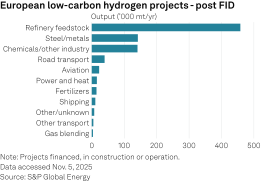
A total of 860,000 metric tons/year of low-carbon hydrogen production capacity had taken positive final investment decisions in Europe as of Nov. 5, with many more poised to do so in 2026, according to S&P Global Sustainable1 data.
Perhaps unsurprisingly, as one of the main incumbent hydrogen consumers, the refining sector is by far the largest offtaker for renewable hydrogen project FIDs in Europe, accounting for over half of all projects financed, in construction or operational, Sustainable1 data showed.
Refining accounts for around 60% of current hydrogen demand in Europe, or around 4.8 million metric tons/year in 2025, the data showed.
The refining sector has policy tailwinds supporting it, with major refiners such as Shell investing in large-scale hydrogen projects at their facilities.
It is also to be expected that sectors in which hydrogen use for decarbonization is novel should be slower to adopt the gas as an energy transition tool.
But that only tells half the story, as ammonia, which accounts for 20% of the incumbent market -- representing around 2 million mt/year according to the European Hydrogen Observatory -- has lagged in green hydrogen projects.
Fertilizer projects are listed as offtakers for just 1.7% of post-FID low-carbon hydrogen projects in Europe, behind steel, chemicals, road transport, power, and heat applications, Sustainable1 data showed.
The reasons come down partly to policy decisions, or lack thereof, and partly to wider dynamics in the ammonia market.
The European ammonia industry took a hit following Russia's full-scale military invasion of Ukraine in 2022, which sent feedstock natural gas prices soaring.
Many European ammonia production plants shut down or were mothballed in the aftermath, with some international operators focusing attention and investment overseas.
The high costs of switching to renewable hydrogen supply for the European industrial sector, together with a lack of national legislation, are threatening the EU's climate and energy goals and risking a collapse of the fertilizer sector in the region, industry representatives said at the European Hydrogen Week conference in Brussels, Belgium, earlier in 2025.
The EU requires the industrial sector to source 42% of its hydrogen consumption from renewable sources from 2030 under the revised Renewable Energy Directive, though few member states have transposed the requirements into national legislation.
At the same time, the EU faces a shortfall in its regulatory green hydrogen demand under its REDIII renewable fuels of non-biological origin rules of 40% by 2030, accounting for around 1.1 million mt of hydrogen, according to industry group Hydrogen Europe. The industrial sector accounts for much of the production gap, with refining coming under transport targets.
Enertrag CTO Tobias Bischof-Niemz said the phase-out of free EU Emissions Trading System CO2 allowances out to 2034 had delayed decisions by fertilizer producers on capital investment in new plants or decarbonization projects, with no short-term incentive and an unclear regulatory outlook.
Steel producers considering decarbonization via hydrogen similarly face high capex costs, fierce international competition, and decisions over whether to invest in Europe or overseas.
Green hydrogen producers also face higher costs from 2028 with the planned implementation of strict EU rules requiring green hydrogen production to match new renewable power generation, and hourly matching requirements from 2030.
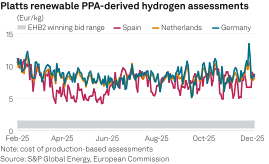
Industry leaders say a rule change could cut costs by Eur2/kg. Platts, part of S&P Global Energy, assessed EU-compliant green hydrogen production costs in Spain at an average of Eur7.49/kg in the year to Dec. 22.
Concrete progress
Despite multiple high-profile project cancellations throughout 2025, committed capital in the sector is rising exponentially, and there is a steady stream of FID announcements for industrial-scale projects.
RWE has just started up a 100-MW green hydrogen plant in Lingen, Germany, Europe's largest electrolyzer to date, with several other projects in construction of a similar scale, adding to 490 MW of operational capacity in Europe.
Industry group the Hydrogen Council estimates green hydrogen demand could reach 5 million mt/year in Europe by 2030 if existing policies are fully implemented. Hydrogen Europe sees regulation-driven demand reaching just 2.8 million mt/year as things stand.
Policy and subsidy announcements in 2026 could bring the market more certainty.
The EU's third European Hydrogen Bank auction closes in February, with winners announced in the spring, funding up to Eur1.3 billion ($1.5 billion) through fixed premium subsidies over 10 years. Germany will provide an additional Eur1.3 billion, while Spain will contribute up to Eur415 million.
In the UK, the government will announce winners of the second electrolytic hydrogen allocation round and open applications for a third round.
Pipeline network developments will also be critical, with several national and international projects underway. Germany has completed the first sections of its national hydrogen grid, and the first Dutch pipeline section is due to start operations in April.

Editor: