Energy Transition, Hydrogen
December 22, 2025
RWE commissioning Europe’s largest green hydrogen plant in Germany

HIGHLIGHTS
100-MW electrolyzer to start commercial operations in 2026
Full 300-MW capacity expected in 2027 for pipeline network
Facility to supply TotalEnergies' Leuna refinery via pipeline
RWE has started commissioning Europe's largest renewable hydrogen plant in Lingen, Germany, the company told Platts, part of S&P Global Energy, on Dec. 22.
The 100-MW electrolyzer is the first part of the 300-MW GET H2 Nukleus project, and will supply hydrogen to TotalEnergies' Leuna refinery in Germany.
"The commissioning process for the first 100 MW of the electrolysis plant in Lingen (GET H2 Nukleus) is underway," a company spokesperson said by email.
The RWE spokesperson said the first phase would start commercial operation in 2026.
The plant will be the largest operational facility on the continent to date, almost double the capacity of the current largest facility.
BASF started up its 54-MW proton exchange membrane electrolyzer in Ludwigshafen, also in Germany, in March.
Several other electrolyzers in the 100-MW range are in construction, and RWE is aiming to start up the full 300 MW of capacity at Lingen in 2027.
In March, RWE signed a 15-year deal with TotalEnergies to supply the eastern German Leuna site with 30,000 mt/year of green hydrogen, starting in 2030.
The hydrogen will be transported via a 600-km pipeline to the refinery, where it will be used to displace conventional fossil fuel-derived hydrogen in fuel production processes.
The pipeline is part of the German core hydrogen grid, which is under construction.
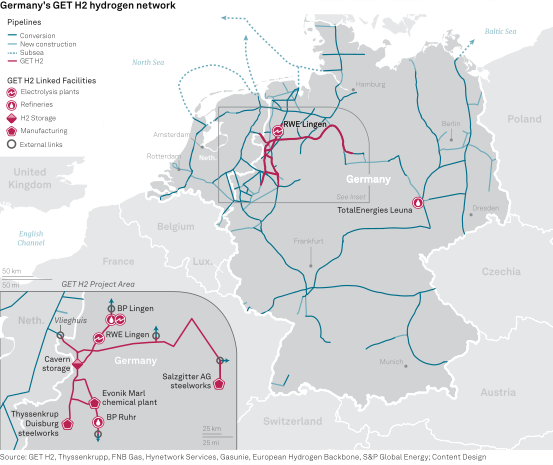
To reliably supply the contractually agreed hydrogen even when there is little sun and wind, RWE will use booked capacities of the hydrogen storage facility in Gronau-Epe, which will be put into operation in 2027, the company said previously.
"The maturity of both the GET H2 Nucleus in Lingen and the hydrogen storage in Epe enabled us to negotiate a 15-year offtake agreement with TotalEnergies," RWE's Generation's Chief Operating Officer Hydrogen, Sopna Sury, told Platts previously.
The company ordered long-lead items for the project and started preparatory work ahead of funding commitments from the government, enabling it to move early, Sury said in emailed comments.
RWE ordered the first two 100-MW PEM electrolysis plants from Linde/ITM power in 2022, with a third 100-MW alkaline electrolyzer from German manufacturer Sunfire.
Platts assessed the cost of EU-compliant green hydrogen production via alkaline electrolysis in Germany, backed by renewable power purchase agreements, at Eur7.54/kg ($8.86/kg) on Dec. 19.

Editor: