Energy Transition, Natural Gas, LNG, Crude Oil, Hydrogen
September 11, 2026 · Updated September 14, 2026
INTERVIEW: Hydrogen in 'different light' as Middle East war prompts structural shift: Jemelkova
By Takeo Kumagai and Ruchira Singh
Editor:
HIGHLIGHTS
Middle East crisis costs importers more than $100B
Energy security drives over 60% of clean hydrogen investment
Europe, India, East Asia have hydrogen frameworks
Hydrogen and its derivatives are being viewed in a "different light" as the conflict in the Middle East and shipping disruptions in the Strait of Hormuz prompt a structural shift, Ivana Jemelkova, CEO of the Hydrogen Council, told Platts, part of S&P Global Energy.
"The lesson here is that long-term resilience needs a structural shift," Jemelkova said in a written interview following the launch of the Hydrogen Council's Global Hydrogen Compass 2026 report on Sept. 10.
"Just two months of the energy crisis triggered by the conflict in the Middle East have cost importing countries in Asia and Europe more than $100 billion," she said. "Many of those countries now view hydrogen and its derivatives in a different light — as a solution for energy security and competitiveness alongside decarbonization."
The Global Hydrogen Compass 2026 report was launched on the sidelines of the Global High-Level Symposium on Hydrogen and Ammonia and the Japan-hosted 8th Hydrogen Energy Ministerial Meeting at Makuhari Messe, on the outskirts of Tokyo, in collaboration with H2 & FC EXPO (International Hydrogen & Fuel Cell Expo) — one of the world's largest hydrogen-related exhibitions.
The Hydrogen Energy Ministerial Meeting and the Global High-Level Symposium on Hydrogen and Ammonia take place as the Middle East conflict has disrupted not only oil and LNG shipments through the Strait of Hormuz but also trade in hydrogen-based products.
In the case of Japan, Jemelkova said its proposed public-private investment road map, published in June, outlined $2.3 trillion (¥370 trillion) in investment and earmarked $38 billion (¥6.2 trillion) for hydrogen and its derivatives through fiscal year 2040-41 (April-March).
"The road map frames hydrogen deployment in terms of economic security and resilience, as well as the opportunity to export Japanese technologies to global markets," she said.
Referring to the CEO sentiment survey published in the latest Global Hydrogen Compass report, Jemelkova said executives across the value chain believe recent energy crises, combined with rising power demand from rapid electrification and new industrial loads, have fundamentally reshaped their strategic priorities.
"Clean molecules have become a geopolitical insurance policy, with hydrogen valued for energy security, resilience and industrial growth as well as for its role as a decarbonization lever. 64% of CEOs told us that recent energy shocks had increased their interest in hydrogen," she said.
The shift is most visible in heavily import-dependent regions such as India, Europe and East Asia, where hydrogen is increasingly viewed as a necessary pathway to long-term energy diversification, she added.
Investment climate
When asked whether the Strait of Hormuz crisis would accelerate hydrogen investment, Jemelkova said that more than 60% of committed global clean hydrogen investment is currently in regions where energy security and industrial growth match or exceed decarbonization as the primary driver.
"Whether the current crisis translates into a boost to further long-term investment in the sector is a question of policy certainty and follow-through on binding demand-side measures actually being implemented," she said.
The investment picture shows both sides of this, Jemelkova said, adding that cumulative committed clean hydrogen investment has reached $130 billion, up from $110 billion a year ago, with a further $5 billion committed to projects scheduled to begin commercial operations after 2030.
"Year-over-year growth in committed investment for projects due by 2030 has moderated to about 20%, against an average of roughly 45% since 2021," Jemelkova said, adding that earlier-stage activity is picking up again after the 2024-2025 reset, with front-end engineering design (FEED)-stage investment up 50% on 2025.
Geographically, the capital is becoming more concentrated. North America and China account for 72% of committed capacity, up from about 70% a year ago, and represent most of the net additions, she said.
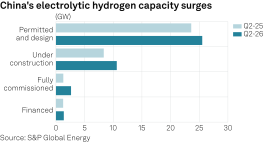
"They are getting there by different routes. China holds about 55% of committed renewable capacity, driven by domestic supply projects and larger average project sizes, and has set a target of at least 2 Mtpa [million tons per annum] of renewable hydrogen production by 2030," Jemelkova said.
North America holds 80% of committed low-carbon capacity and has led overall growth since 2025, expanding from 2.2 million tons/year to 2.9 million tons/year, she added.
"Both of those are policy stories. China's growth rests on a national production target and the 15th Five-Year Plan; North America's on fiscal support that made low-carbon hydrogen bankable," Jemelkova said. "Europe shows what happens when demand policy is actually enforced: committed investment grew 35% this year, supported by the transposition of RED III transport targets in several Member States."
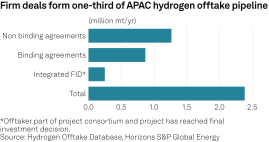
"That is also where the gap is: 6 Mtpa of 2030 demand is already backed by policies in force, and 4.2 Mtpa of that is under binding offtake," she said, adding that another 5 million tons/year could materialize if existing policies were fully implemented, with the RED III industry targets being the obvious example.
"The regions that felt Hormuz hardest, Europe, India and East Asia, have the frameworks. Timing and execution will dictate whether that second 5 Mtpa arrives by 2030 or not," Jemelkova said. "The acceleration they are looking for will come when legislative frameworks are turned into binding demand-side measures and delivered on schedule."