Agriculture, Refined Products, Biofuels, Fuel Oil, Diesel-Gasoil
September 09, 2026
Higher RED III compliance costs divert bunker demand from Rotterdam
Editor:
HIGHLIGHTS
HSFO, VLSFO and MGO Rotterdam-Hamburg spread widens to 5-month high
ZRE-Advanced prices rise 138% from July 27-Sept. 8
Compliance costs erode Dutch bunkering hub competitiveness
Rising costs associated with complying with the EU's Renewable Energy Directive, or RED III, are pushing bunker demand away from Rotterdam toward competing Northwest European ports.
The rising cost of compliance is tied to a recent price rally for Dutch compliance units, known as ZRE-Advanced tickets. These tickets are derived from advanced marine biodiesel blends used to meet RED III maritime blending obligations.
Traders have warned that the escalating compliance costs are making the Dutch bunkering hub increasingly uncompetitive for conventional marine fuels.
They are adding a significant cost burden to conventional bunker stems lifted in Rotterdam, prompting buyers to reroute demand to ports including Hamburg and Antwerp, where bunker suppliers are currently not obligated under RED III mandates.
"The [ZRE-Advanced] ticket price has gone up. It's possible we try to book as much as possible in Belgium. The higher RED III is killing us," a trader said.
A second trader corroborated that "RED III is scaring a lot of people away," adding that the charges were particularly affecting demand for high-sulfur fuel oil HSFO.
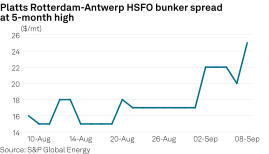
Platts, part of S&P Global Energy, assessed the premium of delivered HSFO, VLSFO and MGO bunker in Rotterdam to Antwerp at $25/mt Sept. 8, a five-month high, compared with $17/mt on Sept. 1.
The Netherlands implemented RED III as of Jan. 1, 2026, while implementation in Belgium has been delayed, and Germany has opted not to impose the requirements on bunker suppliers serving international shipping.
ZRE-Advanced Tickets
On Sep. 8 Platts assessed the ZRE-A current year price at 27.10 euro cent/kgCO2e, up 137.72% from July 27.
Between June 2 and July 27, the price was rangebound between 10.40-11.40-euro cent/kgCO2e.
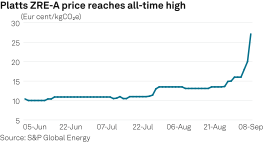
Market participants have attributed the price spike to uncertainty over the volume of ZRE-A tickets required to meet RED III obligations in the Dutch bunker market, limited visibility over actual blending activity and fuel consumption, and fresh demand from bunker suppliers and new accounts.
"If I speak to bunker suppliers, I get the feeling there's not enough being blended, and they are all a bit worried," one Dutch source said. "The problem is no one knows the obligation; they don't know how much is consumed. Bunker suppliers won't tell market participants if they're blending enough, or the amount they are consuming – it's a bit of a black box."
Other sources said the rally may have been amplified by new buyers entering a relatively thin market, rather than by a clear shortage of ZRE-Advanced tickets.
"I think some bunkering companies are starting to buy up ZREs," another Dutch source said.
Regulatory misalignment between FuelEU and RED III
Shipowners are obligated under FuelEU, but this has not yet stimulated demand for physical biodiesel volumes supplied in Rotterdam. This could be due to a multitude of compliance pathways available to shipowners, including bio-LNG, pooling, and biofuel volumes lifted elsewhere.
"There is no demand for biofuels [in the Netherlands] from ship owners, so no ZRE is being generated," a Netherlands-based broker said.
Fuel suppliers in the Netherlands are obligated under RED III to achieve a 2.9% reduction in greenhouse gas emissions from the fossil fuel pool supplied to the market. Given the absence of demand from shipowners for physical biofuel volumes, Dutch fuel suppliers have not been blending sufficient physical biodiesel, thereby generating less ZRE-As.
As a result, obligated parties that lack physical biofuel blending infrastructure are seeking to meet compliance by buying ZRE-As. This means there is greater demand on ZRE-As, amid thin supply.
"There are also a limited number of companies that are able to blend biofuels," the broker continued, underlining that not all fuel suppliers possess biofuel blending infrastructure.
Market sources also reported that some fuel suppliers have sold volumes of conventional fuel oil without procuring the corresponding compliance units.
"I think there is not much blending being done [...] people sold [conventional bunkers] without buying ZREs, so they now have to buy before Q1 2027," a Netherlands-based bio-bunker supplier said, outlining their view that ZRE-A prices could remain supported by continued demand for RED III compliance.
The surge in ZRE-A prices directly increases the RED III compliance costs for conventional fuel suppliers in the Netherlands, in turn prompting some demand to shift to ports in neighboring countries.
According to the Platts RED III compliance calculator, the associated theoretical ZRE-A ticket cost to make one metric ton of MGO and VLSFO compliant on Sept. 8 was $36.69/mt and $34.80/mt, respectively.
