Energy Transition, LNG, Crude Oil, Refined Products, Hydrogen
September 10, 2026
Global hydrogen capacity boosts as energy security drives investment: Hydrogen Council
By Takeo Kumagai and Ruchira Singh
Editor:
HIGHLIGHTS
Operational capacity up 70% to 1.7 million mt/y
Hormuz disruptions reshape hydrogen strategy
India's ammonia supply faces acute Hormuz risk
Stable execution of existing policy needs priority
Global low-carbon hydrogen project capacity has increased to 6.9 million metric tons/year and committed investments amount to $130 billion, the Hydrogen Council said Sept. 10, amid changing dynamics of hydrogen drivers.
The operational capacity grew 70% to about 1.7 million mt/y and is projected to reach about 3.8 million mt/y in 2027 as projects under construction come online, the Hydrogen Council said in its Global Hydrogen Compass 2026 report.
The report — co-authored with McKinsey & Co. — noted that the drivers of hydrogen uptake are shifting as energy security, resilience and industrial growth have gained importance alongside decarbonization.
"The conversation has shifted from sustainability targets to immediate industrial resilience – governments now see hydrogen as a strategic solution to protect their industrial base from external shocks," said François Jackow, CEO, Air Liquide, and also the co-chair of the Hydrogen Council.
The combination of drivers varies by geography, with over 60% of committed investment in regions where security and growth match or exceed decarbonization as primary motivations, according to the report.
The Global Hydrogen Compass 2026 was launched on the sidelines of the Global High-Level Symposium on Hydrogen and Ammonia and the Japan-hosted 8th Hydrogen Energy Ministerial Meeting at Makuhari Messe in collaboration with H2 & FC EXPO (International Hydrogen & Fuel Cell Expo) — one of the world's largest hydrogen-related exhibitions — on the outskirts of Tokyo.
The Hydrogen Energy Ministerial Meeting and the Global High-Level Symposium on Hydrogen and Ammonia take place at a time when the Middle East conflict has not only disrupted oil and LNG shipping via the Strait of Hormuz but also affected hydrogen-based products.
Hormuz impact
Localized clean hydrogen and derivative production could enable import-dependent markets to diversify energy and feedstock supply and develop strategic reserves, according to the Global Hydrogen Compass 2026.
By providing alternative sourcing for agricultural and industrial bases, these solutions may reduce supply chain and critical mineral dependencies while shielding food and fuel systems from price spikes and shortages, the report added.
"Under the current global landscape, energy security and industrial competitiveness have become increasingly critical drivers for the large-scale deployment of hydrogen," Koji Sato, vice chairman at Toyota Motor Corp., said.
The resilience challenge is not purely import dependence, but even more so the concentration risk regarding the routing of supply, according to the report.
Among several key global trade arteries, the Strait of Hormuz is the clearest example, given its role in about one-quarter of global seaborne oil trade and significant LNG and fertilizer-related flows.
For markets like India, this creates a direct food system vulnerability, as 80% of India's ammonia demand relies on imported ammonia or natural gas, 40% of which passes through the Strait of Hormuz, according to the report.
Recent disruptions have already shifted sourcing strategies from lowest-cost procurement toward resilience, diversification and domestic supply options, strengthening the strategic case for clean hydrogen and its derivatives.
India is seeking to mitigate disruptions from exposure to such volatility by supporting additional domestic renewable ammonia supply within a more stable cost range, thereby partially insulating the import-exposed country.
Investments grow
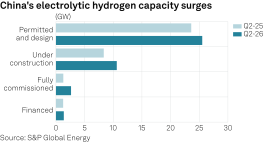
China leads on renewable hydrogen, accounting for over half of global committed capacity and the majority of new operational renewable capacity since 2025, the report said.
"China's deliberate shift toward electrification, where hydrogen is an extension of the renewable power system, is reflected in the country accounting for the largest share of committed hydrogen investment at $44.5 billion, of which about $12 billion advanced to final investment decision over the past year," it said.
Europe is the second-largest economy by committed investments and leads in the overall project count. Investments grew 35% year over year in Europe, supported by the transposition of RED III transport targets, while the US continues to lead in low-carbon deployment, making up over 75% of committed low-carbon capacity globally, according to the report.
In Japan and South Korea, with limited domestic production capacity but ambitious decarbonization targets and acute interest in bolstering energy security, hydrogen investment is focused largely on distribution and end use, the report said.
A renewed focus on sourcing domestic clean hydrogen is also emerging, although long-term ecosystem scaling likely depends on a combination of local production with securing imported molecules and building the import and trade infrastructure to land them, including via an emerging liquid hydrogen value chain, it added.
Hydrogen has shifted from "vision to execution as the project pipeline continues to mature and rationalize," the report said.
It also points out that deploying hydrogen and building an end-to-end value chain requires its own playbook distinct from the deployment model for renewables.
Stable execution of existing policy, even more so than new regulatory design, is the highest priority to firm the potential demand, it added.