Natural Gas, LNG, Energy Transition, Electric Power, Emissions, Hydrogen, Renewables
September 09, 2026
'Not the moment for complacency' on European gas storage: Eurogas

Editor:
HIGHLIGHTS
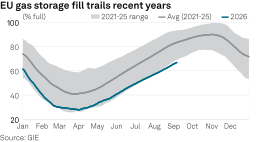
Europe's gas storage sits at 67.1% capacity
Resilience, not mandates, key to gas supply security
Hydrogen market stalls under EU regulations
Europe's natural gas storage levels heading into the winter are low enough to warrant close monitoring but not alarm, the head of European gas industry association Eurogas said in an interview, while warning that regulatory burdens — from storage fill mandates to methane emission rules — are undermining the continent's ability to manage supply efficiently and contract new volumes.
Eurogas Secretary General Andreas Guth said Europe's energy security framework needed to shift its focus toward systemic resilience and market efficiency, rather than prescriptive storage targets, as the continent navigates declining dependence on Russian gas, tighter LNG contracting conditions, and a hydrogen market that has yet to achieve meaningful commercial traction.
"The facts speak for themselves," Guth told Platts, part of S&P Global Energy, on Sept. 8. "We have relatively low storage levels compared to previous years and it is certainly not the moment for complacency, but it is also not the moment to panic."
EU gas storage sites were filled to 67.1% as of Sept. 7, according to the latest data published by Gas Infrastructure Europe, down from 79.5% at the same point in 2025 and 92.8% in 2024.
Guth said storage volumes were only one element of a broader security of supply picture that had changed substantially since 2022, citing significantly lower European gas demand, expanded LNG regasification capacity, and infrastructure adapted to new supply flows.
But a winter cold snap or another supply disruption could still trigger price spikes even in a well-supplied market.
"We are in a difficult market situation, and you see that already today," Guth said. "The prices reflect that in Europe and also Asia."
Platts assessed month-ahead Dutch TTF gas prices at €76.20/megawatt-hours ($88.65/MWh) on Sept. 8, the highest since December 2022.
"What we should be doing in Europe is looking at the overall regulatory framework," Guth added. "We need to make sure that we have the market run efficiently."
Regulatory obstacles
He cautioned against further mandated gas storage levels, noting that the "fill-at-all-cost" market dynamics of the past few years had contributed to price spikes, particularly in 2022 and 2023, and that the European storage regulations were "distorting the market."
Indeed, the backwardated gas market erodes the financial incentive to store gas in the summer for winter consumption, with summer prices at a premium. Platts assessed Dutch TTF gas for winter 2026 at €74.87/MWh, a €1.33/MWh discount to the front-month contract.
"The storage regulation is something that shouldn't be continued beyond its current shelf life," Guth said, echoing earlier remarks from Eurogas in June. "It has not proven to be helpful for the overall security of supply situation of Europe and affordability."
Guth also flagged the EU methane emission regulation as a compounding problem, saying it was making it "extremely difficult" to contract gas supplies at competitive terms — particularly as Europe phases out Russian long-term LNG contracts ahead of upcoming milestone deadlines.
"We are imposing additional requirements on EU quotas through the EU methane emission regulation that currently cannot be complied with, which makes contracting extremely difficult and in some cases delays contracts," he said. "That is not conducive to managing the current situation."
On physical infrastructure security — following a series of incidents, including an intercepted naval drone near an offshore gas platform in the Black Sea and sabotage attacks on German power stations — Guth said the industry's response should be built around resilience, with diversity of energy supply and system redundancy.
He pointed to Europe's rapid buildout of LNG import terminals after 2022 as a model, noting that infrastructure once criticized as likely to be underutilized proved essential.
"That is what creates the resilience and enables us to deal with the geopolitical context such as we have today," he said, referencing the ongoing disruption to Strait of Hormuz LNG transits affecting roughly 20% of global supply.
Hydrogen hurdles
On hydrogen, Guth said Europe's regulatory framework was suppressing market development by being too technology-specific and too restrictive, particularly around EU Renewable Fuels of Non-Biological Origin rules governing green hydrogen production.
Industry leaders say RFNBO rules add about €2/kg to green hydrogen production costs.
Platts assessed the cost of RFNBO-compliant hydrogen production via alkaline electrolysis in Germany, backed by renewable power purchase agreements, at €10.31kg ($11.99/kg) on Sept 8.
"The market is not developing," Guth said, noting particular headwinds for green hydrogen uptake in the industrial sector.
Guth said Eurogas supported renewable hydrogen production standards but that the bloc needed to develop a market first.
"The key question is how do you create the market in the first place," he said.
He also raised concerns about draft implementing rules under the EU's Renewable Energy Directive which he said could prevent industrial consumers from counting hydrogen blended into the gas network toward their renewable hydrogen obligations unless it was deblended and used in pure form.
"Blending is certainly not the destination where we should be heading, but it is a market-creating mechanism," Guth said. "If you do not yet have sufficient demand, you do not yet have sufficient supply, you do not yet have the infrastructure in place, then blending can actually make or break a case for projects that could be producing renewable hydrogen."
Guth said that hydrogen would play a key role in Europe's energy resilience in the future.
"The question is when will it be," he said.
