Energy Transition, Natural Gas, Electric Power, Metals & Mining, Chemicals, Hydrogen, Renewables, Ferrous
August 19, 2026
Europe’s hydrogen pipeline plans confront energy transition reality check

Editor:
HIGHLIGHTS
Pipeline network faces delays, timeline slips to 2030s
Germany completes 400 km, bookings exceed expectations
Most infrastructure plans remain in feasibility stage
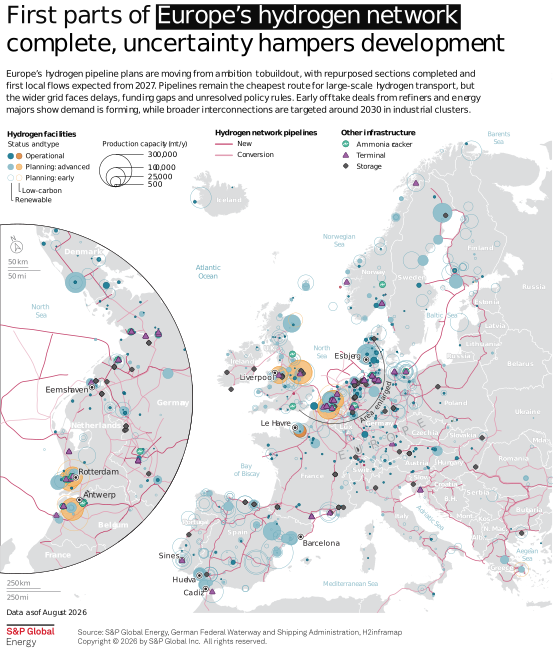
Europe's hydrogen pipeline plans are taking shape, with the first sections of a planned 30,000-kilometer network already completed and primed to start operations. But developers are facing a reality check in Europe's energy transition, which has stalled infrastructure projects and pushed back development timelines.
First hydrogen flows on the planned European Hydrogen Backbone pipeline grid are expected from 2027 along small sections of local networks, before larger sections are connected from around the end of the decade, infrastructure developers say.
The proposed pipeline network is crucial to Europe's plans to decarbonize heavy industry using green hydrogen.
"Hydrogen production will not necessarily be located where the demand will be located," Lucie Boost, Secretary General of trade group Gas Infrastructure Europe, told Platts, part of S&P Global Energy, in an interview on Aug. 13. "Production will be located where there's a lot of renewable electricity available. It will be necessary to link regions with abundant renewables with regions where there is a lot of demand."
And pipelines offer a cost-effective option for transport and energy storage, particularly compared with electricity.
"Pipeline deliveries are still the cheapest way of transmitting hydrogen across Europe at scale," S&P Global Energy senior principal analyst Matthew Hodgkinson said.
The years from 2027 to 2030 mark the early project development stage for many projects, Boost said, with a second round of investments planned by 2035. Much of the network will use repurposed natural gas pipelines.
The development will come on in "leaps and bounds," she said. "It is not something that will be linear, but we do see the development is progressing through national and cross-border projects."
GIE is coordinating the European Hydrogen Backbone initiative, which is being developed by gas transmission system operators across Europe.
TSO Gascade Gastransport GmbH completed the first 400 kilometers of Germany's hydrogen network in December 2025, and early capacity bookings across the planned national network have surpassed expectations.
And the first hydrogen pipeline section in the Netherlands was completed and filled in Rotterdam earlier in 2026, with operations to supply Shell's Pernis refinery to start by the end of the year, while sections of pipeline are also under construction in Belgium.
Several companies have signed large-scale hydrogen offtake agreements via pipeline, with the refining sector a notable early customer for renewable hydrogen, along with potential demand from steelmakers and other industrial companies.
Reality check
But delays in construction, policy, and funding have hindered the rollout of the network, with some initial plans delayed or scrapped.
A planned pipeline from Norway to Germany was abandoned in 2024 after Equinor ASA and Shell PLC both pulled the plug on Norwegian low-carbon hydrogen projects.
In the Netherlands, delays to the proposed Delta Rhine Corridor hydrogen pipeline led Vattenfall AB and Copenhagen Infrastructure Partners P/S to withdraw their 560-MW Zeevonk renewable hydrogen project from the EU Hydrogen Bank subsidy auction.
The European network was initially planned to reach over 31,000 km by 2030, but timelines have slipped as developers grapple with uncertain demand and project delays.
"The expectation was that by 2030 it would be up and running," Boost said. "But we need the legislation. That legislation needs to be implemented on a national basis."
Hodgkinson said most infrastructure plans remained at the feasibility stage, with developers awaiting clarification of renewable hydrogen definitions and national compliance targets.
"The main developments in 2026 are centered around specific transmission routes linking one supply source and offtaker," he said. "Pipeline networks are likely to develop around industrial clusters and production hubs over the medium-term, while it will likely be at least 10 years until a widespread network is available."
Boost said that while the EU had established frameworks, the practical day-to-day details were still to come from member states.
The anticipated timeline for infrastructure delivery has slipped into the next decade. ENTSOG's latest 10-year network development plan report identified just 23% of projects to be commissioned by 2029, down from 74% previously planned.
Nevertheless, the gas TSOs group said a large share of hydrogen infrastructure projects—around 95%—was still expected to be delivered by 2035.
Overcoming barriers
Issues facing infrastructure developers range from discussions over whether to convert gas networks or build new pipelines to questions about hydrogen blending into the natural gas network, purity considerations, and storage, Gas Distributors for Sustainability Public Affairs Advisor Valentin Calfa told Platts in an Aug. 12 interview.
Chemical sector offtakers, for example, require high-purity hydrogen for their processes, whereas other industrial users and TSOs can tolerate lower purity, Calfa said.
The question of where in the system the hydrogen purity is increased and who pays remains unresolved.
Indeed, gas demand has proved more resilient than previously thought when hydrogen pipeline plans were first envisioned, and the potential timelines for switching infrastructure over to alternative use have similarly shifted.
A renewable hydrogen network could enhance power system resilience, reducing the need for electricity flexibility and the need to build long-distance power lines, GIE's Boost said, adding that a holistic approach to energy transition infrastructure was needed.
"We need to make informed decisions and only by having a sector integration approach will we be able to do that."
But the hydrogen network comes at a cost.
Platts assessed Northwest European long-term renewable hydrogen offtake prices at €6.60/metric ton ($7.64/mt) on Aug. 3, around a €4/mt premium to conventional hydrogen.
"It's not about being cheap, it's about being the least cost," Boost said. "Then again, we need to compare it to no action as a cost."
