Energy Transition, Natural Gas, Electric Power, Agriculture, Renewables, Biofuels, Carbon
August 13, 2026
Brazilian biomethane producers race to issue first CGOB certificate
By Felipe Peroni and Beatriz Baltieri
Editor:
HIGHLIGHTS
Natural gas firms face 0.5% mandate by 2026
Dual compliance and voluntary markets emerge
Brazilian biomethane producers are racing to issue the first compliance certificate, called the CGOB, which is expected this year under a new program aimed at decarbonizing the natural gas sector.
"Brazil has the potential to become the world's biggest biomethane producer, and we need to leverage this," Tayane Vieira, head of Environmental, Social, and Governance at biomethane producer Grupo Urca Energia, said Aug. 11, at the 13th Biogas Forum in São Paulo.
At least four biomethane producers already fulfill the requirements to issue the CGOB certificates, and are negotiating with potential buyers. There is a growing expectation about who will reach the milestone of becoming the first CGOB issuer, participants at the event said.
Brazilian gas producers and importers will be required to purchase guarantees of origin for biomethane when the program is fully implemented, with a requirement of 0.5% of annual volumes starting in 2026 – the first year's target will be proportional to the date of the first issuance. State-controlled Petrobras is expected to have the biggest mandate, as the country's largest gas producer.
"This volume will be the equivalent of 500,000 cubic meters/day," Fernando Giachini Lopes, director of accreditation body Instituto Totum, said Aug. 12.
The percentage will increase gradually over time, depending on how biomethane supply improves. The program's long-term goal is for biomethane production to reach 10% of the total gas supply.
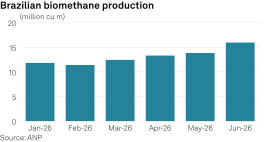
Currently, Brazil has 21 biomethane plants in operation, with an additional 42 planned. Production reached 78.6 million cubic meters in the first half of 2026, up from 50.8 million cubic meters in the same period in 2025, according to the national oil, gas and biofuel regulator, ANP.
The program was established by a law in October 2024, but ANP's resolution detailing the procedures for issuing, certifying and negotiating CGOBs was issued only in March 2026, with the mandate expected to come into effect the same year.
ANP established that biomethane must contain at least 90% methane; below this threshold, CGOB issuance will not be authorized.
Regulation gaps
At this time, there are still significant gaps in the regulation, making it unclear how these certificates will be traded.
For a producer to be certified for CGOB emissions, it needs to be audited by an origin certification agent, or ACO. Currently, six companies are approved by the regulator as ACOs, but the scope of the auditing process has yet to be defined.
Auditing will require on-site inspections and verification of the raw materials used, leading some certifying agents to speed up audits before knowing the full scope, according to several sources.
In addition, the government system for filing and verifying the target's compliance is still under development and is expected to come online by September, according to market participants. Until then, certificate issuance is not possible.
Two markets, one certificate
Adding spice to the mix, the structure of the CGOB's certificates market is unlike any other existing guarantee-of-origin market because the obligation to purchase such certificates will fall on natural gas producers and importers, rather than consumers.
As a result, the program envisions that the certificates could remain in circulation in the voluntary market after the regulatory clearance, until they are eventually retired by a consumer.
It is unclear to market participants how this dual process will affect prices.
"There is expectation of gains from both the compliance component and the voluntary component of the certificate," said Sergio Arosti, director of energy value at biomethane producer Solví.
Lessons from the past
The CGOB program was born in the shadow of the Renovabio, an existing program that aims to incentivize renewable fuels. It created the Decarbonization Credit, or CBIO, which fuel distributors must purchase from biofuel producers.
Each CBIO is equivalent to one metric ton of CO2 emission avoided, according to a calculation methodology developed by ANP. But the credit has been facing tight liquidity and historically low prices.
Platts' daily assessment of CBIO came to 22.25 reais/metric ton of CO2 equivalent Aug. 12, unchanged from the previous day, but down by 27 reais/metric ton of CO2e Aug. 3.
Among the involved parties, there is a clear effort to avoid some of the previous program's mistakes.
"ANP sought to leverage the experience gained from RenovaBio when developing the regulatory framework for CGOB," the agency told Platts on Aug. 11. "One example is the adoption of mechanisms aimed at regulatory proportionality, concentrating compliance obligations on agents with a larger market share."
Natural gas producers with annual volumes of up to 160,000 cubic meters/day will be exempt from compliance targets.
But there is already controversy, as many biomethane producers, being fuel suppliers, also issue CBIO credits. These producers say that issuing both CBIO and CGOB in the same sale would not constitute double counting.
"It is a pacified question that producers are allowed to issue both the credit and certificate from the same biomethane sale," Vieira said.
