Energy Transition, Emissions, Carbon
July 16, 2026
Flexibility is key to increasing the scope and impact of carbon markets: Vitol
By Silvia Favasuli and Charlotte Radford
Editor:
HIGHLIGHTS
Carbon price limits are being tested in Europe
ETS need flexibility through carbon credits to scale
Price convergence is possible at below European prices
Carbon markets in Europe and globally can expand to further cut greenhouse gas emissions only if built with sufficient flexibility tools that make carbon prices equitable across regions, Ariel Perez, Head of Carbon Trading EMEA at Vitol and a veteran of carbon markets, said.
"We are testing the limit of how far [carbon prices] can go," Perez said in an interview with Platts. "There are signs in Europe [of this]," he said.
His remarks come on the eve of a review of the European Emission Trading System, one of the largest compliance carbon markets globally and the first of its kind, that will aim, among other things, to address concerns about the risk of de-industrialization in a continent where carbon prices are currently trading at about Eur80/mtCO2e, well above the price seen in other regions.
"How are we going to have 40%-50% of extra emissions reduction at the price where they are now? Countries are going to sign up for equitable systems based on collaboration," Perez said.
Talking at an event earlier in June, Perez pointed out the risk of having a large premium on carbon prices in Europe versus elsewhere: "The EU cannot have a price of carbon at Eur100/mtCO2e, if the rest of the world is not on the same path because the lost competitiveness and lost political support is irreversible," he said.
Platts, part of S&P Global Energy, assessed its EU Emission Allowance Nearest-December price assessment at Eur81.17/mtCO2e on July 15, down from a peak of Eur92.09/mtCO2e on Jan. 15.
While other countries implementing ETS systems or carbon taxes allow for a limited use of carbon credits, the EU has resisted doing so, missing out, according to Perez, on the opportunity to import much lower abatement costs and bring down the cost of carbon without reducing climate action, he told Platts.
Vitol has been urging the EU to integrate high-integrity international carbon credits under Article 6 of the Paris Agreement into the European ETS scheme and published a white paper on the topic earlier in April.
A global price for carbon
The integration of international carbon credits within compliance carbon schemes worldwide would help distribute the high cost of carbon paid in Europe to other regions and create global carbon price convergence below the price of EU allowances, Perez said: "The point is to spread carbon pricing."
Carbon credits are issued by projects typically located in the Global South, where it's cheaper to implement them, but are traded globally, with most buyers sitting in the Global North, meaning global demand and supply dynamics help set their price.
Perez sees the price Article 6 credits, when integrated in the EU ETS systems and in other carbon schemes globally under the same set of rules, converging at a global weighted average price that will be lower than the price of carbon allowances under the EU ETS scheme but above the cost of abatement in the Global South.
"With $15 to $20/mtCO2e, you replace biomass with clean cooking solutions with the most recent technology and highest integrity. You can also save millions of hectares [of forests] per year, depending on the price of soybeans [and other competing commodities] in the region," Perez said. "People can be surprised at how low the price of carbon can be to have an impact, but to have maximum impact, there needs to be linkages among systems."
The Platts CCP Cookstoves Sub-Saharan Africa Current Year price assessment – an indicator of the price of higher integrity cookstoves credits – was assessed at $13.50/mtCO2e on July 15.
Price fragmentation
Carbon markets are currently deeply fragmented. If companies covered by the EU's ETS are currently exposed to prices at about Eur80/mtCO2e, compliance systems elsewhere, such as China's ETS, the Australian Carbon Credit Unit (ACCU) Scheme or the Regional Greenhouse Gas Initiative (RGGI) in the US, are seeing much lower prices.
The lack of price convergence affects the competitiveness of companies exporting their goods and can lead to carbon leakage, whereby companies simply relocate their factories to areas with less stringent environmental rules or cheaper carbon prices.
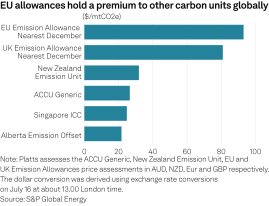
In 2026, the EU introduced the Carbon Border Adjustment Mechanism (CBAM) to address the problem, a carbon tax paid by companies importing goods into the EU and located in countries without a carbon scheme comparable to the EU's ETS.
While this measure has triggered the rise of new ETS systems (or plans to do so), it doesn't create the conditions for global price convergence, according to Perez.
"CBAM is a useful tool to incentivize trading partners to put in place ETS systems, but it's not the right one to incentivize them to have the same ambition as the EU."
Different abatement costs globally mean that the price of carbon needed to make dirty fuels or polluting industrial processes less competitive with their greener alternatives is much higher in Europe than elsewhere, especially in the Global South.
"You need to look at the cost of reducing emissions in Europe versus the cost of reducing emissions internationally – it's not comparable"
Perez sees the proposed penalties for [polluting vessels under] the International Maritime Organization, the cost of Sustainable Aviation Fuel, and the German Greenhouse Gas Reduction Quota (THG-Quote) as indicators of the cost of decarbonizing the middle- and high-hanging fruits in Europe.
But the cost of abatement in less developed countries is not such a quickly moving target, according to Perez: "With $25/mt and below, which can go to $50/mt with restrictions, you can decarbonize."
In such a context, incorporating international credits into ETS systems is the inevitable answer to reducing the cost of decarbonization, according to Perez.
