Energy Transition, Emissions, Carbon
June 26, 2026
INTERVIEW: SBTi's Net Zero 2.0 standard aims to push companies to take action
Editor:
HIGHLIGHTS
Carbon credits complement decarbonization
Hourly electricity matching recommended but optional
The Science Based Targets Initiative's most recent update to its Net Zero standard aimed to push companies toward implementing decarbonization goals, moving beyond simple target-setting and environmental ambition, SBTi's Chief Technical Officer Alberto Carrillo Pineda told Platts in a recent interview.
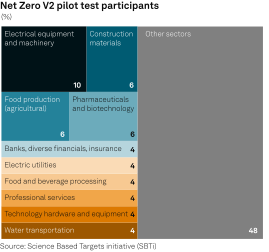
The group published its long-awaited 2.0 version of the standard on June 11, following one year of surveys with 323 companies and pilot tests with 50 selected companies.
"The idea of the revision is to provide companies with a framework that allows them to act," Carrillo Pineda said in the interview, conducted June 19.
The 1.0 Net Zero was launched on October 2021 and quickly became the gold standard of environmental certifications. While including a path for target implementation, the focus of version 1.0 was primarily goal setting and decarbonization ambitions.
"We are now focusing on how companies are going to implement targets, and also what challenges companies face when implementing targets," he said.
One size doesn't fit all
One of the main challenges of Net Zero was creating a framework that applies to companies of different sizes and operating in unequal countries. Large businesses, or companies operating in high-income countries, often have more ability to meet decarbonization goals.
The new version of the standard makes a clearer distinction between Category A companies, which are large businesses from all countries or midsized companies from high-income countries, and Category B, which are medium-sized companies from lower-income countries and small companies from all regions.
The standard then sets different conditions for these two types of companies. For example, near-term targets for reducing Scope 3 emissions -- all indirect emissions in a company's value chain -- are required for Category A companies, while they remain optional for Category B.
"Some companies have the highest opportunities to take action," he said.
Carbon credits as an addition
Market participants had been keenly awaiting the new standard's position on carbon credits, as in the previous version there were restrictions on when they were valid.
The new version states that high-integrity carbon credits and other climate contributions are complementary to decarbonization, rather than a replacement.
"We maintained the same position that the standard is to drive decarbonization directly," Carrillo Pineda said. "What the new version does is to recognize companies that are supporting the value chain with many instruments, including carbon credits," he added.
Hierarchy of actions
In a similar approach, the Net Zero 2.0 includes an implementation chapter containing a hierarchy to guide decarbonization, specifically recommending reducing emissions as close to their sources as possible. Examples are efficiency improvements, fuel switching, and engaging suppliers and customers in decarbonization efforts.
When not possible, companies are encouraged to take action within shared systems, such as electricity grids, or to take sector-level actions.
"Companies don't always know clearly how targets come together, so we added the implementation chapter," Carrillo Pineda added.
Hourly matching
In that area, while the usage of Renewable Energy Certificates remains an acceptable practice, the standard increases pressure to adopt local sourcing and more granular approaches whenever feasible.
The new version establishes a specific framework for reporting electricity hourly matching, which will remain optional but "recommended", especially for type A companies.
"The standard encourages companies to search for more granularity in electricity," he said. "Where this is not feasible, it is not obligatory."
Meanwhile, the standard for the first time said it "requires geographical matching of electricity consumption, either directly or through attributes, based on deliverability regions."
Where such granularity is not possible, an alternative is to enter into a power purchase agreement (PPA), he added.
SBTi will launch a call for evidence to request more information about hourly matching practices, signaling that the practice could be even more present in future revisions of the standard.
The new version is also more emphatic that near-term targets must be set on a five-year basis, without prejudice to long-term targets, to incentivize companies to enter a cycle of planning, execution and improvement, rather than treating targets as a box-ticking exercise.
"What changes is the expectation of continuous improvement through the cycle," Pineda said in the interview, describing a governance and reporting loop that requires companies to assess implementation, document dependencies, and strengthen plans over time.
Also, it considers that markets and technologies could evolve, and more flexibility is needed to adjust the goals.
The revision also focuses on details that appear small at first, but help push companies in the right direction, such as stricter requirements for the base year of targets. The new standard will require companies to set targets using the latest year with available data as the base year, rather than a single historical base year. It also reintroduced the option to set absolute carbon-reduction targets.
"We learned that companies find it easier if they can have aggregate emission targets, so based on this feedback, we reintroduced the option to have absolute reduction targets," he said.
The new version includes a transition period, and more than 11,000 companies have their near-term targets validated through the 1.0 version, which will remain valid until the end of the five-year cycle. For target setting, the approach from version 1.0 continues through the end of 2027, with version 2.0 coming for the following cycle.
"The standard tries to find a balance between what we can practically implement, and achieve emission reductions and drive change on the ground level," Carrillo Pineda said.
Platts is a part of S&P Global Energy.
