Energy Transition, Carbon, Emissions
June 24, 2026
Concerns linger over CORSIA credit demand despite passage of Iran-US ceasefire agreement
By Anirudh Iyer and Felix Njini
Editor:
HIGHLIGHTS
CORSIA credit prices fall 37.5% since war
Airlines delay purchases amid policy uncertainty
EU eligibility rules slow European buyer activity
Demand for Carbon Offsetting and Reduction Scheme for International Aviation credits from airlines may not immediately pick up following an agreement between Iran and the US to end the conflict in West Asia, as several challenges persist, developers and traders told Platts, part of S&P Global Energy, in the week of June 22.
Despite the optimism associated with the announcement in the wider commodities markets, participants Platts spoke to said there were challenges with securing funds at lower rates, thin margins in the airline sector, and a lack of strict regulatory directions, which may not result in a sharp rise in interest from airlines for carbon credits.
Immediately after the conflict escalated in March, energy prices shot up, nudging airlines to allocate funds to ensure they procured jet fuel at competitive prices.
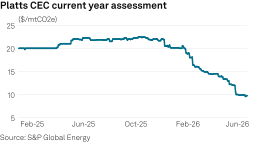
The Platts-assessed CEC current year price has fallen by 37.5% since the start of the war in late February to date.
An Asia-based developer with carbon projects eligible to supply credits into the CORSIA market for the first phase said it thinks the agreement can result in an improvement in demand, but was not sure of the exact timeline for that.
"Survival is the priority now for most of the participants, and even after the conclusion of the war, it may take at least another eight months for demand revival in the larger carbon market," according to an India-based developer looking to set up a CORSIA project in Africa.
Besides persistent weakness in demand from airlines stemming from various policy and geopolitical developments, new projects receiving eligibility to supply credits into Phase 1 of the scheme also weighed on prices.
Currently, the following projects are eligible to supply credits into phase 1 of CORSIA
| CORSIA-eligible projects as of May 29 | ||||||
| ID | Project name | Developer | Project Type | Standard | Region | Country |
| 102 | ART Trees | Guyana | JREDD+ | ART Trees | Americas | Guyana |
| 11677* | Biomass Energy conservation programme | Hestian | Cookstove | Gold Standard | Africa | Malawi |
| 11732 | Efficient and Clean Cooking for households in Tanzania | BURN | Cookstove | Gold Standard | Africa | Tanzania |
| 3699 | DelAgua Clean Cooking Grouped Project in Rwanda | DelAgua | Cookstove | Verra | Africa | Rwanda |
| 4150 | DelAgua Clean Cooking Grouped Project in Rwanda | DelAgua | Cookstove | Verra | Africa | Rwanda |
| 4000 | DelAgua Clean Cooking Grouped Project in Gambia | DelAgua | Cookstove | Verra | Africa | Gambia |
| 3837 | DelAgua Clean Cooking Grouped Project in Sierra Leone | DelAgua | Cookstove | Verra | Africa | Sierra Leone |
| 2924 | Grouped Projects for Laos Improved Cookstove | INTRACO Carbon | Cookstove | Verra | Asia | Laos |
| 3204 | Grouped Projects for Laos Water purifier | INTRACO Carbon | Water purfier | Verra | Asia | Laos |
| 11639 | Spouts water purifier programme in Africa | Spouts International | Water purfier | Gold Standard | Africa | Rwanda |
| 10959* | Safe Water Project In Rwanda | Iceberg Environment | Water purfier | Gold Standard | Africa | Rwanda |
| 3052 | Grouped Project For Cambodia Water purfier | INTRACO Carbon | Water purfier | Verra | Asia | Cambodia |
| 2925 | Grouped Projects for Cambodia Improved Cookstove | INTRACO Carbon | Cookstove | Verra | Asia | Cambodia |
| 2311, 2312, 2313, 2314, 2315, 2685, 2687, 2688, 2689, 2690, 2772, 2773, 2774, 2775, 2776, 2777, 2778, 2779, 2780, 2825, 2826, 2827 | Madagascar Improved Cook Stove Project | Korea Carbon Management | Cookstove | Verra | Africa | Madagascar |
| 4531 | Reducing Gas Leakages within the Hududgaz Gas Distribution Networks across Uzbekistan | ECOEYE, GasGreen Asia, EcoCarbon Services | Leak detection and repair (LDAR) | Verra | Asia | Uzbekistan |
| 2676 | Community Carbon Efficient Cooking Programme | UpEnergy | Cookstove | Verra | Africa | Tanzania |
| Total available supply | ||||||
| Disclaimer: | 11677* refers to the POA ID.Project IDs encompass: 11902, 11903, 11904, 11905, 11906, 11907, 11908, 11909, 11910, 11911, 11912, 11913, 11914, 11915, 11916, 11917, 11918, 11919, 11920, 11921, 11922, 11923, 11924, 11925, 11926, 11927, 11928, 11929, 11930, 11931, 11932 | |||||
| Disclaimer: | 10959* refers to the POA ID. Project IDs encompass: 11098, 11133,11134,11135,11136,11137 |
Airlines hold back from purchasing
Participants Platts spoke to said the lukewarm buying interest from airlines was a key reason for the decline in prices for CORSIA credits.
The Platts-assessed CORSIA price for current year delivery was at $9.75/mtCO2e on June 23, down from $21.75/mtCO2e during the same time the previous year, Platts data showed.
The June 24 assessments of Jet CIF northwest Europe cargo and Jet Kero FOB Singapore cargo increased by 11% and 18.8%, respectively, from around the time of the conflict, Platts data showed.
An incremental rise in the rate of borrowing has also resulted in a general slowdown in investments in carbon projects, thereby reducing demand from institutional buyers, a South Asia-based cookstove developer said.
Market participants said airlines making sporadic purchases for smaller volume CORSIA credits were more reflective of their efforts to test the market rather than their interest in being well-equipped to mitigate their emissions.
Platts previously reported that Singapore Airlines retired 134,781 CORSIA phase 1 credits in April, while Shell retired 180,000 mt credits for Japan Airlines in March.
"These deals can't be considered as firm demand from airlines since it is not a recurring purchase," a Japan-based trader said.
Echoing a similar sentiment, an India-based developer/trader said that since airlines were already a stressed sector in terms of profit margins, perhaps a "travel boom" following the peace agreement may nudge airlines to look at purchasing large volume credits.
Possible fragmentation
The introduction of an additional layer of quality checks by the EU has further contributed to the lull in the market as participants moved to the sidelines amid concerns over a further division in market operations.
Earlier this year, Platts reported the EU was considering introducing stricter rules of eligibility for European airlines to procure CORSIA credits under Phase 1 and Phase 2 of the scheme.
The proposal said the EU would exclude credits from projects using a fraction of non-renewable biomass values above the Clean Development Mechanism's Tool 33 threshold and bar High Forest-Low Deforestation projects from eligibility.
Market participants have continued to attribute stalled buying activity from European airlines to a pending decision on eligible activities.
"No one is quite sure when [the EU is] going to clarify what the EU airlines can or cannot do," said a Europe-based trader. "So, for now, the EU airlines are stuck; they cannot trade, they cannot really get involved."
Market participants said they expect eligibility to be clarified alongside the ETS reform review in July, with liquidity expected to increase thereafter.
"All the signs point to the EU, so by the end of July, we will have clarity, then maybe trading will pick up," an Asia-based developer said. Platts also reported earlier that the Commission was considering extending the EU ETS beyond intra-EU flights to cover extra-European routes.
Such policy uncertainties were stalling a sharp improvement in demand for CORSIA credits from airlines, along with developing geopolitical and economic developments in major regions across the globe, market participants said.
"Perhaps some implementation pressure from IATA can help with demand improvement," an India-based trader said.
