Electric Power, Energy Transition, Renewables
June 19, 2026
Wind and solar back Brazil’s debut battery storage auction

Editor:
HIGHLIGHTS
Brazil to launch first BESS auction in Dec
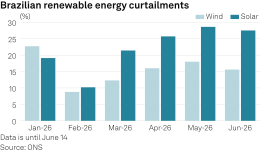
Curtailments hit 20.8% of wind-solar generation
Chile leads region with 3,293 MW storage capacity
Brazilian wind and solar power generators welcomed an announcement in early June of the country's first auction for battery energy storage systems, a move expected to mark Brazil's entry into the technology and tackle curtailments.
On June 3, Brazil's Ministry of Mines and Energy announced two capacity reserve auctions, or LRCap, for battery energy storage systems scheduled for Dec. 2 and Dec. 4. The contracts will have a 15-year duration, with supply expected to begin in 2028.
The ministry said that the systems must have a minimum power capacity of 30 MW, be capable of providing a continuous supply for at least four hours and have a maximum recharge period of six hours.
"Storage systems are the most relevant variable to this structural issue of curtailments," said Fabio Bortoluzo, president of Atlas Renewable Energy, during the ENASE conference June 18 in Rio de Janeiro. He estimates that continued investment in batteries could reduce curtailments by 50% over the next three years.
Curtailments have impacted wind and solar generators, prompting some companies to suspend investments in the country until a long-term solution is implemented.
In May, wind and solar curtailments combined accounted for 20.8% of generation, according to ONS data. This figure is higher than the 19.1% reported in April. In the first 14 days of June, curtailments remained at 18.6% of generation, ONS data showed.
On June 4, during the countrywide Corpus Christi holiday, low electricity demand led to curtailments rising to an average of 9.6 GW, or 35.8% of the day's potential wind and solar generation, according to ONS.
"We have a problem of energy oversupply only at some peak moments of the day," Ruy Chammas, president of ISA Energia, said during the conference.
BESS debut
While the initial auctions are not expected to fully resolve the storage capacity shortfall, they represent an important first step toward adopting this technology -- one that has been anticipated since late 2025, according to conference participants.
During the conference, participants cited Chile as a model to follow.
The South American country has 40 operational storage projects with a capacity of 3,293 MW, according to data from the Chilean Electric Generators Association, or Generadoras. Another 10 projects with 1,301 MW are in the testing phase, while an additional 72 projects are under construction, which could add 5,684 MW if completed, data from the association showed.
"We are many laps behind other countries," CPFL's strategy and innovation director, Bruno Monte, said at the conference.
CPFL has already installed batteries near some of its wind farms and distribution assets to test the technology and integrate it into its operations.
"We have proven cases of technology use, and we understand how it can contribute to operating the electric system," Monte said.
Participants sought clarity -- specifically highlighting uncertainty about how the investment in battery energy storage systems will be financed and by whom. The December auctions are expected to address this issue by promoting competition among companies offering storage solutions.
"This first auction is important for us to increase practical knowledge of storage technologies," Rui Altieri, president of the Brazilian Association of Independent Energy Producers, or Apine, said at the conference.
