Energy Transition, Electric Power, Renewables, Hydrogen
June 18, 2026
INTERVIEW: India's renewable energy push to accelerate but hinges on faster grid build-out

Editor:
HIGHLIGHTS
Grid integration key challenge for renewable energy
Aims for 11 GWp of renewable power capacity by 2026
Targets 13.6 GW of module output capacity by 2027
India's renewable energy capacity is poised for continued rapid expansion, but sustaining momentum would require prioritizing faster grid development, timely power purchase agreements and the integration of storage solutions, according to Avaada Group Founder and Chairman Vineet Mittal.
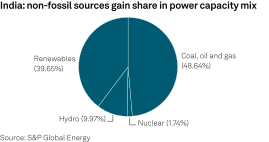
India's renewable power capacity, including large hydro, reached 279.26 GW at the end of April, according to Central Electricity Authority data. The country recorded an all-time high in non-fossil fuel-based power capacity additions in 2025, driven by investments, supportive policies and higher power demand.
"I believe the momentum will continue, although the nature of growth will become more sophisticated," Mittal told Platts, part of S&P Global Energy, in written answers to a questionnaire on June 16.
"Growth will increasingly come from solar-plus-storage, wind-solar hybrids, firm and dispatchable renewable energy, round-the-clock [power], pumped storage, green hydrogen, green ammonia and corporate decarbonization demand," Mittal said.
Rapid growth in data centers and artificial intelligence-driven digital infrastructure is expected to emerge as a major demand driver, said Mittal, whose company has 7.2 gigawatt-peak of operational renewable power capacity and 1.5 million metric tons/year of renewable ammonia projects in Rajasthan and Odisha.
System integration
The challenges hindering faster renewable energy deployment in India persist, but they are becoming more manageable as the ecosystem matures, according to Mittal.
Curtailment remains an issue in some renewable-rich states, particularly when transmission capacity and demand planning do not keep pace with project commissioning, he said.
PPA signing has improved in some segments -- particularly those linked to firm and dispatchable renewable energy, round-the-clock power, corporate PPAs and energy storage -- but delays still persist, Mittal said.
Land continues to be one of the "most execution-sensitive" aspects of the business, while import dependency is declining but not yet eliminated, especially for cells, wafers and certain critical equipment, according to Mittal.
"Our experience is that the sector has moved from a 'pure generation' challenge to a 'system integration' challenge," Mittal said. "Earlier, the question was: can India build solar and wind at scale? That question has been answered. The new question is: can we integrate renewables into the grid reliably, affordably and round the clock?"
Avaada's goals
Avaada is focusing not only on renewable power generation but also on storage, pumped hydro, manufacturing, digital project management, forecasting and green molecule integration -- areas that are as important as winning bids for renewable energy projects, Mittal said.
"The target of about 11GWp by 2026 is an important milestone in our journey, and hopefully it would happen between December 2026 and at most by March 2027, and 30GWp by 2030 remains our broader ambition, depending on grid availability," Mittal said.
"We are scaling our renewable portfolio with a disciplined approach -- focusing on quality of assets, bankable offtake, grid connectivity and long-term value creation."
Earlier in June, Avaada Group secured $950 million in debt financing from a consortium of global and domestic banks for three utility-scale renewable energy projects.
Avaada expects to have about 13.6 GW of module manufacturing capacity by 2027, while its 6 GW of solar cell manufacturing capacity is expected to become operational next month.
The company is also focusing on high-efficiency technologies such as TOPCon, quality certifications, traceability and customer-specific requirements for both Indian and global markets.
Manufacturing push
The government's Approved List of Models and Manufacturers framework, which requires renewable energy projects to procure approved, domestically manufactured components, is a significant step forward in strengthening the Indian supply chain, according to Mittal.
The Ministry of New and Renewable Energy issued the ALMM list-II for solar cells on July 31, 2025, extending the government's approved supplier requirement beyond solar modules to include domestically certified photovoltaic cells.
"This will benefit manufacturers who are investing in real domestic capacity, technology, quality systems and backward integration," Mittal said.
"For Avaada, this aligns perfectly with our strategy. We are not looking at module assembly alone. We are building an integrated solar manufacturing platform covering modules, cells, glass, and, in the future, upstream parts of the value chain."
ALMM list-II is expected to create a more level playing field, reduce excessive dependence on imports, improve traceability and instill greater confidence among developers, lenders and customers, according to Mittal.
"The goal is not merely to manufacture panels," Mittal said. But "to build a globally competitive, bankable and trusted Indian solar manufacturing platform."
Pralhad Joshi, India's minister for new and renewable energy, stated earlier in June that India has achieved self-sufficiency in solar photovoltaic module manufacturing and, with the expansion of domestic capacity, is now positioned to export to global markets.
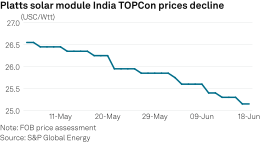
Platts assessed solar module FOB India TOPCon at 25.15 cents/watt on June 18, down 4.2% from a month earlier.
