Energy Transition, Natural Gas, Hydrogen, Carbon, Emissions
June 17, 2026
Dutch Porthos CCS project marks construction progress despite delays

Editor:
HIGHLIGHTS
EU's largest CCS project advances at Rotterdam
Porthos to store 2.5 mil mt/year CO2 from 2027
Subsidies bridge cost gap between CCS, EU ETS
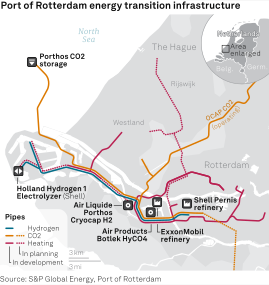
On the western tip of the Dutch Port of Rotterdam, nestled between a giant container terminal and the Gate LNG facility, engineers are constructing what will be the EU's largest carbon and capture project.
From the top of artificial dunes -- built to protect the reclaimed land of Maasvlakte from the sea -- you can make out platform P18-A in the North Sea.
Once a gas production platform, it has now been repurposed as a CO2 injection platform to store captured carbon in the former gas reservoir below the seabed.
Onshore at Maasvlakte, construction of the three compressor stations for the Porthos CCS project is progressing, with the project set to capture and store 2.5 million metric tons of CO2/year from 2027.
Housing for three more compressors is also being readied for the Aramis CCS project, which will store about 10 times that amount.
Porthos -- a joint venture between EBN, Gasunie and the Port of Rotterdam Authority -- has experienced setbacks, and the consortium recently pushed back the start date from late 2026.
The delays had come from late changes in engineering and a lack of resources, Porthos construction manager Reinier Lissenberg told Platts during a tour of the facility in May, though he noted that such challenges were to be expected for first-of-a-kind projects such as this.
Lissenberg said the actual engineering construction was relatively straightforward; the project's design was the most challenging aspect.
Blue hydrogen production
Shell, ExxonMobil, Air Liquide and Air Products are the customers for the 2.5 million metric ton/year facility, and are all building capture units at their refineries and industrial gas plants.
Porthos will operate for 15 years before reaching capacity of about 37 million mt, and will then be permanently sealed.
Air Products and Air Liquide are both constructing carbon capture projects retrofitted onto their respective hydrogen production facilities in Rotterdam, each of around 100,000 mt/year capacity.
The plants will be the largest CCS-enabled hydrogen production facilities in Europe, supplying existing refinery and chemicals customers in the region.
A Porthos spokesperson said the project would help cut Rotterdam's emissions by 10%.
Porthos is just one part of Rotterdam's decarbonization plans, with a hydrogen network also under development, and several companies carrying out substantial efficiency drives to cut emissions too.
Rotterdam handles 13% of Europe's energy consumption and is positioning itself as a hub for the energy transition, with 7.4 GW of offshore wind capacity set to connect to the port by 2032 and plans for 2-2.5 GW of electrolysis capacity, Port of Rotterdam CEO Boudewijn Siemons told reporters at the World Hydrogen Summit in May.
Under pressure
The compressor station will receive CO2 from the emitters via an onshore pipeline at 30 bar, increasing the pressure to around 130 bar for the Porthos store, before pumping it through a 1-meter-diameter offshore pipeline tunneled under the sea wall to the injection platform.
Aramis CCS could store 22 million metric tons/year of CO2 from 2030, with a planned final investment decision in 2027.
Investors EBN and Gasunie opened a tendering process for the offshore pipeline in November, after Shell and TotalEnergies stepped back from the project earlier in 2025.
The pipeline for Aramis would use a higher pressure still, sending CO2 a longer distance to the storage site.
Aramis could also receive liquid CO2 by tanker at the planned CO2next terminal.
And a group of Dutch and German companies signed a cross-border pipeline cooperation agreement earlier in June to link German emitters to the Aramis store.
Project economics
Surplus heat from the compressor station will be sent to the Gate LNG terminal to vaporize incoming natural gas.
The buildings for Porthos are scheduled to be finished by the end of 2026, with a test phase commencing early in 2027 ahead of commissioning operations.
Construction started in early 2024, and the offshore pipeline was laid on the seabed in 2025, with completion of the well conversion for CO2 storage in January 2026.
The project received Eur102 million in EU funding, with total investment of Eur1.3 billion, a spokesperson said.
The Dutch energy ministry-commissioned Xodus study estimates Porthos transport and storage costs at around Eur50/mtCO2, while subsidies reduce the cost to customers.
Emitters receive a subsidy to bridge the gap between EU carbon prices and full CCS costs.
Platts, part of S&P Global Energy, assessed nearest December EU ETS CO2 allowances at Eur79.91/mt on June 16.
