Electric Power
June 15, 2026
INTERVIEW: Brazil's power market faces a liquidity crisis amid costs, supply woes

Editor:
HIGHLIGHTS
Brazilian energy traders see low liquidity, higher risks
Energy costs soar amid hydrological risks
Curtailments hit 18.6% of renewables in June
The Brazilian electricity and International Renewable Energy Certificate markets are facing a liquidity crisis driven by multiple factors, including hydrological risks and curtailments, as well as regulatory bottlenecks, according to an official with the Brazilian Electricity Traders Association (Abraceel).
The issue has increased the credit risk for companies operating in the free market, reducing appetite and creating a vicious cycle in the Brazilian power market, said Abraceel Executive President Rodrigo Ferreira. Abraceel is preparing a technical study to detail the cause of low liquidity and explore possible solutions.
"There's no power to buy," Ferreira told Platts, part of S&P Global Energy, June 11. "And when there is, it comes at an unbearable price."
The issue is only beginning to show in available data. The Brazilian Electricity Trading Chamber (CCEE) liquidity index fell to 4.71 in April, down from 5.0 in March. The index, which measures how often electricity is traded before reaching the consumer, meaning that the market's liquidity was 5.8% lower in April than in March.
High costs, low trade
Energy costs, which have soared this year following stricter criteria adopted in the use of hydroelectric capacity, are one of the causes.
"The factors behind price formation in the Brazilian market are extremely significant, and this has been killing trading activity," Ferreira said. "When a company can't understand or predict future prices, it simply refrains from selling its products, and that is why we don't see buying and selling."
The Brazilian electric system is centrally coordinated by the National System Operator (ONS), which determines, among other things, how much generation should be dispatched and which plants will be called upon to generate electricity. Due to Brazil's reliance on hydroelectric power, the ONS uses statistical models to minimize hydrological risk, essentially estimating the likelihood that reservoirs could fall to critically low levels.
Abraceel considers some of the models' parameters to be excessively conservative, such as the Conditional Value at Risk (CVaR) and the Reference Curve of Storage (CRef). These parameters essentially define the models' risk aversion and estimate the hydrological conditions for each year.
"Current models of operation are assuming a catastrophic scenario as likely," Ferreira said.
A government committee kept the model parameters unchanged June 10, but most market participants pushed for more flexible parameters.
The problem is exacerbated by market concentration among a few generators, Ferreira said. Moreover, a 2025 law gives distributors greater flexibility, reducing the energy they must purchase to meet regulatory requirements. However, regulators must still complete a rulemaking process before the law takes effect.
"All we're asking is for the law to be upheld," Ferreira said.
Curtailments
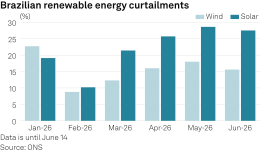
Growing curtailments in solar and wind generation are also reducing supply and leading to liquidity issues.
"Companies that were previously offering electricity have not only been prevented from delivering, but also forced to buy energy to meet their contracts," Ferreira said.
In May, wind and solar curtailments combined accounted for 20.8% of generation, according to ONS figures. The figure is above the 19.1% reported in April. In the first 14 days of June, curtailments remained at 18.6% of generation, the ONS said.
Platts, part of S&P Global Energy, assessed both vintage 2026 wind and solar I-RECs at Real 1.05/megawatt-hour (21 cents/MWh) June 12, unchanged from June 11.
Credit risk
Higher energy costs and lower availability of energy in the free market have threatened the financial stability of several energy trading companies.
"Trading becomes impossible if you are unsure you are going to be able to buy energy when you most need it," Ferreira said.
Market participants have become more uneasy about the financial risk of companies in the free market, after multiple companies faced liquidity constraints this year. The issue did not go unnoticed by the association.
"We are developing self-regulation practices within Abraceel members, including independent audits and eventual penalties for noncompliant companies," Ferreira said.
