Energy Transition, Hydrogen
June 04, 2026
Hydrogen moves from blueprints to reality as capacity set to double: Hydrogen Council

Editor:
HIGHLIGHTS
Industry sees operational capacity doubling in 2026
Energy security, resilience become driving force
EU RFNBO rules need quick, decisive rationalization
The hydrogen sector has fundamentally shifted from planning to execution, with global operational production capacity expected to double in 2026 as industrial-scale projects come online, Hydrogen Council CEO Ivana Jemelkova told Platts, part of S&P Global Energy.
The milestone reflects a step change in project scale and maturity, with companies now building multi-hundred megawatt-scale facilities, Jemelkova said in an interview following the World Hydrogen Summit in Rotterdam in May.
The first 10-MW-scale plants began operating only in the last few years.
"Hydrogen is happening," Jemelkova said in the May 21 interview. "It is now a reality. We are in the middle of actually executing rather than planning or setting the vision. It's steel in the ground."
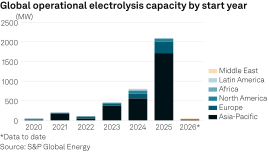
S&P Global Energy Horizons data shows a total of 3.7 GW of installed electrolyzer capacity globally, with over 2.1 GW of that coming online since the start of 2025.
The shift comes as governments reassess energy investments in the wake of compounded crises.
The Hydrogen Council estimates energy-importing countries in Europe and Asia have spent an additional $100 billion on fossil fuel imports and fiscal measures in just the first two months after the start of the US-Israeli war with Iran, which could have accelerated clean technology deployment.
"Right now, we are spending billions of euros, billions of dollars on additional costs for the existing supply," Jemelkova said. "All of this could be invested into the future."
Recent energy shocks -- including the post-COVID disruption, the Russia-Ukraine conflict and the war in the Middle East -- have prompted governments to fundamentally rethink energy strategies, Jemelkova said.
The crises have heightened awareness of energy security and costs, creating new urgency around domestic resource development and diversified supply partnerships.
"Imagine what we could do with that if we were to invest it into clean technologies, into resilience measures," Jemelkova said. "The value that we're wasting right now is tremendous."
The Hydrogen Council's 2025 Compass report identified $110 billion in committed low-carbon hydrogen investments.
Hydrogen inflection point
The doubling of operational hydrogen capacity represents a crucial inflection point for an industry that has moved rapidly from the megawatt to gigawatt scale. Of some 1,700 announced projects globally, around 510 have reached advanced stages, passing final investment decisions or entering construction, according to the Hydrogen Council's tracking data.
Those statistics were reflected in the mood at the World Hydrogen Summit, with executives optimistic about the sector following a period of policy uncertainty, project delays and cancellations, and consolidation.
Discussions have focused on scaling production, whereas just a year ago the emphasis was on implementation of policy, plans and projects.
The Hydrogen Council has called on governments to accelerate implementation of existing policies, particularly in Europe where ambitious strategies have not fully translated into market reality.
Jemelkova said the Hydrogen Council's call to action had received a positive reception from officials, including the Dutch energy minister who chaired the meeting.
She said the practical implementation of frameworks like the EU's Renewable Energy Directive and rules for renewable fuels of non-biological origin could provide significant momentum.
"Just the implementation of what we already have could be a big boost," Jemelkova said. "Obviously, it wouldn't be enough, but it would give industry the confidence to keep going and keep building."
European hydrogen rule review
The European Commission's review of rules governing renewable hydrogen production has divided industry participants, with some supporting the postponement of requirements like additionality and temporal matching, while first movers who have already taken investment decisions seek regulatory certainty.
The planned move to hourly matching of hydrogen production with renewable generation would add about Eur2/kg to production costs, industry leaders say.
Platts assessed the cost of EU-compliant green hydrogen production via alkaline electrolysis in the Netherlands, backed by renewable power purchase agreements, at Eur9.46/kg ($11/kg) on June 3.
The Hydrogen Council advocates rationalizing Renewable Fuels of Non-Biological Origin rules to enable broader market participation while protecting first movers who responded to regulatory signals.
"It doesn't matter if you win the race if you're the only one running," Jemelkova said. "It is really important that we unlock the market, and that requires pragmatism. We need to be practical to allow more players to come in and give everyone the opportunity to transition."
Jemelkova said any review must be completed quickly and decisively, potentially through mechanisms like grandfathering to balance opening markets with maintaining advantages for early projects.
"We cannot have another two or three years of wondering which way to go," Jemelkova said. "If the European Commission wants to review, please do it quickly and decisively so that we know where we stand."
