Fertilizers, Chemicals, Energy Transition, Renewables, Hydrogen
September 09, 2025
Global hydrogen FID capacity reaches 6 million mt/year: Hydrogen Council

HIGHLIGHTS
Global investment reaches $110 billion across 500+ projects
China leads renewable hydrogen deployment, investment
Demand challenges persist; offtake lags at 3.6 million mt/year
Global hydrogen FID capacity reaches 6 million mt/year: Hydrogen Council
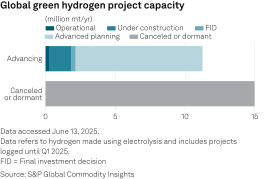
Global low-carbon hydrogen project capacity that has reached final investment decision has surpassed 6 million metric tons/year, with $110 billion committed across more than 500 projects, according to the industry association, the Hydrogen Council.
Of this, 1 million mt/year of capacity is already operational, the Hydrogen Council said in its Global Hydrogen Compass report, co-authored with McKinsey and published Sept. 9.
The council said the development highlights the industry's transition from early-stage projects to commercial deployment and marks a $35 billion increase in committed capital from 2024.
"After accounting for delays and expected attrition, the current project pipeline could support up to 9 million-14 million mt/year of clean hydrogen capacity by 2030, but requires demand to materialize, and unlocking it is the next big challenge," the council said.
To date, there is a mismatch between supply and demand. The funding surge reflects both rapid sector expansion and natural market maturation as projects with stronger business cases advance while less viable ventures are withdrawn, it said.
"About 3.6 million mt/year of binding offtake has been secured," the Hydrogen Council said.
This could rise to 8 million mt/year by 2030 "as policy clarity emerges in key markets such as the EU, US, Japan and Korea," it added.
The investment growth indicates momentum in the market despite headwinds, including persistently high interest rates and delayed policy implementation, which are pressuring project viability.
Since 2020, the sector has maintained an average 50% year-over-year committed investment growth rate, while hydrogen project announcements have increased 7.5-fold to more than 1,700 globally, the report said.
The Hydrogen Council said the project attrition that accompanied the rapid sector expansion signaled industry maturation.
Approximately 50 projects have been publicly canceled in the past 18 months, representing about 3% of the total pipeline. Most cancellations affect early-stage renewable hydrogen ventures.
The association said this reflects the challenging environment in which only projects with the strongest business cases can secure financing and advance to construction.
The Hydrogen Council said that 74% of industry CEOs surveyed reported stable or increased investment appetite over the past two years.
In a recent interview, ING Bank told Platts, part of S&P Global Energy, that energy transition investments are entering a phase of realism amid mounting concerns over project delivery and technological challenges, but funding remains plentiful.
Dedicated funds are making significant inroads into the sector, and there is robust capital availability for energy transition projects, ING said.
Regional leadership
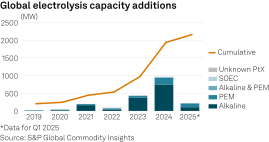
China leads the global landscape with $33 billion in committed investments and dominates renewable hydrogen production, accounting for 55% of global capacity to have passed FID, totaling 19 GW.
North America follows with $23 billion in investments, hosting 2.2 million mt/year of committed carbon capture-enabled hydrogen production from natural gas, or 85% of the global total, highlighting different regional technology focuses. The Hydrogen Council noted limited demand-side policies in the US and Canada.
Europe ranks third in investment at $19 billion but accounts for almost 5 million mt/year of demand by 2030, nearly two-thirds of the global total, creating potential supply-demand imbalances that could drive international trade flows.
Platts assessed the cost of green hydrogen production via alkaline electrolysis in Germany, backed by renewable power purchase agreements, at Eur9.01/kg ($10.60/kg) on Sept. 8.
The assessment reflects one possible pathway for producing EU Renewable Energy Directive-compliant green hydrogen.
Meanwhile, the Hydrogen Council identified India as a cost leader in renewable ammonia production, with emerging export potential.
Projects in the Middle East are focused on exports, with 500,000 mt/year of capacity to have passed FID, split between 55% renewable hydrogen and 45% low-carbon projects.
In Japan and South Korea, around 1 million-1.5 million mt/year of ammonia cofiring demand could emerge by 2030, the report found.
Projects in South America and Oceania are less advanced but hold large-scale export potential, the council said.
"To sustain this momentum and fully unlock hydrogen's potential, consistent policy support and effective execution are essential in accelerating a clean, resilient and secure energy future," said Jaehoon Chang, vice-chair of Hyundai Motor Group and co-chair of the Hydrogen Council, in a statement.